GERMAN'S HEAD CHOPPED OFF: BROWNSVILLE HERALD, MAY 24, 1936
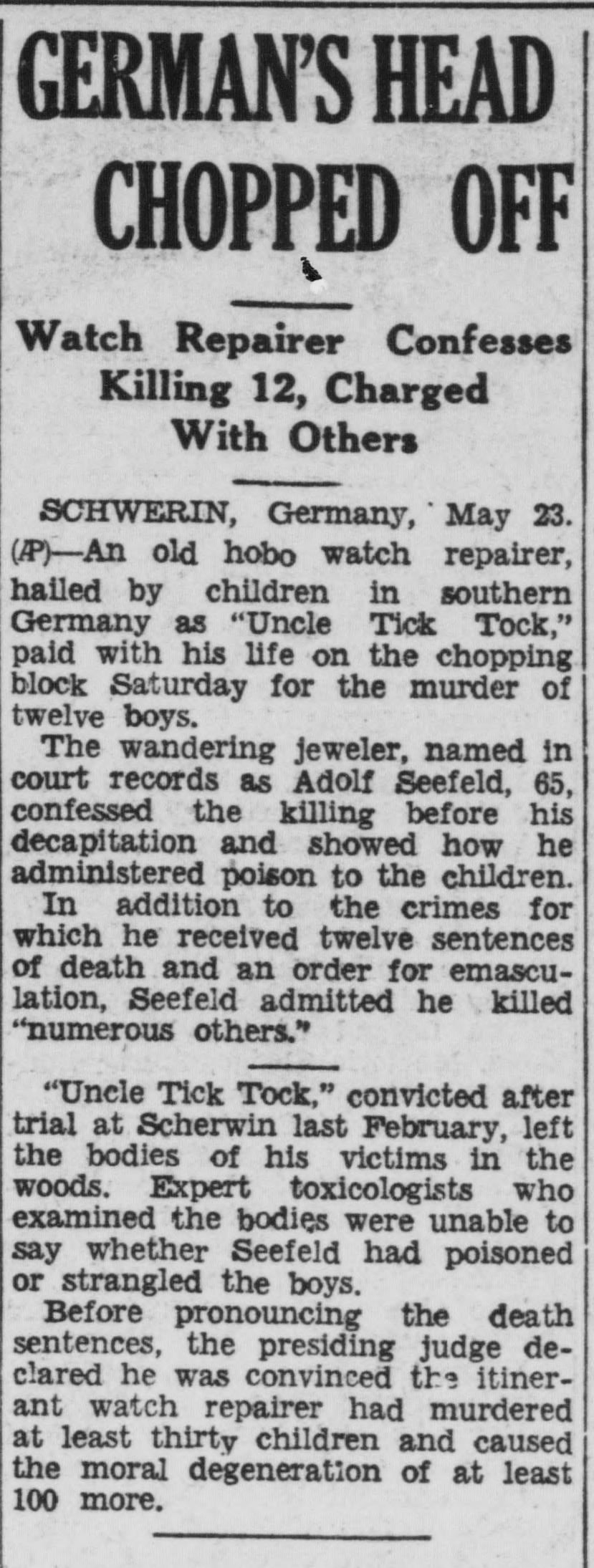
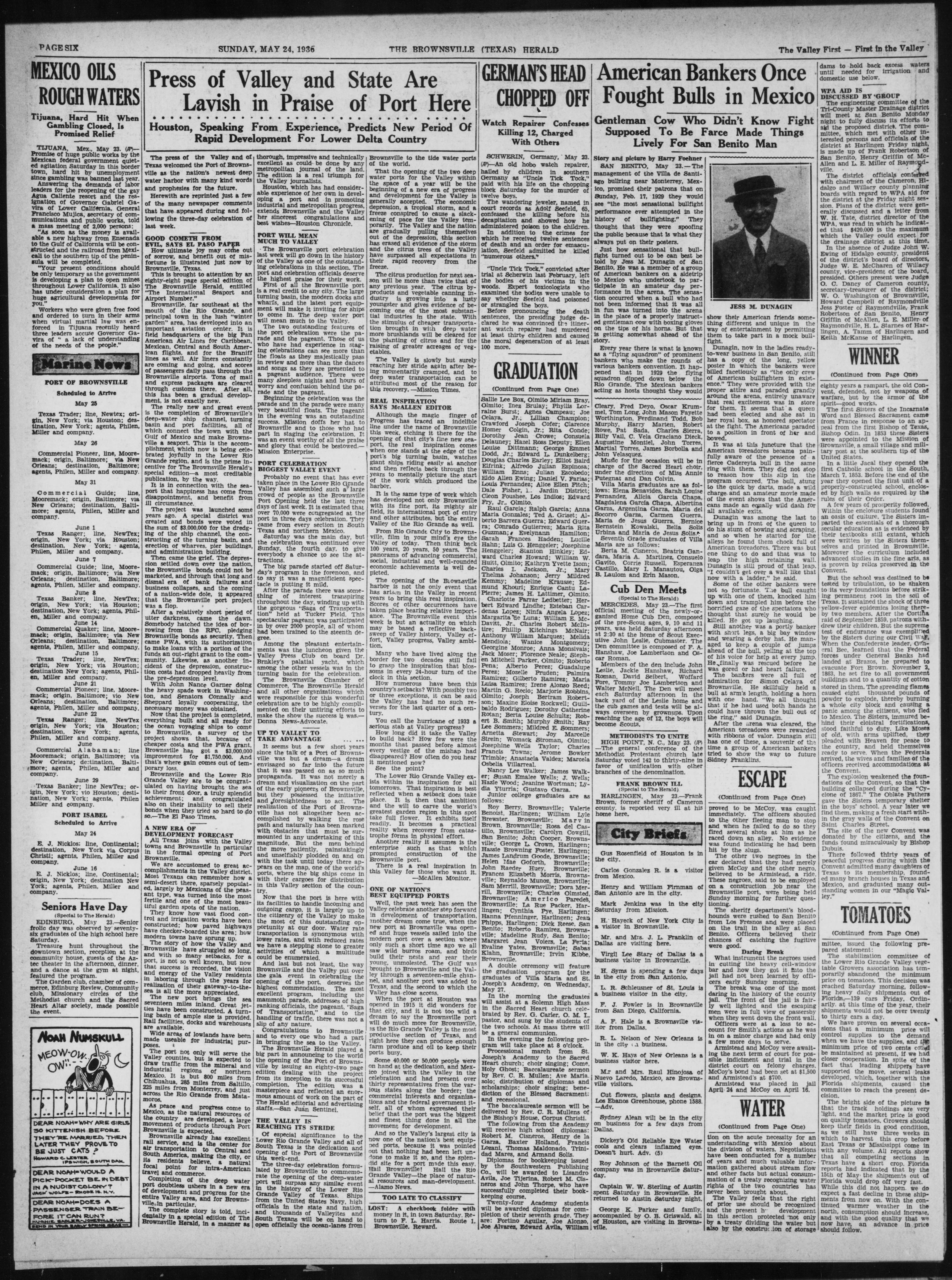
Adolf Gustav Seefeld went to the block at Schwerin on Saturday, May 23, 1936, and the next morning the news reached the southern tip of Texas, on page 6 of the Brownsville Herald, under a headline that wasted no words: "German's Head Chopped Off." The Associated Press dispatch behind it runs five short paragraphs. It calls him "an old hobo watch repairer," gives the name the village children had for him, "Uncle Tick Tock," and says he paid with his life "for the murder of twelve boys." Those were the twelve deaths the Schwerin court had accepted in February, and for them, the paper reports, he had received twelve sentences of death and an order for emasculation.
The middle of the story is a confession. Before he died, the AP says, Seefeld admitted the killings and "showed how he administered poison to the children," and he admitted that he had killed "numerous others." It is the neatest version of the case a reader in 1936 could have been handed, and the dispatch undercuts it in the very next paragraph. The boys had been left in the woods, it says, and the expert toxicologists who examined their bodies "were unable to say whether Seefeld had poisoned or strangled the boys." The prisoner claimed poison. The science could not confirm it.
The last word belongs to the bench. Before pronouncing the twelve death sentences, the paper says, the presiding judge, Karl Friedrich Sarkander, declared himself convinced that the itinerant repairer had murdered at least thirty children and "caused the moral degeneration of at least 100 more." Neither number was ever proved. What the dispatch preserves is the shape the case has kept ever since: twelve boys named in a verdict, a far larger toll announced from a courtroom and repeated in print, and a method of killing that nobody, the experts included, could pin down.
This is an AP wire report filed from Schwerin on the day of the execution and reprinted in Texas the next morning; it is not a court record, and it gets some plain facts wrong. It gives Seefeld's age as 65, though he was born on March 6, 1870, and was sixty-six when he died. It places "Uncle Tick Tock" in southern Germany, when Schwerin and the villages he worked lie in the north, in Mecklenburg and Brandenburg. The confession it reports came after the verdict, while the Gestapo held him, and was obtained under torture, and the trial pathologists had told the court the boys were strangled or throttled, not poisoned. Seefeld was convicted of twelve murders. The judge's thirty and the "numerous others" were never proved.
The Brownsville Herald printed this on May 24, 1936, and the scan is the Library of Congress copy in Chronicling America, with the citation and the Library's rights statement set out beneath it. Because the issue is less than ninety-five years old, the Library says only that it believes the paper to be in the public domain, and warns that newspapers of this age may contain some copyrighted third-party material. The story is AP wire copy, but it carries no copyright line of its own, while a different AP story in the same issue does, and no renewal was found for the paper or for the AP.
Every word was taken from the scan, and none had to be marked illegible. The compositor's slips are left standing: "Scherwin" for Schwerin in the fourth paragraph, although the dateline spells the city correctly, and "southern Germany" exactly as printed. The "the" in "the itinerant" is broken in the scan and is set as the word intended. The short rule between the third and fourth paragraphs is the paper's own, not a gap in the story, which is complete in this one column.
Transcription
Transcribed word for word from the page scan. Original spelling, punctuation, capitalisation and typographical errors have been kept exactly as printed. Unreadable words are marked [illegible]. Nothing has been modernised or corrected.
GERMAN'S HEAD CHOPPED OFF
Watch Repairer Confesses Killing 12, Charged With Others
SCHWERIN, Germany, May 23. (AP)—An old hobo watch repairer, hailed by children in southern Germany as "Uncle Tick Tock," paid with his life on the chopping block Saturday for the murder of twelve boys.
The wandering jeweler, named in court records as Adolf Seefeld, 65, confessed the killing before his decapitation and showed how he administered poison to the children.
In addition to the crimes for which he received twelve sentences of death and an order for emasculation, Seefeld admitted he killed "numerous others."
"Uncle Tick Tock," convicted after trial at Scherwin last February, left the bodies of his victims in the woods. Expert toxicologists who examined the bodies were unable to say whether Seefeld had poisoned or strangled the boys.
Before pronouncing the death sentences, the presiding judge declared he was convinced the itinerant watch repairer had murdered at least thirty children and caused the moral degeneration of at least 100 more.
Notes, kept as printed: "Scherwin" for Schwerin in the fourth paragraph (the dateline spells it correctly); "southern Germany" (Schwerin is in the north). "the itinerant" has a broken "the" in the scan and is set as the intended word. The wire credit is the AP's stylised "(AP)". A short rule is printed between the third and fourth paragraphs. No words were illegible.