NEWS BRIEF ON GEORGE CHAPMAN'S EXECUTION: THE WASHINGTON TIMES, APRIL 7, 1903
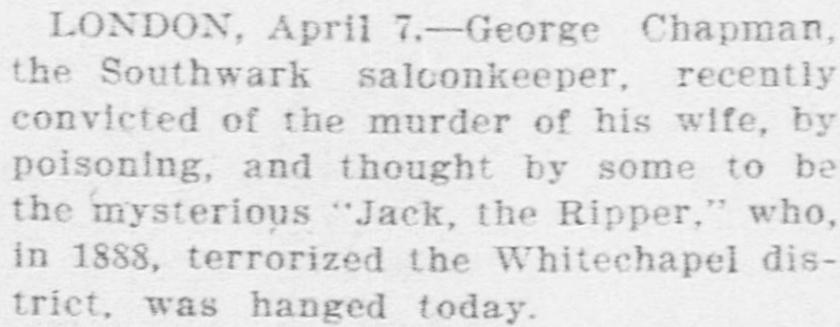
The whole item is one sentence. On April 7, 1903, the day George Chapman was hanged at Wandsworth Prison, a cable from London reached The Washington Times and went into a column of short cable news with no headline at all. It called him "the Southwark saloonkeeper," the American word for an English publican, and it gave his crime in a clause: "recently convicted of the murder of his wife, by poisoning." Then, before it reached the verb, it added the reason an American paper bothered with a London hanging.
He was, the paper said, "thought by some to be the mysterious 'Jack, the Ripper,'" who had terrorized Whitechapel in 1888. Fifteen years after those murders, on the day of the hanging, an American paper could treat the idea as needing no explanation. The suspicion had a source. Inspector Frederick Abberline, one of the original Whitechapel detectives, set out his suspicion of Chapman by name in two interviews with the Pall Mall Gazette in 1903, and he is said to have told the officer who arrested him, "You've got Jack the Ripper at last!"
What the sentence leaves out is the women. Chapman, born Seweryn Kłosowski in Poland, was hanged for the murder of Maud Marsh, a young barmaid from Croydon who had gone through a false marriage with him and died in the rooms above the Crown, a public house in Borough High Street, in October 1902, with her mother beside her. After her death the bodies of two earlier women who had lived with him as his wives, Mary Isabella Spink and Bessie Taylor, were exhumed. Both contained antimony. He was tried for Maud Marsh alone.
This is a forty-three-word cable brief, set without a headline among other short items; it is not a report of the trial and names no one but him. "His wife" was Maud Marsh, whose marriage to him was a false one. Chapman was convicted at the Old Bailey on March 19, 1903, of her murder only, though the exhumed bodies of Mary Spink and Bessie Taylor also held antimony. The Ripper link was suspicion in 1903 and remains so: as far as is known, Chapman was not a suspect in 1888, and no court ever tested the idea.
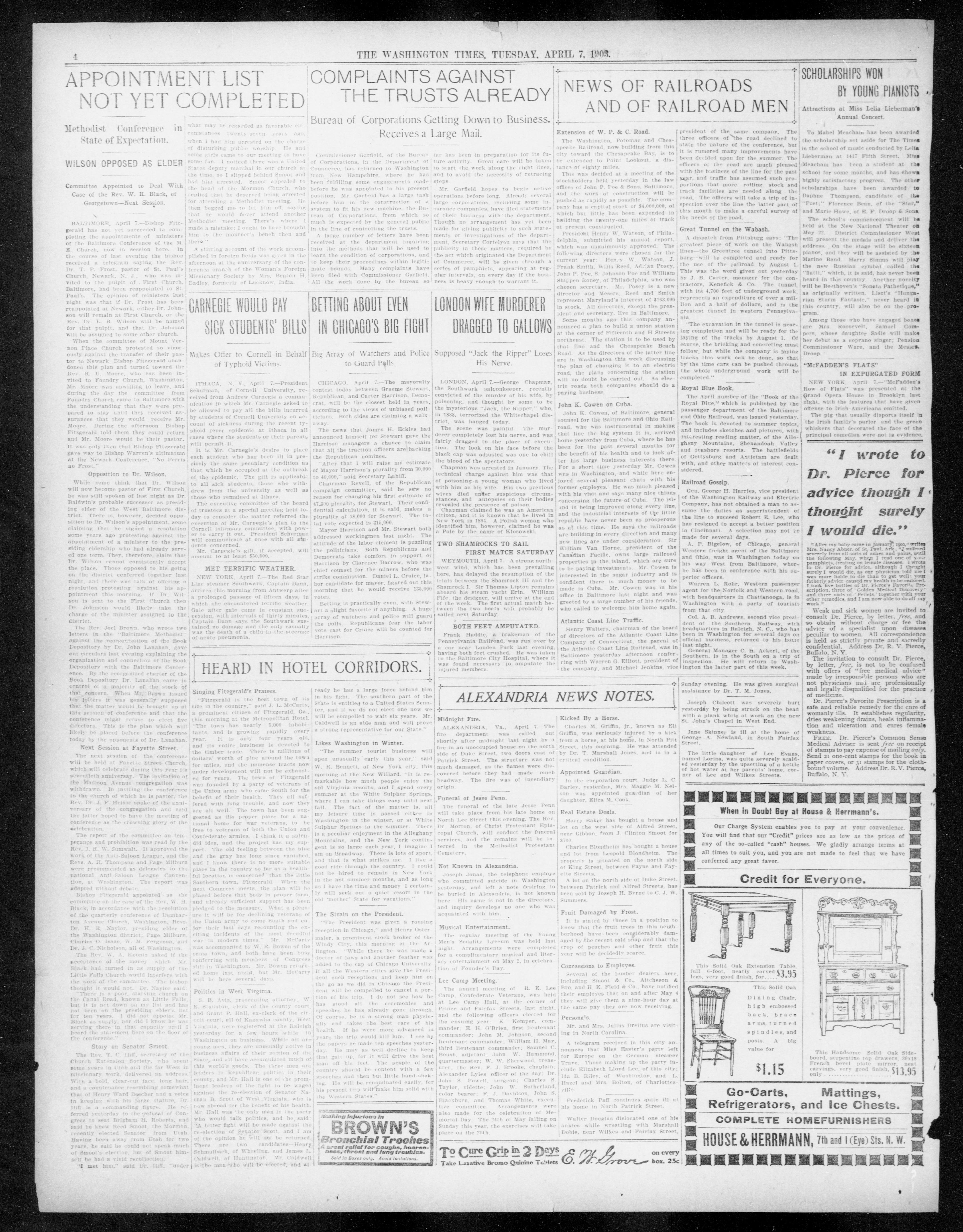
The Washington Times of April 7, 1903, is far more than ninety-five years old and therefore in the public domain, cable item and all. The scan comes from the Library of Congress copy of that day's page in Chronicling America, and the citation and the Library's rights statement are printed under it.
The item is a single clean paragraph, and it is transcribed in full, with no word marked illegible. The paper's own choices stand: "saloonkeeper" for an English publican, the comma inside "Jack, the Ripper," the comma after "his wife," and the American spelling "terrorized." There is no headline to transcribe, and the item does not continue anywhere else on the page.
Transcription
Transcribed word for word from the page scan. Original spelling, punctuation, capitalisation and typographical errors have been kept exactly as printed. Unreadable words are marked [illegible]. Nothing has been modernised or corrected.
LONDON, April 7.—George Chapman, the Southwark saloonkeeper, recently convicted of the murder of his wife, by poisoning, and thought by some to be the mysterious "Jack, the Ripper," who, in 1888, terrorized the Whitechapel district, was hanged today.
Transcriber's notes
- Readability: excellent. Clean type. No [illegible] markers were needed.
- Kept as printed: "saloonkeeper" for the English publican; the comma inside the quotation in "Jack, the Ripper"; "terrorized"; and the comma after "his wife".
- This is a 43-word single-paragraph item with no headline of its own, set in a column of short cable news. It is not a passing mention: it reports the execution, the conviction and the poisoning method in one sentence, and records the contemporary suspicion that Chapman — born Seweryn Kłosowski — was the Whitechapel murderer, a theory still argued over.
- Chapman was hanged at Wandsworth on 7 April 1903, the day of this dispatch.