EXECUTION OF AN ENGLISH MURDERESS: THE REPUBLICAN JOURNAL, APRIL 10, 1873
To a reader in Belfast, Maine, in the spring of 1873, the woman hanged at Durham had a twin across the water. The Republican Journal printed its account of Mary Ann Cotton's execution on April 10, a little over two weeks after the event, and it opens not with her but with Lydia Sherman, the "Connecticut Borgia," whose career it calls a "singularly correct parallel" to Cotton's in everything except the punishment. Both women had poisoned within their own families, over years, so carefully that the last crime was the first to draw suspicion. Had English law been as mild as American, the paper says, Cotton might be like her rival, "in a state of superlative ecstasy in some British jail."
Its summary of her life is a list of funerals. She married young and went off with her husband to live among the coal mines; her children died of gastric fever, and then he died of it too. She married again, and gastric fever carried off several of her new relations. Widowed a second time, she married once more and was at last brought to justice over the death of a stepson. The paper names none of them. The boy was Charles Edward Cotton, seven years old, who died at West Auckland in July 1872, and the parts of his body that his doctor had kept showed arsenic.
The second half of the column is the morning of March 24. She walked out with a male warder on either side, in a black stuff gown, a black and white check shawl fastened over the pinioning straps, and as she left her cell she said, "Heaven is my home." She moaned and prayed all the way to the drop. Calcraft covered her face with the white cap, strapped her legs and stepped back to the bolt, and as she murmured, "Lord, have mercy on my soul," his assistant drew it. Everyone there was deeply moved, the paper says, the Under-Sheriff so badly that he had to be held up.
An American weekly's retelling, printed seventeen days after the hanging, is not a court record, and this one compresses her life. It has her married three times; she married four, the fourth time bigamously, and Charles's father, Frederick Cotton, had died the December before the boy did. It gives her last words as "Lord, have mercy on my soul"; other accounts have "Lord Jesus receive my spirit." It says nothing of the short drop, or of the three minutes she struggled on the rope. She was charged with four murders and tried and convicted for one, Charles's. Arsenic was proved in four deaths, and estimates of how many she killed run from fourteen to twenty-one.
Published on April 10, 1873, this issue of The Republican Journal of Belfast, Maine, is in the public domain in its entirety, with no restriction of any kind attached to it. The scan is the Library of Congress copy from Chronicling America, and the Library's citation and rights statement follow directly beneath it.
The column is well inked, a little gray at the head, and nothing in it defeated the transcriber, so there are no illegible marks. The printer's errors are left in place, most memorably "It English law had been as mild as American," where "If" was meant, along with the missing comma in "tried condemned and executed" and the spellings "skillfully" and "offences" as set. The article ends at a rule, and what follows it has nothing to do with the case.
Transcription
Transcribed word for word from the page scan. Original spelling, punctuation, capitalisation and typographical errors have been kept exactly as printed. Unreadable words are marked [illegible]. Nothing has been modernised or corrected.
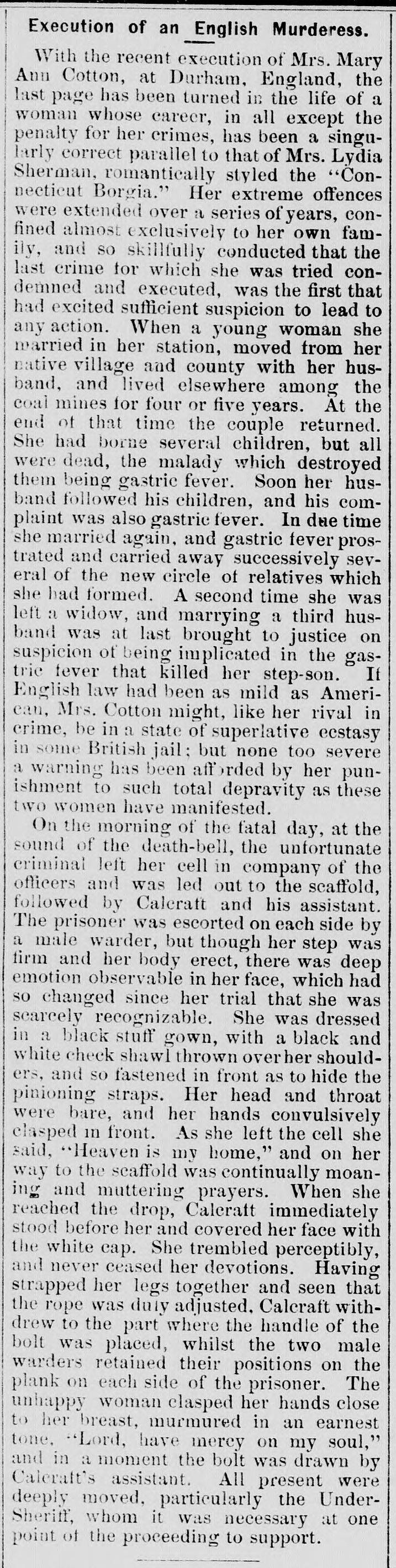
Execution of an English Murderess.
With the recent execution of Mrs. Mary Ann Cotton, at Durham, England, the last page has been turned in the life of a woman whose career, in all except the penalty for her crimes, has been a singularly correct parallel to that of Mrs. Lydia Sherman, romantically styled the "Connecticut Borgia." Her extreme offences were extended over a series of years, confined almost exclusively to her own family, and so skillfully conducted that the last crime for which she was tried condemned and executed, was the first that had excited sufficient suspicion to lead to any action. When a young woman she married in her station, moved from her native village and county with her husband, and lived elsewhere among the coal mines for four or five years. At the end of that time the couple returned. She had borne several children, but all were dead, the malady which destroyed them being gastric fever. Soon her husband followed his children, and his complaint was also gastric fever. In due time she married again, and gastric fever prostrated and carried away successively several of the new circle of relatives which she had formed. A second time she was left a widow, and marrying a third husband was at last brought to justice on suspicion of being implicated in the gastric fever that killed her step-son. It English law had been as mild as American, Mrs. Cotton might, like her rival in crime, be in a state of superlative ecstasy in some British jail; but none too severe a warning has been afforded by her punishment to such total depravity as these two women have manifested.
On the morning of the fatal day, at the sound of the death-bell, the unfortunate criminal left her cell in company of the officers and was led out to the scaffold, followed by Calcraft and his assistant. The prisoner was escorted on each side by a male warder, but though her step was firm and her body erect, there was deep emotion observable in her face, which had so changed since her trial that she was scarcely recognizable. She was dressed in a black stuff gown, with a black and white check shawl thrown over her shoulders, and so fastened in front as to hide the pinioning straps. Her head and throat were bare, and her hands convulsively clasped in front. As she left the cell she said, "Heaven is my home," and on her way to the scaffold was continually moaning and muttering prayers. When she reached the drop, Calcraft immediately stood before her and covered her face with the white cap. She trembled perceptibly, and never ceased her devotions. Having strapped her legs together and seen that the rope was duly adjusted, Calcraft withdrew to the part where the handle of the bolt was placed, whilst the two male warders retained their positions on the plank on each side of the prisoner. The unhappy woman clasped her hands close to her breast, murmured in an earnest tone, "Lord, have mercy on my soul," and in a moment the bolt was drawn by Calcraft's assistant. All present were deeply moved, particularly the Under-Sheriff, whom it was necessary at one point of the proceeding to support.
Transcriber's notes
- Readability: very good. The type is clean and well inked, slightly grey at the head of the column. No [illegible] markers were needed.
- Printer's errors kept as printed: "It English law had been as mild as American" (for "If"); "skillfully"; "offences"; "recognizable"; "Calcraft" spelled consistently (William Calcraft was the hangman).
- The comparison the paper draws is to Lydia Sherman, the "Connecticut Borgia", whose confession is the subject of another article in this same batch (Wheeling daily register, 16 January 1873). The two pieces were printed within three months of each other and read as a pair.
- Mary Ann Cotton was hanged at Durham on 24 March 1873. This weekly printed the account on 10 April. The article ends at a rule; what follows below is unrelated.