DURRANT PAYS THE PENALTY: HOT SPRINGS WEEKLY STAR, JANUARY 14, 1898
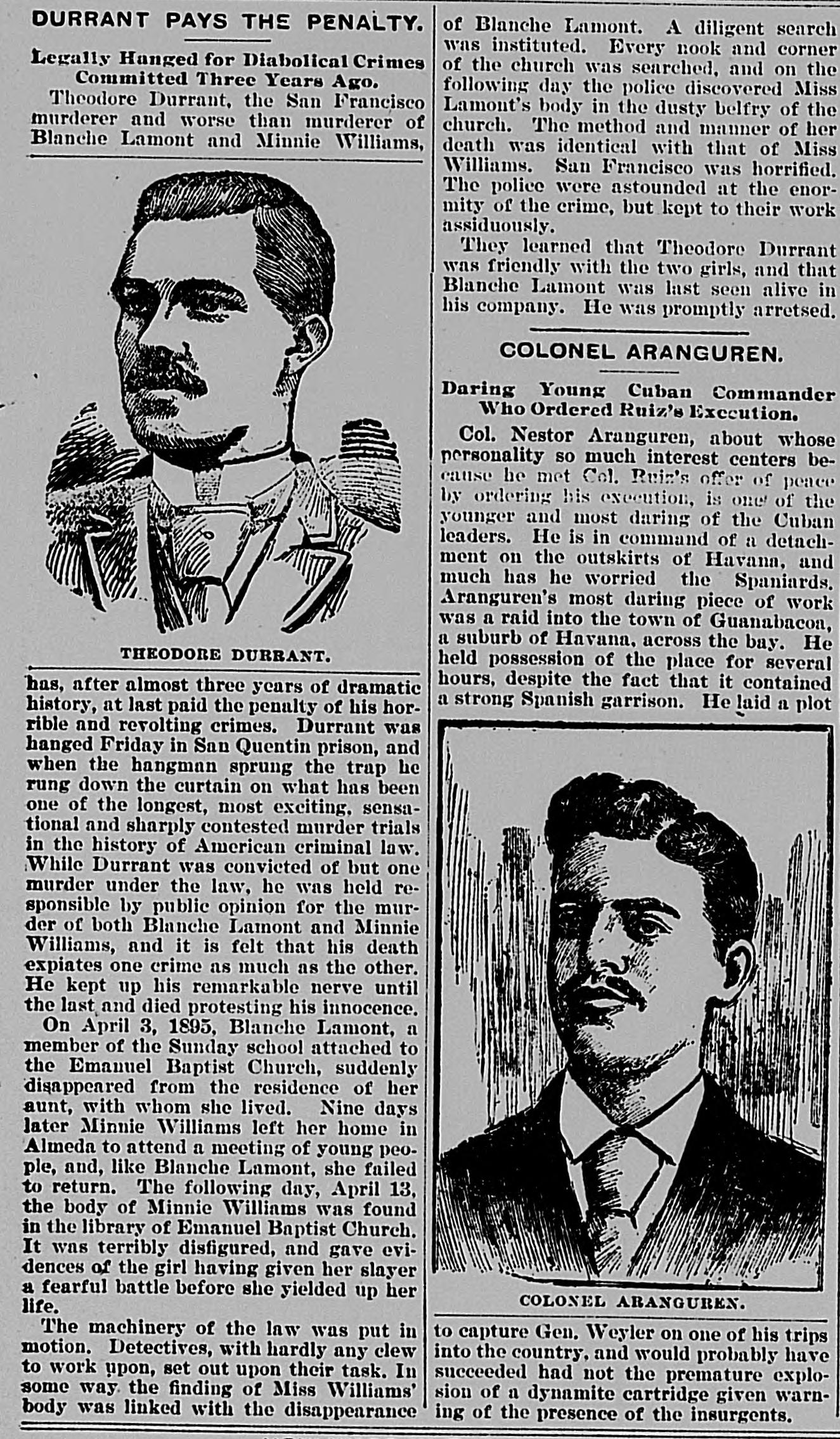
Theodore Durrant went to the gallows at San Quentin on Friday, January 7, 1898, still saying he was innocent, and a week later the Hot Springs Weekly Star in South Dakota printed the news with his face in the middle of it. The engraved portrait is set right into the opening sentence, so that the line naming him as the murderer "of Blanche Lamont and Minnie Williams" breaks off for the picture and picks up again underneath it.
The first half of the piece is about the hanging and about a distinction the paper takes care to make. In law, Durrant had been convicted of only one murder. Public opinion, the Star says, held him responsible for both, and it treats his death as settling one crime as much as the other. The second half retells the case from the beginning: Blanche Lamont gone from her aunt's house on April 3, 1895; Minnie Williams leaving home nine days later for a young people's meeting and never coming back; Williams found the next day in the library of the Emanuel Baptist Church, and Lamont found the day after that in the dusty belfry of the same building.
It closes on the arrest. The police learned that Durrant was friendly with both young women and that Blanche Lamont had last been seen alive in his company, and they took him in. Almost three years of trial and appeal stand between that sentence and the hanging the article opens with, and the piece leaves them out entirely.
The article is a contemporary summary written for a reader who had followed the case only from a distance, not a court record. It says Durrant was convicted of one murder without saying which; it was Blanche Lamont's, and although he was charged with the murder of Minnie Williams, he was never tried for it. The paper's verdict on the second killing is public opinion, which the article itself says plainly, and it should be read that way. The engraving is a newspaper likeness of the period, not a photograph.
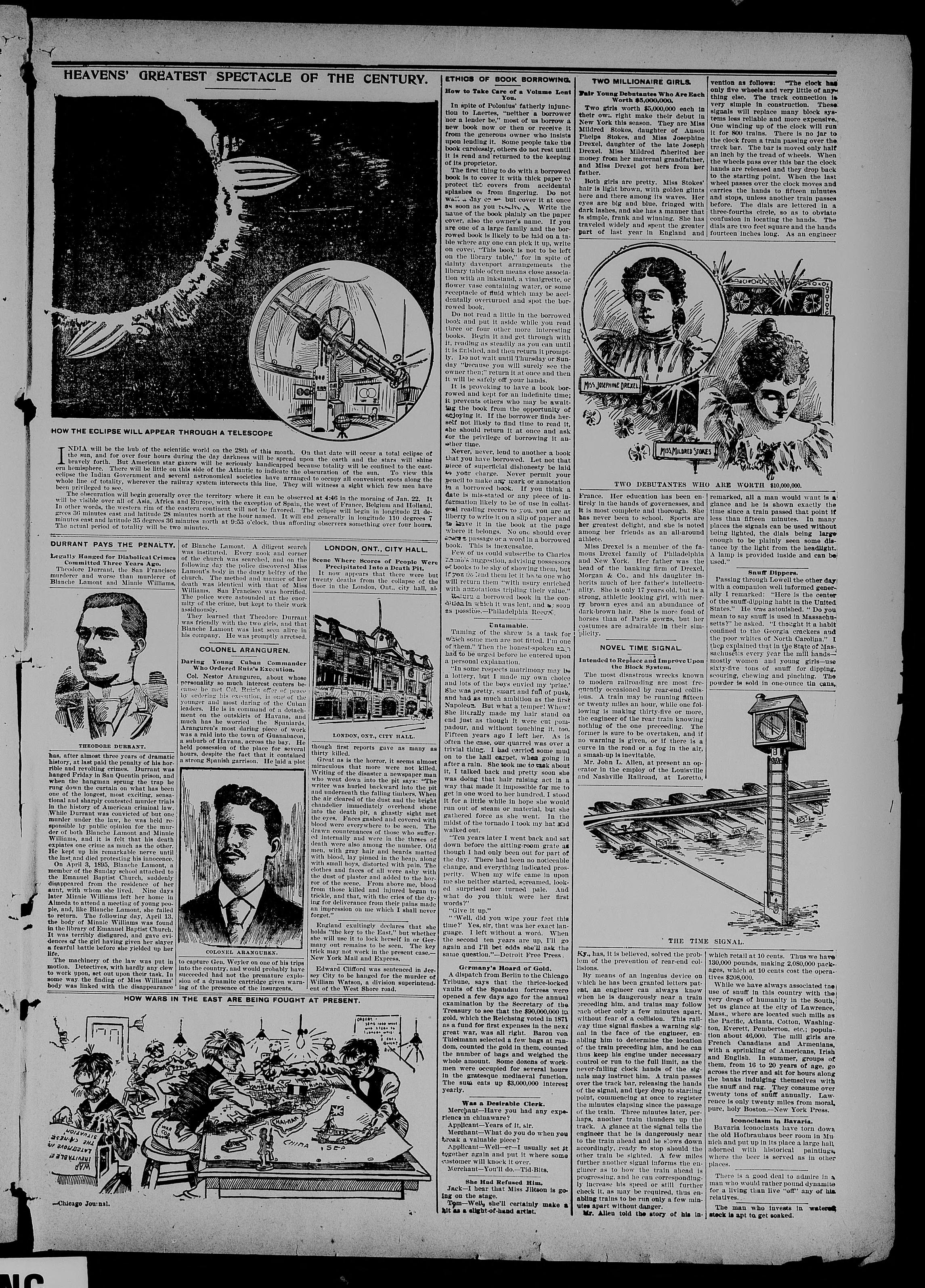
Published in 1898, the Hot Springs Weekly Star is in the public domain. The scan is the Library of Congress copy from Chronicling America, and the citation and the Library's rights statement are printed under it. The crop covers both columns of the story, so the top of an unrelated item, headed "COLONEL ARANGUREN," shows at the foot of the second column.
Every word of the transcription comes from the scan, and none of it was illegible. The paper's errors stand: "arretsed" in the last sentence, "Almeda" for Alameda, and "clew," which was an ordinary spelling in 1898. Where the portrait interrupts the text, the transcription marks the break, and no words are missing there.
Transcription
Transcribed word for word from the page scan. Original spelling, punctuation, capitalisation and typographical errors have been kept exactly as printed. Unreadable words are marked [illegible]. Nothing has been modernised or corrected.
DURRANT PAYS THE PENALTY.
Legally Hanged for Diabolical Crimes Committed Three Years Ago.
Theodore Durrant, the San Francisco murderer and worse than murderer of Blanche Lamont and Minnie Williams,
[engraved portrait, captioned: THEODORE DURRANT.]
has, after almost three years of dramatic history, at last paid the penalty of his horrible and revolting crimes. Durrant was hanged Friday in San Quentin prison, and when the hangman sprung the trap he rung down the curtain on what has been one of the longest, most exciting, sensational and sharply contested murder trials in the history of American criminal law. While Durrant was convicted of but one murder under the law, he was held responsible by public opinion for the murder of both Blanche Lamont and Minnie Williams, and it is felt that his death expiates one crime as much as the other. He kept up his remarkable nerve until the last and died protesting his innocence.
On April 3, 1895, Blanche Lamont, a member of the Sunday school attached to the Emanuel Baptist Church, suddenly disappeared from the residence of her aunt, with whom she lived. Nine days later Minnie Williams left her home in Almeda to attend a meeting of young people, and, like Blanche Lamont, she failed to return. The following day, April 13, the body of Minnie Williams was found in the library of Emanuel Baptist Church. It was terribly disfigured, and gave evidences of the girl having given her slayer a fearful battle before she yielded up her life.
The machinery of the law was put in motion. Detectives, with hardly any clew to work upon, set out upon their task. In some way the finding of Miss Williams' body was linked with the disappearance of Blanche Lamont. A diligent search was instituted. Every nook and corner of the church was searched, and on the following day the police discovered Miss Lamont's body in the dusty belfry of the church. The method and manner of her death was identical with that of Miss Williams. San Francisco was horrified. The police were astounded at the enormity of the crime, but kept to their work assiduously.
They learned that Theodore Durrant was friendly with the two girls, and that Blanche Lamont was last seen alive in his company. He was promptly arretsed.
Transcriber's notes
- Readability: very good. Clean, well-inked type throughout. No words required an [illegible] marker.
- Printer's errors kept as printed: "arretsed" for arrested in the final sentence; "Almeda" for Alameda; "clew" for clue (standard in 1898); "Emanuel Baptist Church" (the building is now usually given as Emmanuel Baptist Church).
- The article is laid out around an engraved portrait of Durrant, which interrupts the opening sentence between column one's first paragraph and its continuation. The break is marked above; no words are missing.
- The piece continues from column 1 into the top of column 2, ending above an unrelated item headed "COLONEL ARANGUREN." The crop supplied with this folder is a single rectangle covering both columns of the Durrant piece, so the top of the adjacent Cuban item is visible at the foot of column 2.