DUG UP FIVE BODIES: MILFORD CHRONICLE, MAY 8, 1908
In the first week of May 1908, men with shovels were working through the yard of a burned-out farmhouse outside La Porte, Indiana, and the count of the dead was still rising. The Milford Chronicle in Delaware printed what was known on May 8. The house had burned on the night of April 28, and its owner, Belle Gunness, was believed to have died in the fire with three of her children. Now five bodies had been found in the yard, every one of them murdered, and only two had names.
One was Andrew Helgelien, who had come from Mansfield, South Dakota, to marry Mrs. Gunness after meeting her through a matrimonial bureau. He had lent her $1,500, the paper says, and carried another $1,500 of his own, and his body had been cut apart and the pieces buried in different parts of the yard. The other was Jennie Olson, a Chicago girl Mrs. Gunness had adopted, who had dropped out of sight in September 1906 after word went around that she had gone to Los Angeles for school. The remaining three were a man and two children so incomplete that no one could yet say whether the children were boys or girls.
The search began because Helgelien's brother John refused to believe he had simply left. He noticed freshly turned earth in the yard and asked Sheriff Smutzer to dig, and the body was found almost at once, four feet down in a gunnysack. The article also gives a long quotation from Ray Lamphere, the hired man then under arrest for the fire, who said that people came out to that farm who were never seen to go away, and it reports that expressmen had delivered five trunks there in six months. These were the first days of the investigation, long before the digging was finished.
This is an early wire report, written before most of what is now known about the case, and much of it is rumor and suspicion of the moment. The paper names the hired man as Guy Lamphere; his name was Ray. It blames Helgelien's death on Mrs. Gunness, on Lamphere, or on both. Lamphere was later charged with arson and murder, and the jury convicted him of arson only. The theory of a "clearing house for murderers" fed by trunks from Chicago is the paper's report of what the authorities suspected that week, not an established fact. The body in the ruins was later ruled to be hers by the coroner, and the paper's report of her death in the fire reflects what was believed at the time.
The Milford Chronicle of May 8, 1908, is in the public domain. The scan is the Library of Congress copy in Chronicling America; the citation and the rights statement follow the scan.
The column is cleanly printed and the transcription is complete, with nothing marked illegible. It keeps the paper's words and its mistakes, including "grewsome," the deck "ONLY TWO BODIES IDENTIFIES," "Bella Gunness," "Helgelein" and "Max Sorenson" for the first husband, whose name is more usually given as Mads. None of them has been corrected.

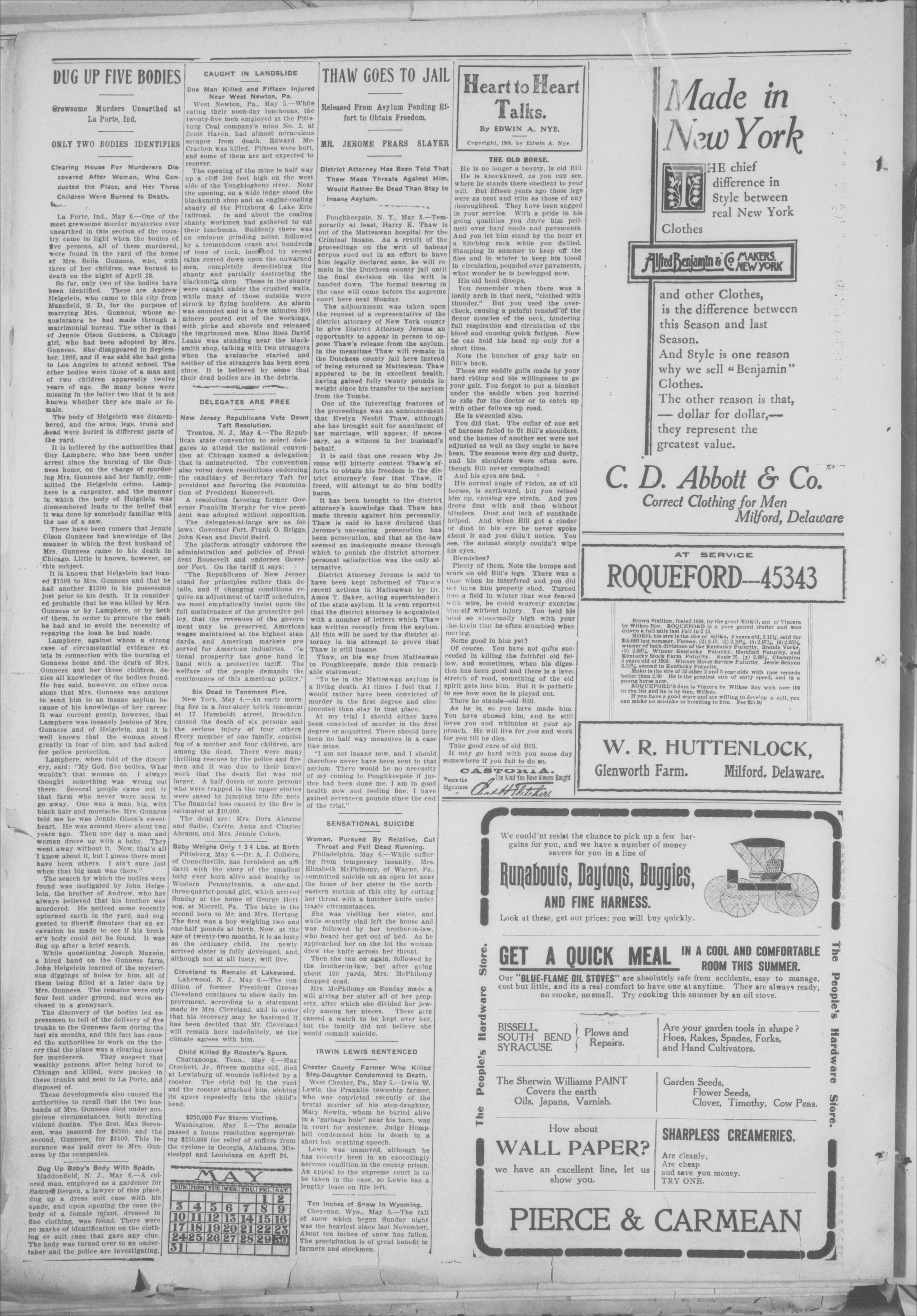
Transcription
Transcribed word for word from the page scan. Original spelling, punctuation, capitalisation and typographical errors have been kept exactly as printed. Unreadable words are marked [illegible]. Nothing has been modernised or corrected.
DUG UP FIVE BODIES
Grewsome Murders Unearthed at La Porte, Ind.
ONLY TWO BODIES IDENTIFIES
Clearing House For Murderers Discovered After Woman, Who Conducted the Place, and Her Three Children Were Burned to Death.
La Porte, Ind., May 6.—One of the most grewsome murder mysteries ever unearthed in this section of the country came to light when the bodies of five persons, all of them murdered, were found in the yard of the home of Mrs. Bella Gunness, who, with three of her children, was burned to death on the night of April 28.
So far, only two of the bodies have been identified. These are Andrew Helgelein, who came to this city from Mansfield, S. D., for the purpose of marrying Mrs. Gunness, whose acquaintance he had made through a matrimonial bureau. The other is that of Jennie Olson Gunness, a Chicago girl, who had been adopted by Mrs. Gunness. She disappeared in September, 1906, and it was said she had gone to Los Angeles to attend school. The other bodies were those of a man and of two children apparently twelve years of age. So many bones were missing in the latter two that it is not known whether they are male or female.
The body of Helgelein was dismembered, and the arms, legs, trunk and head were buried in different parts of the yard.
It is believed by the authorities that Guy Lamphere, who has been under arrest since the burning of the Gunness home, on the charge of murdering Mrs. Gunness and her family, committed the Helgelein crime. Lamphere is a carpenter, and the manner in which the body of Helgelein was dismembered leads to the belief that it was done by somebody familiar with the use of a saw.
There have been rumors that Jennie Olson Gunness had knowledge of the manner in which the first husband of Mrs. Gunness came to his death in Chicago. Little is known, however, on this subject.
It is known that Helgelein had loaned $1500 to Mrs. Gunness and that he had another $1500 in his possession just prior to his death. It is considered probable that he was killed by Mrs. Gunness or by Lamphere, or by both of them, in order to procure the cash he had and to avoid the necessity of repaying the loan he had made.
Lamphere, against whom a strong case of circumstantial evidence exists in connection with the burning of Gunness home and the death of Mrs. Gunness and her three children, denies all knowledge of the bodies found. He has said, however, on other occasions that Mrs. Gunness was anxious to send him to an insane asylum because of his knowledge of her career. It was current gossip, however, that Lamphere was insanely jealous of Mrs. Gunness and of Helgelein, and it is well known that the woman stood greatly in fear of him, and had asked for police protection.
Lamphere, when told of the discovery, said: "My God. five bodies. What wouldn't that woman do. I always thought something was wrong out there. Several people came out to that farm who never were seen to go away. One was a man, big, with black hair and mustache. Mrs. Gunness told me he was Jennie Olson's sweetheart. He was around there about two years ago. Then one day a man and woman drove up with a baby. They went away without it. Now, that's all I know about it, but I guess there must have been others. I ain't sure just when that big man was there."
The search by which the bodies were found was instigated by John Helgelein, the brother of Andrew, who has always believed that his brother was murdered. He noticed some recently upturned earth in the yard, and suggested to Sheriff Smutzer that an excavation be made to see if his brother's body could not be found. It was dug up after a brief search.
While questioning Joseph Maxson, a hired hand on the Gunness farm, John Helgelein learned of the mysterious diggings of holes by him, all of them being filled at a later date by Mrs. Gunness. The remains were only four feet under ground, and were enclosed in a gunnysack.
The discovery of the bodies led expressmen to tell of the delivery of five trunks to the Gunness farm during the last six months, and this fact has caused the authorities to work on the theory that the place was a clearing house for murderers. They suspect that wealthy persons, after being lured to Chicago and killed, were packed in these trunks and sent to La Porte, and disposed of.
These developments also caused the authorities to recall that the two husbands of Mrs. Gunness died under suspicious circumstances, both meeting violent deaths. The first, Max Sorenson, was insured for $8500, and the second, Gunness, for $3500. This insurance was paid over to Mrs. Gunness by the companies.
Transcriber's notes
- Readability: very good. Clean, heavily inked body type. No words required an [illegible] marker.
- Printer's errors and period spellings kept as printed: the deck "ONLY TWO BODIES IDENTIFIES" (for IDENTIFIED), "grewsome" for gruesome, "Bella Gunness" (she is now generally called Belle), "Helgelein" (usually Helgelien or Helgelein in later sources), "Guy Lamphere" (his name was Ray Lamphere), "Max Sorenson" (usually Mads Sorenson), "rumors", "La Porte" as two words.
- The article is datelined 6 May 1908, two days before this weekly went to press.