DR. MARCEL PETIOT CHARGED WITH AT LEAST 26 MURDERS DURING WAR: THE WILMINGTON MORNING STAR, MARCH 10, 1946
Two years after the smoke, Paris was ready to try the man who made it. On March 9, 1946, the United Press told American readers that Dr. Marcel Petiot, "sinister 'Bluebeard' of occupied Paris," would go on trial on March 18 charged with at least 26 murders, and the next morning The Wilmington Morning Star ran the dispatch on page 23. The police, it said, had heard a bigger number from Petiot himself. He had admitted complicity in 63 deaths, and he had an explanation ready for every one of them.
Thirty of the dead, he claimed, were Germans, and the rest were Gestapo agents and Nazi spies, "eradicated" on behalf of a secret underground resistance organization that he said he led, which the paper calls "fly-tox." The evidence the dispatch lists tells a different story: partly consumed human remains in quicklime, and 39 suitcases "crammed with clothing" believed to have belonged to the victims. Among the dead, it says, were "shady characters" of the Paris underworld known as "Mo the Boxer," "Francois the Corsican" and "Paulette the Chinawoman." Petiot, the police said, claimed they had all worked for the Gestapo.
Then the dispatch goes back to the beginning. On March 11, 1944, a resident of the street, Jacques Marcais, telephoned the police about thick black smoke with an unpleasant smell pouring from the chimney of No. 21. Officers broke in and found the house deserted and deep in dust. In the basement a furnace was still burning a pile of human remains, with two almost complete skeletons stacked on the floor beside skulls, feet and hands. Out in the yard lay a trench of quicklime holding more. Police identified at least ten bodies, five men and five women. Petiot was gone, and the column stops in the middle of a sentence, three weeks later, at a village called Courson Les Carrieres.
A wire dispatch written on the eve of the trial is not a court record, and this one is out of step with the established account on the night of the discovery. Other accounts have firemen forcing the door, and Petiot arriving while the police were there, saying the bodies were Germans and collaborators, and being allowed to leave; here the house is empty and he has already vanished. Petiot was tried for 27 murders, not 26, and on April 4, 1946, was convicted of 24 and sentenced to death; he was guillotined on May 25. The 63 killings were his own claim, and so was his account of who the victims were. His clients included Jews trying to escape the occupation.
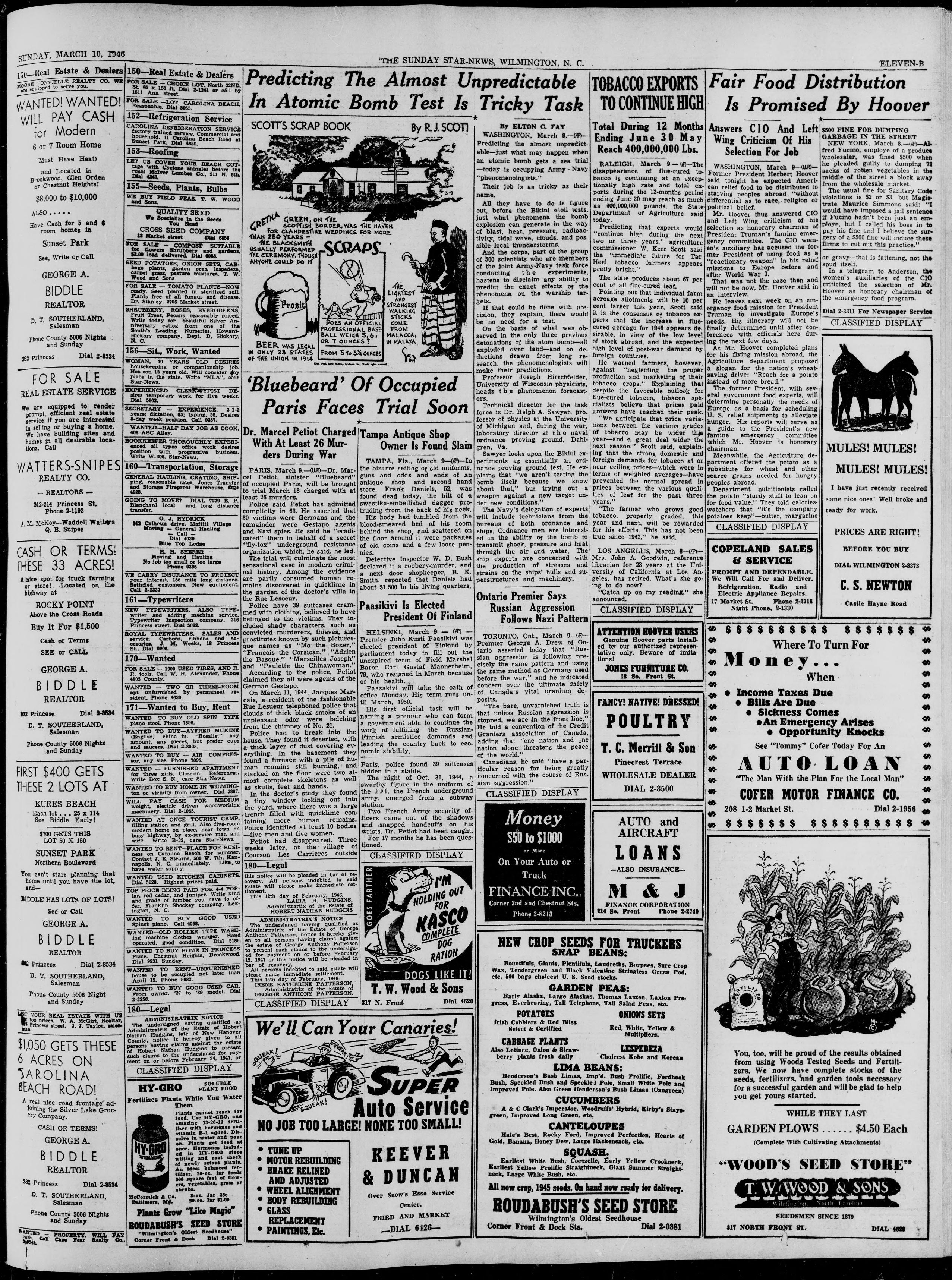
This issue of The Wilmington Morning Star is dated March 10, 1946. The Library of Congress believes the newspapers in Chronicling America to be in the public domain, but cautions that issues less than ninety-five years old may contain some copyrighted third-party material. Nothing in this dispatch indicates separately copyrighted matter. The scan is the Library's own copy, and the citation and rights statement are printed beneath it.
Every word was read from a sharp, dark scan, and none had to be marked illegible. The paper's mistakes stand: "belinged" for belonged, and the street spelled two ways in the same story, "Rue Lesoeur" and then "Rue Lesueur," for what is properly the Rue Le Sueur. French names run without their accents, as set. The headline keeps the paper's line-break hyphen in "Mur- / ders." The story breaks off mid-sentence at the foot of the column with no jump line and is not continued on the page; its last line, just below the edge of the crop, was read from the full-page scan.
Transcription
Transcribed word for word from the page scan. Original spelling, punctuation, capitalisation and typographical errors have been kept exactly as printed. Unreadable words are marked [illegible]. Nothing has been modernised or corrected.
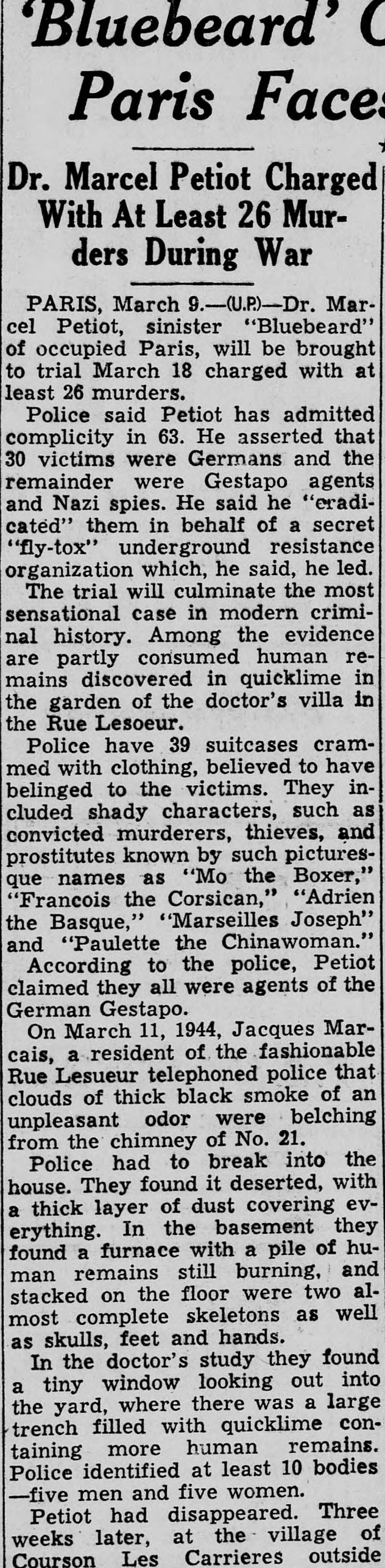
Dr. Marcel Petiot Charged With At Least 26 Mur- ders During War
PARIS, March 9.—(U.P.)—Dr. Marcel Petiot, sinister "Bluebeard" of occupied Paris, will be brought to trial March 18 charged with at least 26 murders.
Police said Petiot has admitted complicity in 63. He asserted that 30 victims were Germans and the remainder were Gestapo agents and Nazi spies. He said he "eradicated" them in behalf of a secret "fly-tox" underground resistance organization which, he said, he led.
The trial will culminate the most sensational case in modern criminal history. Among the evidence are partly consumed human remains discovered in quicklime in the garden of the doctor's villa in the Rue Lesoeur.
Police have 39 suitcases crammed with clothing, believed to have belinged to the victims. They included shady characters, such as convicted murderers, thieves, and prostitutes known by such picturesque names as "Mo the Boxer," "Francois the Corsican," "Adrien the Basque," "Marseilles Joseph" and "Paulette the Chinawoman."
According to the police, Petiot claimed they all were agents of the German Gestapo.
On March 11, 1944, Jacques Marcais, a resident of the fashionable Rue Lesueur telephoned police that clouds of thick black smoke of an unpleasant odor were belching from the chimney of No. 21.
Police had to break into the house. They found it deserted, with a thick layer of dust covering everything. In the basement they found a furnace with a pile of human remains still burning, and stacked on the floor were two almost complete skeletons as well as skulls, feet and hands.
In the doctor's study they found a tiny window looking out into the yard, where there was a large trench filled with quicklime containing more human remains. Police identified at least 10 bodies—five men and five women.
Petiot had disappeared. Three weeks later, at the village of Courson Les Carrieres outside
Transcriber's notes
- Readability: Excellent. The type is dark and sharp throughout the column and every word is plainly legible. No [illegible] markers were needed.
- Printers' errors kept as printed: "believed to have belinged to the victims" — "belinged" for "belonged".
- The paper spells the street two different ways within the same article: "the Rue Lesoeur" at the first mention and "the fashionable Rue Lesueur" at the second. Both are kept as printed. (The accepted form of the address is the Rue Le Sueur.)
- French names are set without accents, as printed: "Francois the Corsican", "Jacques Marcais", "Courson Les Carrieres".
- Period usage kept as printed: "organization", "odor", "in behalf of", and the dateline credit "(U.P.)".
- The headline is set in three lines within the one column and is broken by the paper's own hyphenation ("26 Mur- / ders During War"); it is given above exactly as the lines are printed, and is followed by a short rule.
- The article breaks off mid-sentence at the foot of column 2 and NO jump line is printed. Immediately below it a rule and the classified heading "180—Legal" begin the legal-notice column, and column 3 carries a different story ("Tampa Antique Shop Owner Is Found Slain"), so the piece is not continued anywhere on this page. The sentence is simply left unfinished as the paper printed it.
- The supplied crop stops one line short of the foot of the column: the tiles end at "weeks later, at the village of", while the column's last printed line is "Courson Les Carrieres outside". That final line has been included above and was read from the full-page scan held in the same folder as the tiles (petiot.fullpage.jpg), not supplied from context.
- Apart from the rule at the very top of the first tile and the "180—Legal" classified matter just past the bottom edge, no unrelated articles or advertisements fall inside the crop.