DEEMING DIES: RIVER FALLS JOURNAL, MAY 26, 1892
He swallowed the brandy at a gulp. A few moments before ten o'clock on the morning of May 23, 1892, Frederick Bailey Deeming was given a glass in the Melbourne jail, told he could have more if the prison doctor so ordered, and led to the gallows, where the drop was seven feet. Three days later the River Falls Journal in Wisconsin ran the cable account of his last hours: the Sunday spent writing, the small allowance of spirits swallowed eagerly three times that night, the manacles taken off his wrists for the first time since his arrest, and a cigar smoked while he talked with the men around him.
He told the prison governor he had made his peace with God, and he thanked the officials and his counsel. On one point he would not bend: he went on denying that he was guilty of what the paper calls "the Rain Hill murders." Those were the deaths that made his name. In March 1892, after the body of his young wife, Emily Mather, was found under a hearthstone in a house at Windsor, Melbourne, police at Rainhill, near Liverpool, took up the floor of Dinham Villa and found a woman and four little children. The woman was his first wife, Marie, and the children were theirs.
The second half of the column is the story as American readers had it that spring, and it carries an idea that would outlive him. Among the Liverpool women he courted under the name Williams, the paper says, was one who became terribly afraid of him after his talk of the "Jack the Ripper" crimes; he failed to come to tea one evening, and she never saw him again. The writer also finds a gentler side on the voyage out, when he doctored the sick and saved titbits from his table for the steerage passengers. The piece closes on certainty: had he escaped in Australia, he "would undoubtedly have been hanged for the Rain Hill murders" in England.
This is a cable report with a summary of the case written for American readers, not a court record, and the summary is loose in places. Deeming was convicted of one murder, Emily Mather's at Windsor, and hanged for it. A coroner's jury at Rainhill found that he had murdered Marie and the four children, but he was never tried for those deaths and denied them to the end. The paper says he confessed in court after sentence to killing Emily; the speech other accounts describe came before the verdict, and in it he said he knew in his own mind he was not guilty. "Kate Rounseville" was Kate Rounsefell. The Ripper idea was press speculation, and no evidence has placed him in London during the 1888 murders.
The River Falls Journal for May 26, 1892, is well over ninety-five years old and in the public domain without qualification, so neither the column nor the cable matter in it carries any restriction. The scan reproduced here is the Library of Congress copy from Chronicling America; its citation and rights statement appear beneath it.
Clean, well-inked type meant that no word in this column had to be marked illegible. The paper's own forms stay as printed: "Rain Hill" as two words for Rainhill, "Dinham villa" with a small v, "Kate Rounseville," "titbits," and the spellings "skillful," "modeler" and "defense." "Mr. Lyle, his counsel" is also left as the paper has it. The column ends at a rule on the same page, and nothing continues elsewhere.

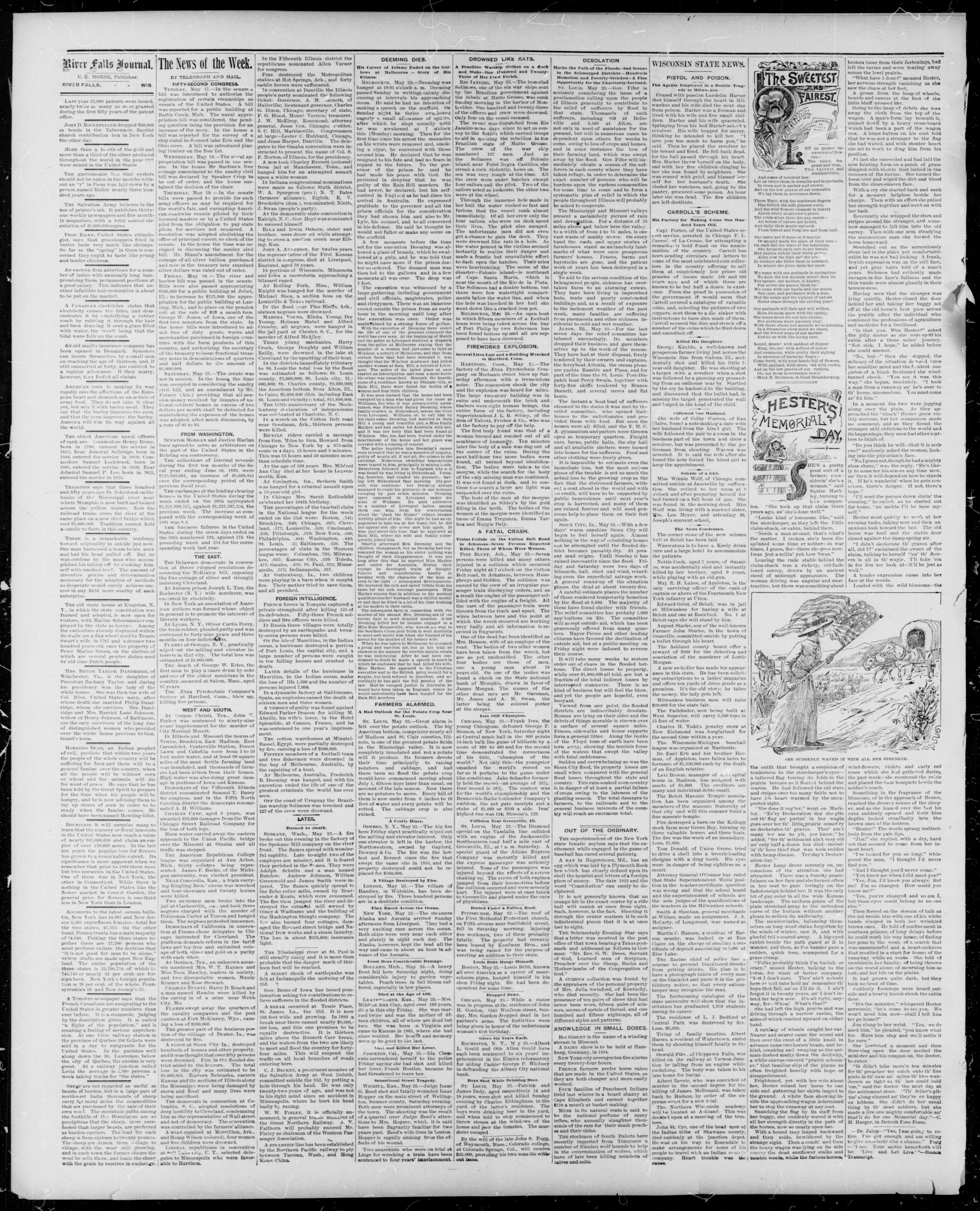
Transcription
Transcribed word for word from the page scan. Original spelling, punctuation, capitalisation and typographical errors have been kept exactly as printed. Unreadable words are marked [illegible]. Nothing has been modernised or corrected.
DEEMING DIES.
His Career of Infamy Ended on the Gallows at Melbourne — Story of His Crimes.
MELBOURNE, May 23.—Deeming was hanged at 10:01 o'clock a. m. Deeming passed Sunday in writing, calmly discussing at intervals his approaching doom. He said he had no intention of making a speech on the scaffold. On Sunday night he thrice swallowed eagerly a small allowance of spirits, after which he slept soundly until he was awakened at 7 o'clock this (Monday) morning. Then for the first time since his arrest the manacles on his wrists were removed and, smoking a cigar, he conversed with those around him. He declared that he was resigned to his fate and had no fears in regard to the future. To the governor of the prison he said he had made his peace with God. He persisted in denying that he was guilty of the Rain Hill murders. He had never, he declared, lost his self-control in England as he had since his arrival in Australia. He expressed gratitude to the governor and all the prison officials for the consideration they had shown him and also to Mr. Lyle, his counsel, and to all concerned in his defense. He said he thought he would not falter or make any scene on the scaffold.
A few moments before the time set for the execution Deeming was allowed a glass of brandy, which he swallowed at a gulp, and he was told that he might have more if the prison doctor so ordered. The doomed man was then led to the gallows and in a few moments all was over. The drop was 7 feet.
The execution was witnessed by a large gathering, including government and civil officials, magistrates, police and clergymen. There was an immense crowd outside the prison from an early hour in the morning until long after the execution was over. Order was maintained by a strong force of police.
With the execution of Deeming there ended the life of one of the greatest criminals the world has ever seen. At the beginning of March last the police at Liverpool received a dispatch from the police at Melbourne stating that the murder of a woman had just come to light at Windsor, a suburb of Melbourne, and that from certain facts that had been revealed it was thought that the Windsor murderer had killed another woman at Rain Hill, a suburb of Liverpool. The police of the latter place at once started an investigation and soon a most horrible crime was unearthed. Beneath the hearthstone of a residence known as Dinham villa, at Rain Hill, there were found the bodies of a woman and four little children.
It was soon learned that the house had been occupied by a man who had given his name as Williams, but who, it was subsequently ascertained, was Frederick Bailey Deeming, whose family resided in Birkenhead, across the river from Liverpool. Williams, or, to call him by his right name, Deeming, had married at Rain Hill a young and beautiful girl, a Miss Emily Mather, and had sailed for Australia with her, and it was her body that had been found at Windsor. She, too, had been buried under the hearthstone of the house and her grave was covered with a coating of cement.
The police inquiries into Deeming's career soon revealed that he was a monster of iniquity, guilty of nearly all, if not all, the crimes in the calendar. Numerous swindling transactions were traced to him, principally in mining lands. Detectives followed him to England, where it was found he was living in Birkenhead. Deeming, however, had evaded his pursuers, having left Birkenhead that morning. The pursuit was continued, but Deeming always managed to evade his pursuers, in one instance escaping by just seven minutes. Deeming later appeared in Liverpool under his alias of Williams. He paid addresses to a number of Liverpool ladies, among them one who, from his conversation about the "Jack the Ripper" crimes, became terribly afraid of him. One night he had an engagement to take tea at her home, but he did not appear and she never saw him again. It was just about this time that he appeared at Rain Hill, where his wife and family subsequently joined him.
Shortly afterward Mrs. Deeming and the children disappeared, but as Deeming had represented the woman as his sister nothing was thought of their disappearance. It was not long after this that he married Miss Mather and sailed for Australia. During their voyage he developed traits of thoughtfulness and consideration hardly in keeping with the character of the man as seen in the light of subsequent developments. He doctored the sick and saved titbits from his table for the sick steerage passengers. Miss Mather relates that in addition to his medical qualifications her husband was a skillful modeler and that he filled in a lot of his time working at his models in their cabin.
The subsequent facts in connection with the murder of the second Mrs. Deeming are of too recent date to need detailed mention. After Deeming killed her he became engaged to a Miss Kate Rounseville, who was on her way to the Southern Cross gold fields in west Australia to meet and marry him when she learned of his arrest for the murder of his former wife.
When he was taken to Melbourne he assumed a jovial and careless air, but at his trial he showed in his manner the terrible mental strain he was undergoing. After he had been condemned to death he made a speech in court in which he confessed that he had killed his wife, Miss Mather. He appealed to the Victorian executive and to the British privy council for a respite, but both refused to interfere, and accordingly he has paid the full penalty of the law. Had he escaped justice in Australia he would have been taken to England, where he would undoubtedly have been hanged for the Rain Hill murders.
Transcriber's notes
- Readability: very good. Clean, well-inked type throughout. No [illegible] markers were needed.
- Kept as printed: "Rain Hill" as two words (the place is Rainhill); "Dinham villa" (the house was Dinham Villa); "titbits"; "skillful"; "modeler"; "defense"; "Kate Rounseville" (usually Rounsefell); and "Mr. Lyle, his counsel".
- The paper refers to the dead woman at Rainhill as his wife and to the four children; Deeming killed his first wife Marie and their four children there in 1891, and Emily Mather at Windsor, Melbourne, in December 1891.
- The paragraph about his conversation on the "Jack the Ripper" crimes is the origin of the long-running claim that Deeming was the Ripper; it is reproduced as printed and is not evidence of anything beyond what he said to a Liverpool acquaintance.
- The article ends at a rule; what follows below it is unrelated.