COURT CONVICTS MALE NURSE IN THREE INSULIN DEATHS: THE SALT LAKE TRIBUNE, MARCH 7, 1968
For twelve years the deaths around William Dale Archerd had been put down to pneumonia, barbiturates, a brain hemorrhage and a car accident, and in March 1968 a Los Angeles judge called them murder. Superior Judge Adolph Alexander, hearing the case without a jury, found the fifty-five-year-old guilty of three counts of first-degree murder, and the Associated Press story in The Salt Lake Tribune of March 7 carries his verdict on the man as well as the case: "this defendant knew more about insulin than most doctors." Archerd took it calmly. He told the newsmen crowding him, "this is just the first round."
The three dead were Zella Winders Archerd, forty-eight, his fourth wife, who died on July 25, 1956; his nephew Burney Kirk Archerd, fifteen, who died on September 2, 1961; and Mary Brinker Post Arden, sixty, his seventh wife, a novelist whose "Annie Jordan" the paper calls a million-copy seller. Zella sank into a coma the night of a robbery Archerd reported and the investigating officer never believed. Burney went down in a hospital bed after a hit-and-run story built on a truck that could not have been driven off unseen. Mary slipped away days after a minor car accident. None of them came out of the coma.
In 1956 nothing could find injected insulin in a body, and Archerd knew it. Between 1939 and 1941 he had worked the insulin shock ward at Camarillo State Hospital, and he once told a wife that no test could measure insulin and that no one would think to look for it. The case turned when a UCLA pathologist, Dr. Edward Arquilla, showed detectives that proof could rest on brain damage visible in slides preserved from Burney and Mary, and on lives that never showed natural low blood sugar. The judge sentenced Archerd to death. The sentence became life in 1972, and he died in prison in 1977.
This is a wire report of the verdict, not a court record, and its larger number is an accusation. The headline calls him a male nurse; his hospital work had been as an attendant on the Camarillo insulin ward. The six deaths in its first line are the three he was convicted of and three more, William Edward Jones in 1947, his wife Juanita Plum in 1958 and Frank L. Stewart in 1960, which the prosecution put into evidence to show a common plan but never charged. The paper's "two male friends" covers Jones, a friend, and Stewart, the former husband of another of his wives. Mary's death is dated November 3 here, as in the indictment; some records give November 2.
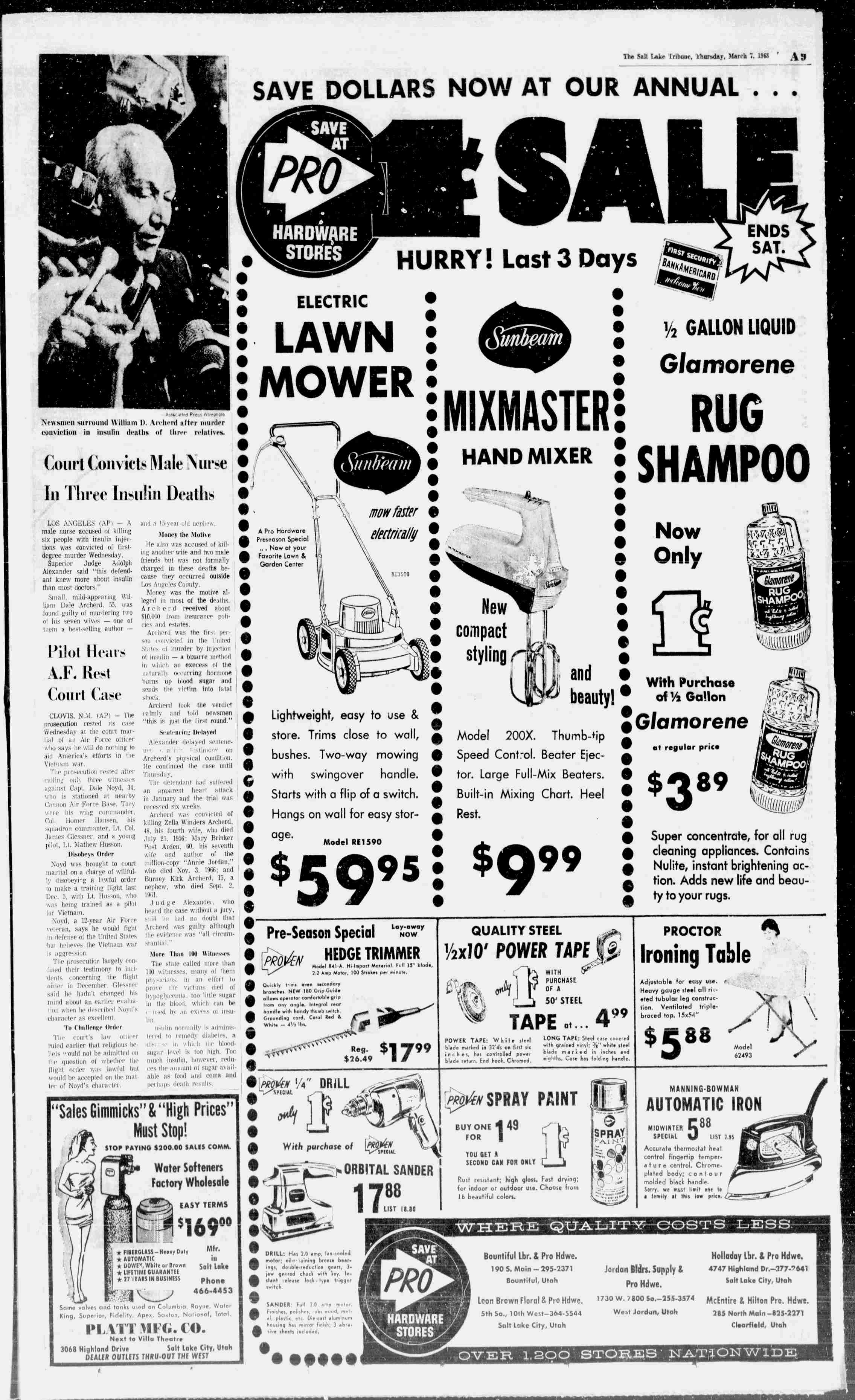
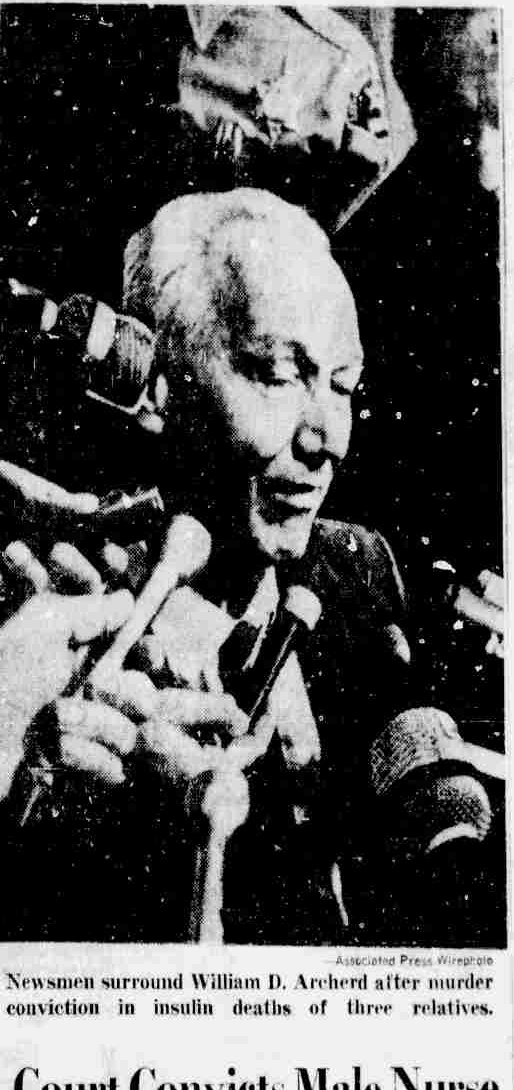
Credited to the Associated Press, with no staff byline, the story ran on page A9 of The Salt Lake Tribune for March 7, 1968, and the photograph above it carries its own credit, "Associated Press Wirephoto." The scan is from Utah Digital Newspapers at the University of Utah's J. Willard Marriott Library, which rates the issue "No Copyright - United States," its finding that the item is free of copyright under U.S. law, set issue by issue. No copyright notice was found on the story or the masthead. The citation and the rating appear under the scan.
The story is L-shaped, so it is shown in three crops, in order: the headline and the tops of both columns, the rest of the second column, and the wirephoto with its caption from above the headline. All three parts are transcribed. Two words in the "Sentencing Delayed" paragraph are broken beyond reading in the scan and are marked [illegible]; the words on either side, "sentencing" and "testimony," are clear. The paper's "execess" and its "Superior Judge," with no "Court," stay as printed, and the caption's "William D. Archerd" is kept beside the story's "Dale."
Transcription
Transcribed word for word from the page scan. Original spelling, punctuation, capitalisation and typographical errors have been kept exactly as printed. Unreadable words are marked [illegible]. Nothing has been modernised or corrected.
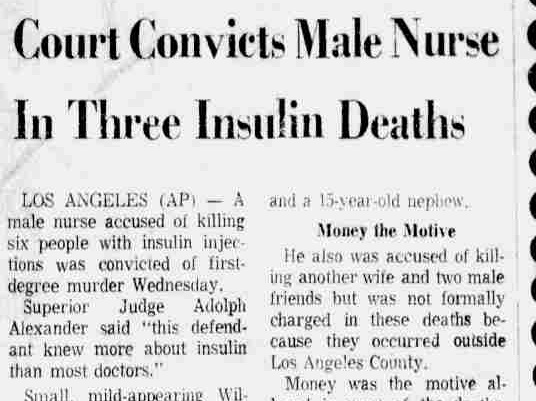
Court Convicts Male Nurse In Three Insulin Deaths
LOS ANGELES (AP) — A male nurse accused of killing six people with insulin injections was convicted of first-degree murder Wednesday.
Superior Judge Adolph Alexander said "this defendant knew more about insulin than most doctors."
Small, mild-appearing William Dale Archerd, 55, was found guilty of murdering two of his seven wives — one of them a best-selling author — and a 15-year-old nephew.
Money the Motive
He also was accused of killing another wife and two male friends but was not formally charged in these deaths because they occurred outside Los Angeles County.
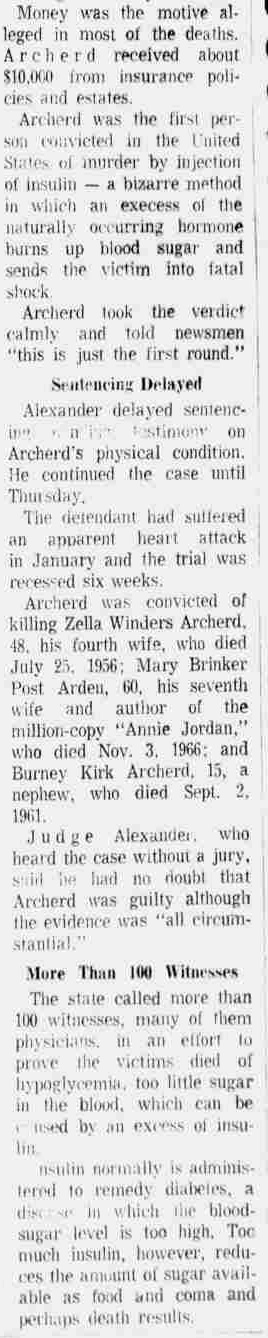
Money was the motive alleged in most of the deaths. Archerd received about $10,000 from insurance policies and estates.
Archerd was the first person convicted in the United States of murder by injection of insulin — a bizarre method in which an execess of the naturally occurring hormone burns up blood sugar and sends the victim into fatal shock.
Archerd took the verdict calmly and told newsmen "this is just the first round."
Sentencing Delayed
Alexander delayed sentencing [illegible] [illegible] testimony on Archerd's physical condition. He continued the case until Thursday.
The defendant had suffered an apparent heart attack in January and the trial was recessed six weeks.
Archerd was convicted of killing Zella Winders Archerd, 48, his fourth wife, who died July 25, 1956; Mary Brinker Post Arden, 60, his seventh wife and author of the million-copy "Annie Jordan," who died Nov. 3, 1966; and Burney Kirk Archerd, 15, a nephew, who died Sept. 2, 1961.
Judge Alexander, who heard the case without a jury, said he had no doubt that Archerd was guilty although the evidence was "all circumstantial."
More Than 100 Witnesses
The state called more than 100 witnesses, many of them physicians, in an effort to prove the victims died of hypoglycemia, too little sugar in the blood, which can be caused by an excess of insulin.
Insulin normally is administered to remedy diabetes, a disease in which the blood-sugar level is too high. Too much insulin, however, reduces the amount of sugar available as food and coma and perhaps death results.
[Photo caption] —Associated Press Wirephoto Newsmen surround William D. Archerd after murder conviction in insulin deaths of three relatives.
Notes: Kept as printed: "execess"; "Superior Judge" (no "Court"). The caption gives the middle initial as "D." where the story has "Dale". The second line of "Sentencing Delayed" is badly broken in the scan: "sentencing" and "testimony" are readable, but the two words between them (probably "until he hears" or similar) are not, and are marked [illegible]. "said he had no doubt that", "caused by" and "disease" are faint but readable. The story is L-shaped: column 1 carries only the opening paragraphs, above the unrelated story "Pilot Hears A.F. Rest Court Case", and column 2 runs on down the page. So it is supplied as ARTICLE-CROP.jpg (the headline and the tops of both columns), ARTICLE-CROP-PART-2.jpg (the rest of column 2) and ARTICLE-CROP-PHOTO.jpg (the AP Wirephoto and caption above the headline). Readability: fair. 2 words illegible.