COUNSEL TO ASK PSYCHIATRIC TEST FOR REES: EVENING STAR, JUNE 30, 1960
Less than a week after Melvin Rees was arrested in Memphis, one of his own lawyers conceded that a single piece of paper worried him. Walter L. Green of Hyattsville, Maryland, who had spent two hours with Rees in his cell at the Shelby County Jail, telephoned The Star from Jacksonville, Florida, and chose his words with care. It would be premature, he said, to say an insanity plea would be entered, but he would seek a full psychiatric examination for the 31-year-old Washington musician, accused of killing the four members of the Carroll V. Jackson family and Mrs. Margaret V. Harold.
Most of the FBI's case, Green told reporters, looked circumstantial. The exception was a handwritten document found in Rees's parents' home in Hyattsville, which the FBI said was in Rees's hand. It "looks bad," Green said. The paper calls it a sort of a diary, and investigators described its contents as a "depraved and obscene" account of the last hours of the Jackson family. Whether Rees would be moved before a federal removal hearing set in Memphis for July 6 was still undecided, and the Baltimore prosecutor who had won his indictment under the Lindbergh Law was away for the holiday weekend.
The story closes on the crime. Carroll Jackson, 29, a truck driver, his wife, Mildred, 27, and their daughters, Susan Ann, 5, and Janet, 18 months, were taken on a lonely road in Virginia on the night of January 11, 1959. Carroll and Janet were found on March 4 near Fredericksburg, he shot and the baby apparently suffocated. Mildred and Susan Ann had been driven into Maryland, and their beaten bodies were found in a shallow grave near Gambrills seventeen days later. The document Green feared was illustrated with newspaper photographs of Mildred and Susan, a gag penciled over the mother's mouth.
This is local reporting from the first days after the arrest, when Rees had been convicted of nothing, and the paper rightly calls him a suspect. He was later tried in three courts. Maryland convicted him of Margaret Harold's murder; a federal jury convicted him of kidnapping Mildred and Susan Jackson across state lines and killing them; and Virginia convicted him of Carroll Jackson's murder and sentenced him to death, a sentence reduced to life in 1972. The handwritten account was kept from the Virginia jury, because his father's consent to the search could not waive Rees's own rights. The paper places the abduction near the family's home; their car was found about halfway between Mildred's parents' house and their own.
The Evening Star published this on June 30, 1960. Because the issue is less than ninety-five years old, the Library of Congress, which believes it to be in the public domain, also warns that papers of this age may include some copyrighted third-party material; nothing in this report suggests any. The scan is the Library's copy from Chronicling America, with the citation and rights statement beneath it.
Each word was read from the scan. The only hard patch, an ink smudge across a subhead and the paragraph beginning "In his talk with newsmen," still left every letter legible, so nothing is marked illegible. The paper's "lonley road" stands uncorrected, as do "kidnaper" with one p, "week end" as two words and the lower-case house style of "Melvin D. Rees, jr." The story ends cleanly at "17 days later." with no jump.

Transcription
Transcribed word for word from the page scan. Original spelling, punctuation, capitalisation and typographical errors have been kept exactly as printed. Unreadable words are marked [illegible]. Nothing has been modernised or corrected.
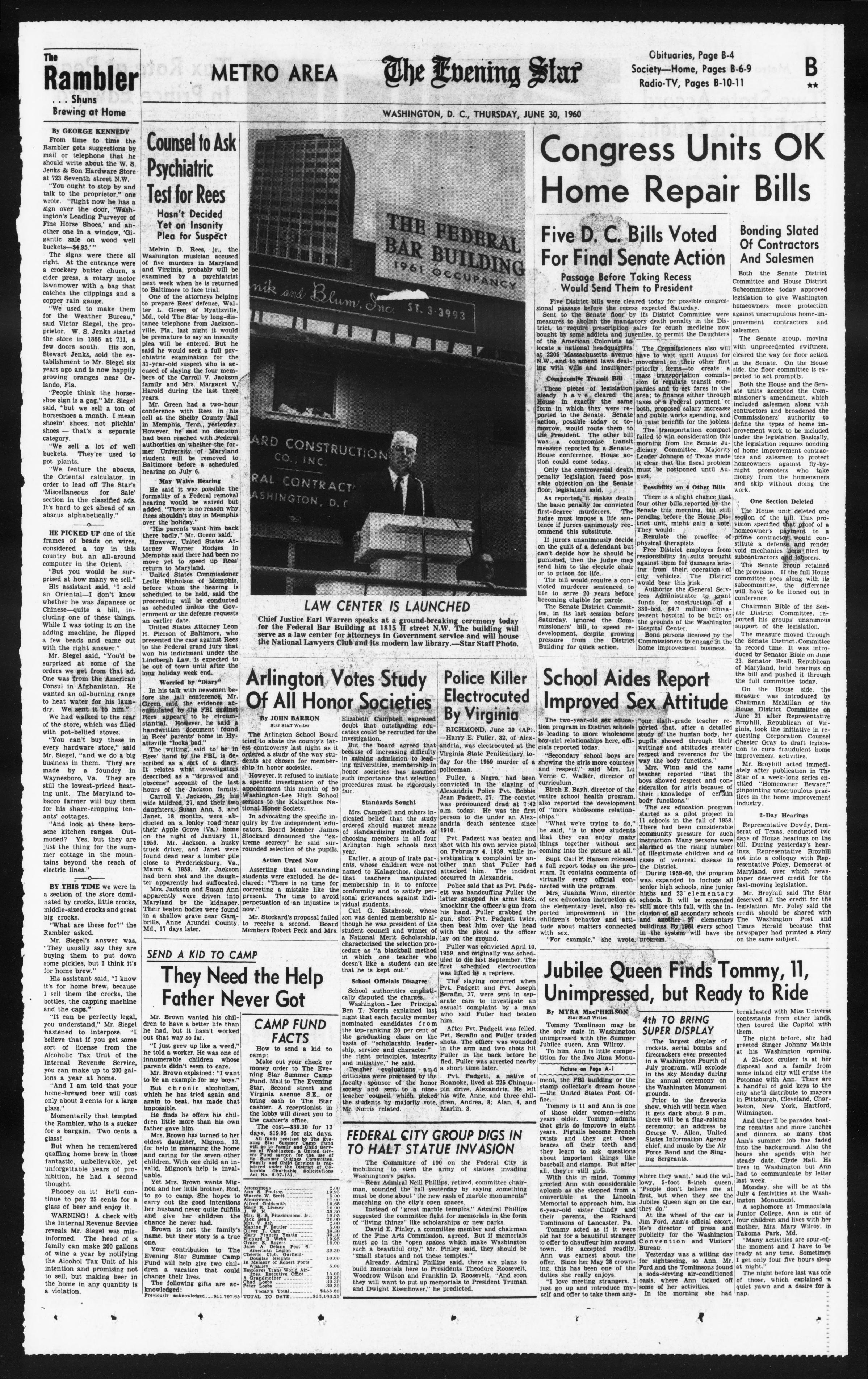
Counsel to Ask Psychiatric Test for Rees
Hasn't Decided Yet on Insanity Plea for Suspect
Melvin D. Rees, jr., the Washington musician accused of five murders in Maryland and Virginia, probably will be examined by a psychiatrist next week when he is returned to Baltimore to face trial.
One of the attorneys helping to prepare Rees' defense, Walter L. Green of Hyattsville, Md., told The Star by long-distance telephone from Jacksonville, Fla., last night it would be premature to say an insanity plea will be entered. But he said he would seek a full psychiatric examination for the 31-year-old suspect who is accused of slaying the four members of the Carroll V. Jackson family and Mrs. Margaret V. Harold during the last three years.
Mr. Green had a two-hour conference with Rees in his cell at the Shelby County Jail in Memphis, Tenn., yesterday. However, he said no decision had been reached with Federal authorities on whether the former University of Maryland student will be removed to Baltimore before a scheduled hearing on July 6.
May Waive Hearing
He said it was possible the formality of a Federal removal hearing would be waived but added, "There is no reason why Rees shouldn't stay in Memphis over the holiday."
"His parents want him back there badly," Mr. Green said.
However, United States Attorney Warner Hodges in Memphis said there had been no move yet to speed up Rees' return to Maryland.
United States Commissioner Leslie Nicholson of Memphis, before whom the hearing is scheduled to be held, said the proceeding will be conducted as scheduled unless the Government or the defense requests an earlier date.
United States Attorney Leon H. Pierson of Baltimore, who presented the case against Rees to the Federal grand jury that won his indictment under the Lindbergh Law, is expected to be out of town until after the long holiday week end.
Worried by "Diary"
In his talk with newsmen before the jail conference, Mr. Green said the evidence accumulated by the FBI against Rees appears to be circumstantial. However, he said a handwritten document found in Rees' parents' home in Hyattsville "looks bad."
The writing, said to be in Rees' hand by the FBI, is described as a sort of a diary. It relates what investigators described as a "depraved and obscene" account of the last hours of the Jackson family.
Carroll V. Jackson, 29; his wife Mildred, 27, and their two daughters, Susan Ann, 5, and Janet, 18 months, were abducted on a lonley road near their Apple Grove (Va.) home on the night of January 11, 1959. Mr. Jackson, a husky truck driver, and Janet were found dead near a lumber pile close to Fredericksburg, Va., March 4, 1959. Mr. Jackson had been shot and the daughter apparently had suffocated.
Mrs. Jackson and Susan Ann apparently were driven into Maryland by the kidnaper. Their beaten bodies were found in a shallow grave near Gambrills, Anne Arundel County, Md., 17 days later.
Transcriber's notes
- Readability: Very good. The headline and the first two-thirds of the column are crisp; the only troublesome patch is tile c1_002960, where a dark smudge of ink runs across the paragraph beginning "In his talk with newsmen" and over the sub-head "Worried by "Diary"". Every word there was still legible. No [illegible] markers were needed.
- Printers' error kept as printed: "abducted on a lonley road" (for "lonely").
- Period spelling kept as printed: "kidnaper" (single "p"), and "week end" set as two words.
- The lower-case "jr." in "Melvin D. Rees, jr." is the paper's house style and has been kept.
- The article begins at the headline and ends cleanly at "17 days later."; there is no jump line and no continuation beyond the last tile. The remainder of the last tile below that sentence is blank.
- There is no photograph or engraving within the article.
- No unrelated matter intrudes into the crop: the tiles are a single column bounded by column rules on both sides, and nothing from the neighbouring columns or any advertisement is readable inside them.