CORONA LAWYER WANTS NEW TRIAL: THE HERALD JOURNAL, JANUARY 19, 1973
Within hours of the verdict, the juror who had held out longest was taking it back. On Thursday, January 18, 1973, a jury in Fairfield, California, found Juan Corona, a thirty-eight-year-old farm labor contractor from Yuba City, guilty of murdering twenty-five itinerant farm hands and burying them along the Feather River in early 1971. The vote had come only when Naomi Underwood, a sixty-three-year-old widow from Vallejo, gave up a two-day holdout on the fifteenth secret ballot. Afterward she told United Press International what it had cost her. "I may be wrong but I decided to make it unanimous ... I am still not quite convinced yet. I feel bad about it."
She described a jury room with "a lot of yelling at each other," where the others knew she was the holdout from her handwriting on the ballots. "Can you imagine what it's like with 10 men and another woman trying to convince you what you don't believe," she said. "I've been under terrific pressure." The defense attorney, Richard Hawk, seized on it. "I love her," he said. "She blew the whole thing wide open." He moved for a new trial, and Judge Richard Patton set a hearing for January 29 and put off sentencing until after it. The jury had deliberated for forty-six hours, and all of the evidence against Corona, the paper reminded its readers, was circumstantial.
Corona took the verdicts stoically, gripping the defense table and rocking back and forth through the thirty minutes it took the jury to report guilty on each of the twenty-five counts. His wife, Gloria, and their four daughters sat in silent despair until court adjourned, then broke down; his eleven-year-old daughter collapsed and was taken to Solano County Hospital, where she was treated and released. One line near the end would matter more than anything else in the story. The foreman, Ernest Phillips, said the jury had been bothered that Hawk called no defense witnesses, and asked whether the defense attorney had made a mistake, Mrs. Underwood answered, "you bet he did."
This is a wire story from the day of the verdict, built around one juror's second thoughts, and it is not a court record. It puts the deliberations at forty-six hours, where the record has forty-five, and says Corona had two heart attacks after his 1971 arrest; the record notes one, a mild attack in the Yuba City jail in June 1971. "Vacaville State Prison" was the California Medical Facility there. Corona was sentenced to twenty-five life terms, and on May 8, 1978, the California Court of Appeal threw out the convictions, not over the juror but because Hawk, who held the rights to his client's story, had failed to give him a competent defense. At a retrial in Hayward in 1982 a second jury convicted him again on all twenty-five counts.
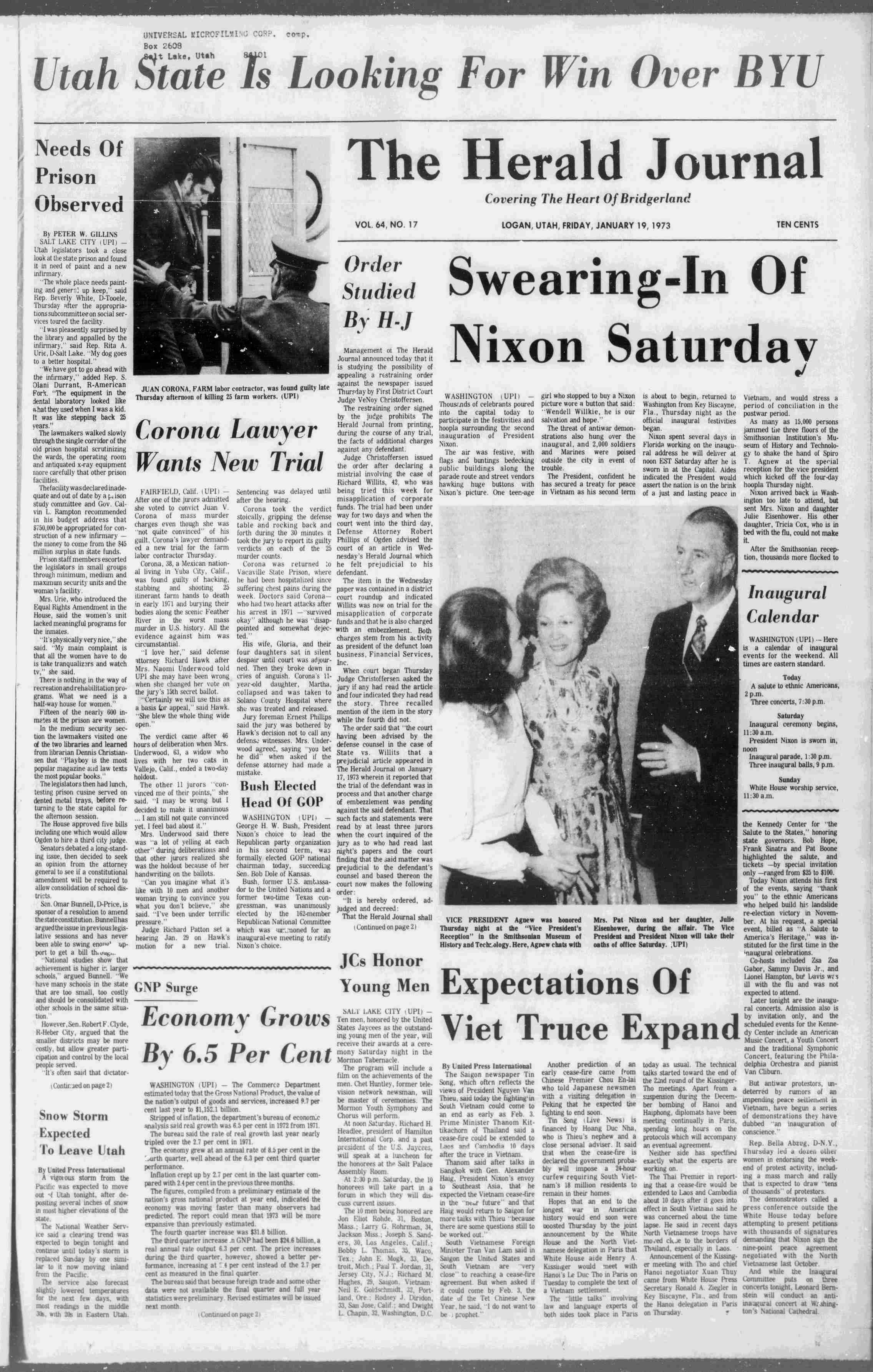
Front page, The Herald Journal of Logan, Utah, January 19, 1973. The story and the photograph of Corona are both credited to United Press International, and neither carries a copyright notice; a search of all fourteen pages of the issue found none anywhere, and in 1973 an American publication needed one to keep its copyright. The scan is from Utah Digital Newspapers, the University of Utah's J. Willard Marriott Library collection, which catalogs the title as the Logan Herald Journal and rates this issue "No Copyright - United States." Its citation and rights statement are printed below the scan.
The column breaks are the only complication. The story is L-shaped: the first column runs deeper than the second, which stops above an unrelated item headed "Bush Elected Head Of GOP," so the scan is split, with the photograph, caption, headline and both columns in one crop and the foot of the first column in another. Read the first column to "new trial." before starting the second. Every word was legible and is given as printed, including the paper's uneven spacing around the two dashes in the sentence about his heart attacks.
Transcription
Transcribed word for word from the page scan. Original spelling, punctuation, capitalisation and typographical errors have been kept exactly as printed. Unreadable words are marked [illegible]. Nothing has been modernised or corrected.
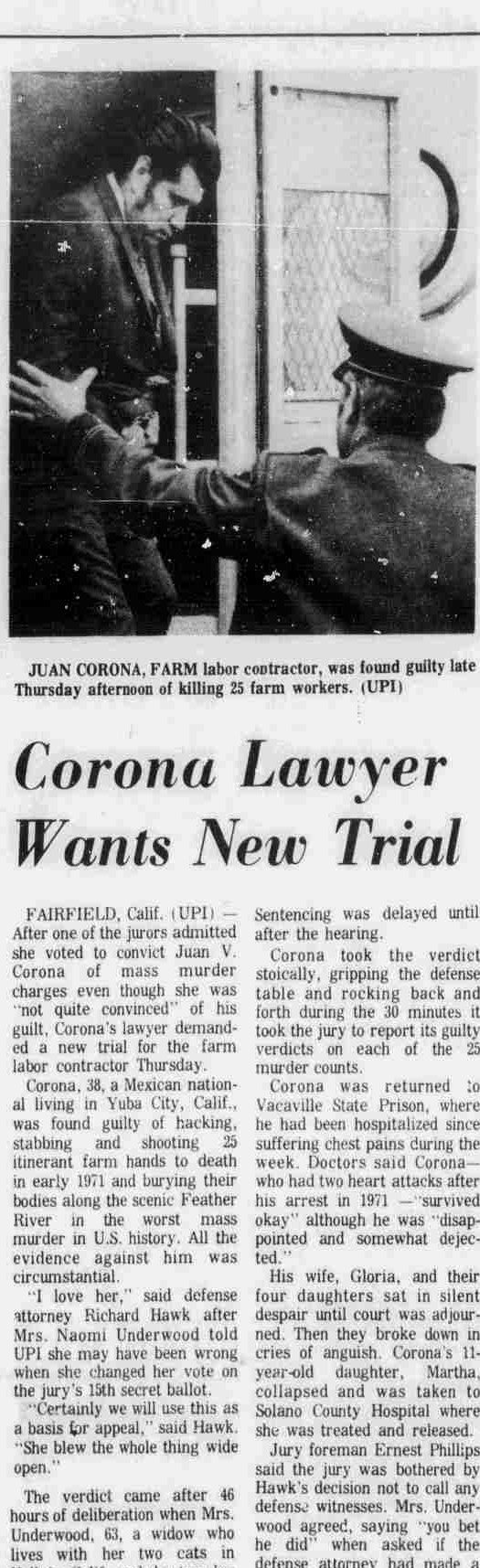
[Photo caption] JUAN CORONA, FARM labor contractor, was found guilty late Thursday afternoon of killing 25 farm workers. (UPI)
Corona Lawyer Wants New Trial
FAIRFIELD, Calif. (UPI) — After one of the jurors admitted she voted to convict Juan V. Corona of mass murder charges even though she was "not quite convinced" of his guilt, Corona's lawyer demanded a new trial for the farm labor contractor Thursday.
Corona, 38, a Mexican national living in Yuba City, Calif., was found guilty of hacking, stabbing and shooting 25 itinerant farm hands to death in early 1971 and burying their bodies along the scenic Feather River in the worst mass murder in U.S. history. All the evidence against him was circumstantial.
"I love her," said defense attorney Richard Hawk after Mrs. Naomi Underwood told UPI she may have been wrong when she changed her vote on the jury's 15th secret ballot.
"Certainly we will use this as a basis for appeal," said Hawk. "She blew the whole thing wide open."
The verdict came after 46 hours of deliberation when Mrs. Underwood, 63, a widow who lives with her two cats in Vallejo, Calif., ended a two-day holdout.
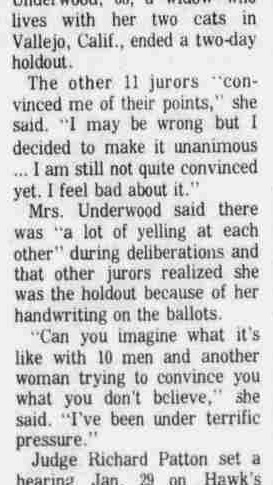
The other 11 jurors "convinced me of their points," she said. "I may be wrong but I decided to make it unanimous ... I am still not quite convinced yet. I feel bad about it."
Mrs. Underwood said there was "a lot of yelling at each other" during deliberations and that other jurors realized she was the holdout because of her handwriting on the ballots.
"Can you imagine what it's like with 10 men and another woman trying to convince you what you don't believe," she said. "I've been under terrific pressure."
Judge Richard Patton set a hearing Jan. 29 on Hawk's motion for a new trial.
Sentencing was delayed until after the hearing.
Corona took the verdict stoically, gripping the defense table and rocking back and forth during the 30 minutes it took the jury to report its guilty verdicts on each of the 25 murder counts.
Corona was returned to Vacaville State Prison, where he had been hospitalized since suffering chest pains during the week. Doctors said Corona—who had two heart attacks after his arrest in 1971 —"survived okay" although he was "disappointed and somewhat dejected."
His wife, Gloria, and their four daughters sat in silent despair until court was adjourned. Then they broke down in cries of anguish. Corona's 11-year-old daughter, Martha, collapsed and was taken to Solano County Hospital where she was treated and released.
Jury foreman Ernest Phillips said the jury was bothered by Hawk's decision not to call any defense witnesses. Mrs. Underwood agreed, saying "you bet he did" when asked if the defense attorney had made a mistake.
Notes: The story is L-shaped: column 1 runs further down the page than column 2, which ends above the separate story "Bush Elected Head Of GOP". So it is supplied as ARTICLE-CROP.jpg (the photograph, caption, headline and both columns) and ARTICLE-CROP-PART-2.jpg (the foot of column 1). Read column 1 to "new trial." and then column 2. "Corona—who" is printed with no space and "1971 —" with a space before the dash; both kept. No words were illegible.