CONFESSION OF KLINGENBERG: ABERDEEN HERALD, APRIL 7, 1910
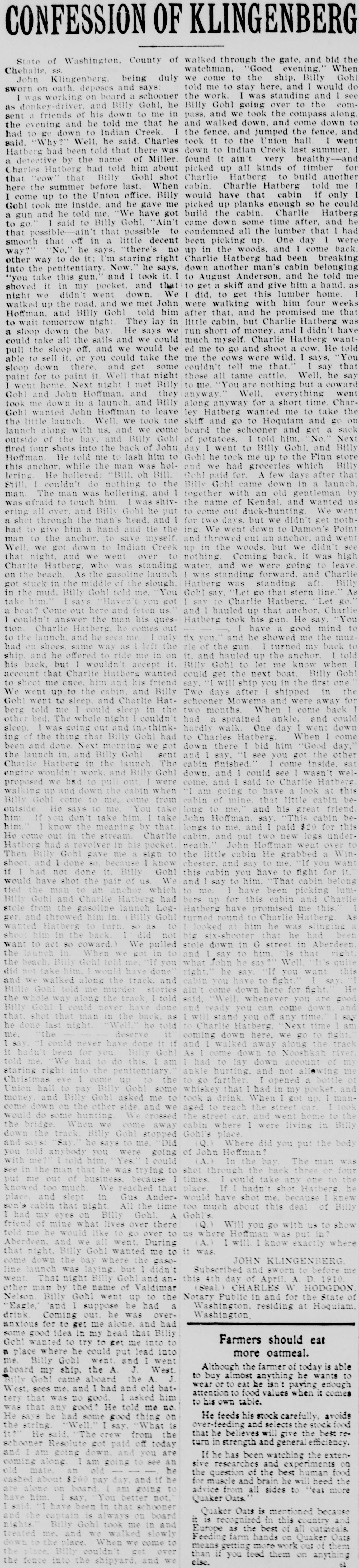
The case against Billy Gohl, the Aberdeen agent of the Sailors' Union of the Pacific, rested in large part on one man's word, and on April 7, 1910, the Aberdeen Herald printed that word in full. John Klingenberg, a sailor, had sworn it before a Hoquiam notary three days earlier. It runs two solid columns, a single breathless paragraph in his own broken English, from the night Gohl handed him a gun in the union office to the cabin on Indian Creek where both bodies began.
In Klingenberg's telling, Gohl was afraid. A man named Charles Hadberg (the paper prints it Hatberg) had been talking to a detective about a cow Gohl had shot, and Gohl told him there was no way out: "I'm staring right into the penitentiary." Out on the bay, Klingenberg says, Gohl fired four shots into the back of John Hoffman and ordered him to lash the man to an anchor while Hoffman was still crying out, "Bill, oh Bill." At Indian Creek the next day it was Klingenberg who shot Hadberg, at a sign from Gohl, because he believed that if he refused, Gohl would kill them both.
The rest wanders, the way a frightened man's statement does. There is a Christmas Eve walk on which he was sure Gohl meant to get rid of him because he knew too much, a stolen ship's compass, an old quarrel over a cabin at Indian Creek in which Hadberg and Hoffman both pulled guns on him. It ends on two questions from the officers. Asked whether he would show them where Hoffman went into the water, he answered, "I will. I know exactly where it was."
This is an accuser's sworn statement, printed as a confession because Klingenberg admits a killing in it, and it is his account alone, not a finding of any court. Other accounts of his evidence differ: have Hadberg killed first, around December 21, 1909, and Hoffman two days later, and have Klingenberg himself finishing Hoffman off on Gohl's orders and taking $450 from him. Klingenberg was sentenced to twenty years. In May 1910 a Chehalis County jury convicted Gohl of first-degree murder for both deaths, and he was spared hanging at the jury's request. The legend of a hundred more victims was never proved, and a historian of the case argues that the witnesses against Gohl had reasons to lie.
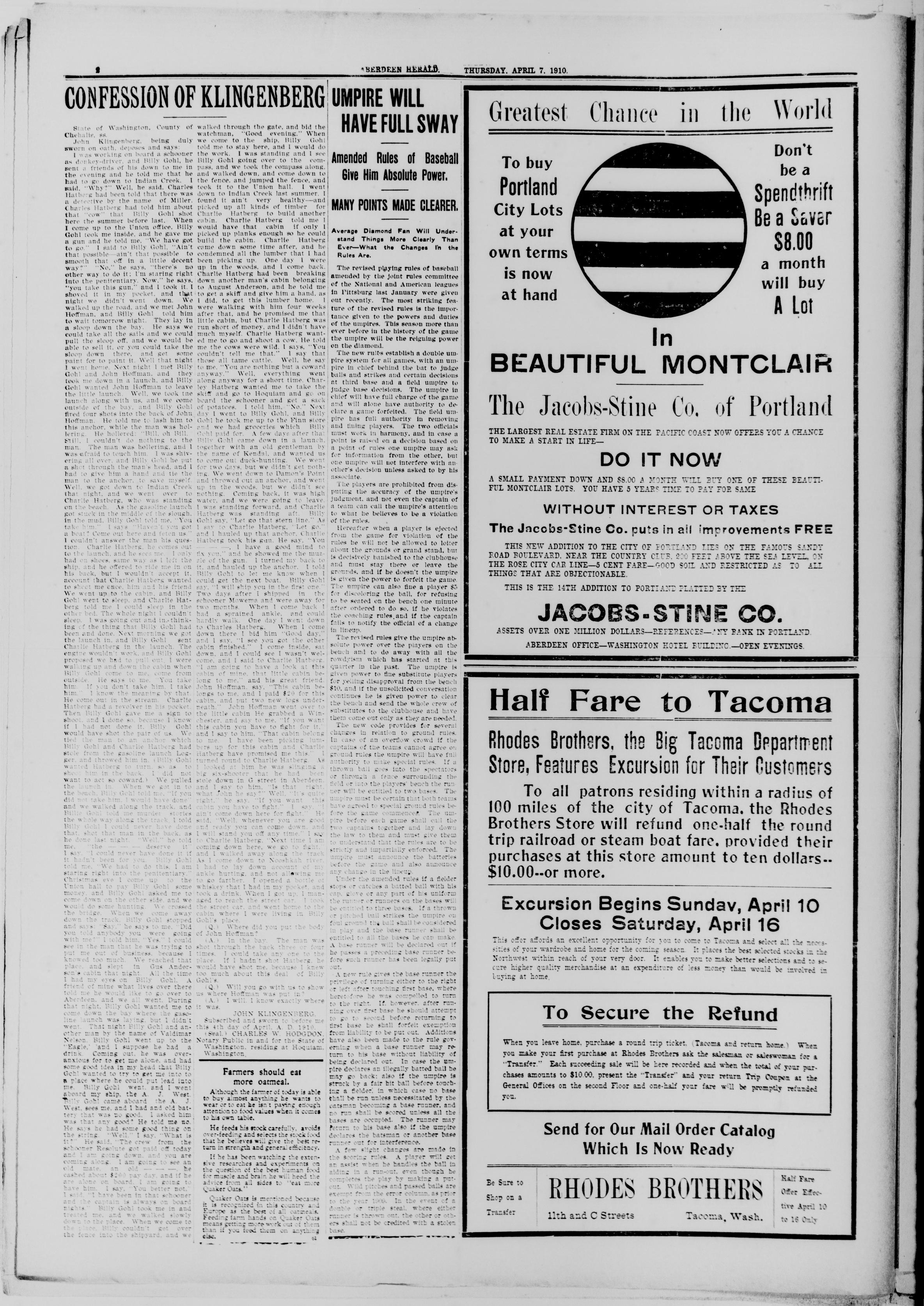
The Aberdeen Herald of April 7, 1910, is public domain in its entirety, and no restriction attaches to the affidavit or to anything else printed on the page. The Library of Congress copy in Chronicling America supplies the scan, and the citation and the Library's rights statement follow it.
The lower half of each column is grey and broken, and in that worn type a comma and a full point can look the same, so commas are set only where the sentence makes them certain; every word was finally read, and nothing is marked illegible. Klingenberg's grammar is left exactly as printed, "we didn't went down," "I were walking," "if he are alone on board," with the paper's unclosed quotation marks, its rows of dashes in place of profanity, and "Nooshkah river" where the Wishkah is meant. A Quaker Oats advertisement below the closing rule is not part of the affidavit and was not transcribed.
Transcription
Transcribed word for word from the page scan. Original spelling, punctuation, capitalisation and typographical errors have been kept exactly as printed. Unreadable words are marked [illegible]. Nothing has been modernised or corrected.
CONFESSION OF KLINGENBERG
State of Washington, County of Chehalis, ss.
John Klingenberg, being duly sworn on oath, deposes and says:
I was working on board a schooner as donkey-driver, and Billy Gohl, he sent a friends of his down to me in the evening and he told me that he had to go down to Indian Creek. I said, "Why?" Well, he said, Charles Hatberg had been told that there was a detective by the name of Miller. Charles Hatberg had told him about that "cow" that Billy Gohl shot here the summer before last. When I come up to the Union office, Billy Gohl took me inside, and he gave me a gun and he told me, "We have got to go." I said to Billy Gohl, "Ain't that possible—ain't that possible to smooth that off in a little decent way?" "No," he says, "there's no other way to do it; I'm staring right into the penitentiary. Now," he says, "you take this gun," and I took it. I shoved it in my pocket, and that night we didn't went down. We walked up the road, and we met John Hoffman, and Billy Gohl told him to wait tomorrow night. They lay in a sloop down the bay. He says we could take all the sails and we could pull the sloop off, and we would be able to sell it, or you could take the sloop down there, and get some paint for to paint it. Well that night I went home. Next night I met Billy Gohl and John Hoffman, and they took me down in a launch, and Billy Gohl wanted John Hoffman to leave the little launch. Well, we took the launch along with us, and we come outside of the bay, and Billy Gohl fired four shots into the back of John Hoffman. He told me to lash him to this anchor, while the man was hollering. He hollered: "Bill, oh Bill. Still, I couldn't do nothing to the man. The man was hollering, and I was afraid to touch him. I was shivering all over, and Billy Gohl he put a shot through the man's head, and I had to give him a hand and tie the man to the anchor, to save myself. Well, we got down to Indian Creek that night, and we went over to Charlie Hatberg, who was standing on the beach. As the gasoline launch got stuck in the middle of the slough, in the mud, Billy Gohl told me, "You take him." I says "Haven't you got a boat? Come out here and fetch us." I couldn't answer the man his question. Charlie Hatberg, he comes out to the launch, and he sees me. I only had on shoes, same way as I left the ship, and he offered to ride me in on his back, but I wouldn't accept it, account that Charlie Hatberg wanted to shoot me once, him and his friend We went up to the cabin, and Billy Gohl went to sleep, and Charlie Hatberg told me I could sleep in the other bed. The whole night I couldn't sleep. I was going out and in, thinking of the thing that Billy Gohl had been and done. Next morning we got the launch in, and Billy Gohl sent Charlie Hatberg in the launch. The engine wouldn't work, and Billy Gohl proposed we had to pull out, I were walking up and down the cabin when Billy Gohl come to me, come from outside. He says to me, "You take him. If you don't take him, I take him." I know the meaning by that. He come out in the stream. Charlie Hatberg had a revolver in his pocket. Then Billy Gohl gave me a sign to shoot, and I done so, because I know if I had not done it, Billy Gohl would have shot the pair of us. We tied the man to an anchor which Billy Gohl and Charlie Hatberg had stole from the gasoline launch Logger, and throwed him in. (Billy Gohl wanted Hatberg to turn, so as to shoot him in the back. I did not want to act so coward.) We pulled the launch in. When we got in to the beach, Billy Gohl told me, "If you did not take him, I would have done" and we walked along the track, and Billie Gohl told me murder stories the whole way along the track, I told Billy Gohl I could never have done that, shot that man in the back, as he done last night. "Well," he told me, "the —— —— —— deserve it" I say, "I could never have done it if it hadn't been for you. Billy Gohl told me, "We had to do this, I am staring right into the penitentiary." Christmas eve I come up to the Union hall to pay Billy Gohl some money, and Billy Gohl asked me to come down on the other side, and we would do some hunting. We crossed the bridge. When we come away down the track, Billy Gohl stopped and says: "Say," he says to me, "Did you told anybody you were going with me?" I told him, "Yes." I could see in the man that he was trying to put me out of business, because I knowed too much. We reached that place, and slept in Gus Anderson's cabin that night. All the time I had my eyes on Billy Gohl. A friend of mine what lives over there told me he would like to go over to Aberdeen, and we all went. During that night, Billy Gohl wanted me to come down the bay where the gasoline launch was laying, but I didn't went. That night Billy Gohl and another man by the name of Valdimar Nelson. Billy Gohl went up to the "Eagle," 'and I suppose he had a drink. Coming out, he was over-anxious for to get me alone, and had some good idea in my head that Billy Gohl wanted to try to get me into to a place where he could put lead into me. Billy Gohl went, and I went aboard my ship, the A. J. West. Billy Gohl came aboard the A. J. West, sees me, and I had and old battery that was no good. I asked him was that any good? He told me no. He says he had some good thing on the string. "Well," I say, "What is it?" He said, "The crew from the schooner Resolute got paid off today and I am going down, and you are coming along. I am going to see an old mate, an old —— —— ——, he cashed about $200 pay day, and if he are alone on board, I am going to have him. I say, "You better not." I said, "I have been in that schooner and the captain is always on board nights." Billy Gohl took me in and treated me, and we walked slowly down to the place. When we come to the place, Billy couldn't get over the fence into the shipyard, and we walked through the gate, and bid the watchman, "Good evening." When we come to the ship, Billy Gohl told me to stay here, and I would do the work. I was standing and I see Billy Gohl going over to the compass, and we took the compass along, and walked down, and come down to the fence, and jumped the fence, and took it to the Union hall. I went down to Indian Creek last summer, I found it ain't very healthy——and picked up all kinds of timber for Charlie Hatberg to build another cabin. Charlie Hatberg told me I would have that cabin if only I picked up planks enough so he could build the cabin. Charlie Hatberg came down some time after, and he condemned all the lumber that I had been picking up. One day I were up in the woods, and I come back. Charlie Hatberg had been breaking down another man's cabin belonging to August Anderson, and he told me to get a skiff and give him a hand, as I did, to get this lumber home. I were walking with him four weeks after that, and he promised me that little cabin, but Charlie Hatberg was run short of money, and I didn't have much myself. Charlie Hatberg wanted me to go and shoot a cow. He told me the cows were wild. I says, "You couldn't tell me that." I say that those all tame cattle. Well, he say to me, "You are nothing but a coward anyway." Well, everything went along anyway for a short time. Charley Hatberg wanted me to take the skiff and go to Hoquiam and go on board the schooner and get a sack of potatoes. I told him, "No." Next day I went to Billy Gohl, and Billy Gohl he took me up to the Finn store and we had groceries which Billy Gohl paid for. A few days after that Billy Gohl came down in a launch, together with an old gentleman by the name of Kendal, and wanted us to come out duck-hunting. We went for two days, but we didn't get nothing. We went down to Damon's Point and throwed out an anchor, and went up in the woods, but we didn't see nothing. Coming back, it was high water, and we were going to leave. I was standing forward, and Charlie Hatberg was standing aft. Billy Gohl say, "Let go that stern line." As I say to Charlie Hatberg, "Let go," and I hauled up that anchor, Charlie Hatberg took his gun. He say, "You —— —— ——, I have a good mind to fix you," and he showed me the muzzle of the gun. I turned my back to it, and hauled up the anchor. I told Billy Gohl to let me know when I could get the next boat. Billy Gohl say, "I will ship you in the first one." Two days after I shipped in the schooner Mowema and were away for two months. When I come back I had a sprained ankle, and could hardly walk. One day I went down to Charles Hatberg. When I come down there I bid him "Good day," and I say, "I see you got the other cabin finished." I come inside, sat down, and I could see I wasn't welcome, and I said to Charlie Hatberg, "I am going to have a look at this cabin of mine, that little cabin belong to me," and his great friend, John Hoffman, say, "This cabin belongs to me, and I paid $20 for this cabin, and put two new logs underneath." John Hoffman went over to the little cabin He grabbed a Winchester, and say to me, "If you want this cabin you have to fight for it," and I say to him, "That cabin belong to me. I have been picking lumbers up for this cabin and Charlie Hatberg have promised me this." I turned round to Charlie Hatberg. As I looked at him he was slinging a big six-shooter that he had been stole down in G street in Aberdeen, and I say to him, "Is that right, what John he say?" Well, "It's quite right," he say, "If you want this cabin you have to fight." I say, "I ain't come down here for fight." He said, "Well, whenever you are good and ready you can come down, and I will stand you off any time." I say to Charlie Hatberg, "Next time I am coming down here, we go to fight," and I walked away along the track As I come down to Nooshkah river, I had to lay down account of my ankle hurting, and not allowing me to go farther. I opened a bottle of whiskey that I had in my pocket, and took a drink. When I got up, I managed to reach the street car. I took the street car, and went home to the cabin where I were living in Billy Gohl's place.
(Q.) Where did you put the body of John Hoffman?
(A.) In the bay. The man was shot through the back three or four times. I could take any one to the place. If I hadn't shot Hatberg, he would have shot me, because I knew too much about this deal of Billy Gohl's.
(Q.) Will you go with us to show us where Hoffman was put in?
(A.) I will. I know exactly where it was.
JOHN KLINGENBERG.
Subscribed and sworn to before me this 4th day of April, A. D. 1910.
(Seal.) CHARLES W. HODGDON. Notary Public in and for the State of Washington, residing at Hoquiam, Washington.
Transcriber's notes
- Readability: Good at the head of each column and poor in the lower stretches of both. The ink fades badly from tile c1_002960 to the foot of column 1, and again from c2_002220 to the foot of column 2, where the type is grey and broken. Every word could finally be read and **no [illegible] markers were needed**. One caution: in this worn typeface a comma and a full point are often indistinguishable at the baseline, so commas have been set only where the sentence structure makes the mark unambiguous.
- The affidavit now **begins and ends cleanly**. It opens with the headline and the venue line "State of Washington, County of Chehalis, ss.", and closes with the signature "JOHN KLINGENBERG.", the jurat, and the notary's name and seal line, followed by a heavy rule. Nothing is cut at either end and there is no jump line.
- The headline is set across both columns and the crop splits it: column 1 carries "CONFESSION OF" and column 2 "KLINGENBERG", with the two crops overlapping slightly so that a fragment of the last letter of "OF" shows at the left edge of the column-2 tile. Joined as printed, it reads "CONFESSION OF KLINGENBERG".
- The text runs continuously from the foot of column 1 ("...couldn't get over the fence into the shipyard, and we") to the head of column 2 ("walked through the gate..."); the turn has been joined without duplicating the overlap.
- Printers' errors and non-standard grammar kept exactly as printed: "he sent a friends of his down to me"; "that night we didn't went down"; "but I didn't went"; "I were walking up and down the cabin"; "One day I were up in the woods"; "I were walking with him four weeks after"; "the cabin where I were living"; "I had and old battery"; "if he are alone on board"; "wanted to try to get me into to a place"; "had some good idea in my head" (for "I had"); "I say that those all tame cattle" (no verb); "he had been stole down in G street"; "Charlie Hatberg have promised me this"; "I ain't come down here for fight"; "we go to fight"; "him and his friend We went up to the cabin" and "went over to the little cabin He grabbed a Winchester" (full point omitted in both); "and I walked away along the track As I come down" (likewise); "I would have done" and "deserve it" both closed without a full point inside the quotation; and the dangling sentence "That night Billy Gohl and another man by the name of Valdimar Nelson." which has no verb as printed.
- Unclosed quotation marks are reproduced as printed: the speech beginning "Bill, oh Bill. is never closed; the long speech beginning "The crew from the schooner Resolute runs on without a closing mark; and "I could never have done it if it hadn't been for you. likewise.
- The oddly set apostrophe in `"Eagle," 'and I suppose` is as printed, as is the doubled dash in "I found it ain't very healthy——and picked up all kinds of timber".
- Profanity is represented in the original by dashes, set as three separate rules in each of the three instances, and has been kept exactly so: "the —— —— —— deserve it", "an old —— —— ——, he cashed about $200", and "You —— —— ——, I have a good mind to fix you".
- Names are inconsistent in the original and have been left as printed: "Hatberg" throughout, with the same man called "Charles Hatberg", "Charlie Hatberg" and once "Charley Hatberg"; "Billy Gohl" throughout except for one "Billie Gohl"; "Gus Anderson's cabin" in column 1 against "belonging to August Anderson" in column 2; and "Valdimar Nelson", "Kendal", "Mowema".
- Stated neutrally, with the transcription left as printed: the paper sets the river where Klingenberg rested his ankle as "Nooshkah river", where the accepted name of the Aberdeen river associated with this case is the Wishkah. The reading "Nooshkah" is what the type shows and has not been altered.
- Unrelated matter at the edge of the crop: below the heavy rule that closes the affidavit, the foot of column 2 carries a filler item headed "Farmers should eat / more oatmeal." with several paragraphs beneath it, running to the end of the last tile. Its text promotes Quaker Oats by name and it ends with a small figure "61" at the foot, so it reads as an advertisement rather than news matter. It is no part of the affidavit and has not been transcribed. Nothing else intrudes: narrow slivers of type from the adjoining columns show at the outer edges of some tiles and have been ignored.
- This file replaces an earlier transcription made from a crop that cut the headline and the opening of the affidavit and broke off mid-sentence in column 1. Everything that version reported as missing — the headline, the venue line, the oath line, and the whole of the second column through to the notary's seal — is transcribed above.