CHRISTMAS CRIMES: THE SEMI-WEEKLY MINER, DECEMBER 26, 1885
Austin spent Christmas Day of 1885 in shock, with talk of lynching in the streets. Two women had been struck down with an axe after midnight, within about an hour of each other and in houses several squares apart, and the wire report that reached Butte for the Semi-Weekly Miner of December 26, 1885, set them at the end of a year of terror. "Fully a dozen servants have been outraged and eight murdered within this period," it said, and the crimes "all have the evidence of being perpetrated and planned by the same persons." It is an early reading of the killings later laid to the Servant Girl Annihilator as one series.
Then it gives the night itself. W. H. Hancock, a carpenter on Water Street, woke to groans, found his wife's bed empty and spotted with blood, and followed the trail around the house to the back yard, where Susan Hancock lay with her skull fractured by two blows of "a blunt axe." She was forty, still alive, and the doctors said she would surely die. At about one o'clock on Hickory Street, an older Mrs. Phillips woke to her grandson crying and found the baby bloody on the bed and her son James senseless from a blow to the head. His wife, Eula, was gone. A neighbor followed her blood into the next yard, where she lay dead under heavy rails, killed by an axe blow to the forehead.
The rest of the dispatch is a city with nothing to hold onto. There was "no clue to either crime." Detectives had been hired, many Black men had been arrested and put through rigid examinations, and nothing had come of it. "Christmas was forgotten." The mayor called a meeting at the State House, nearly a thousand citizens came, a committee of public safety was organized, and a house-to-house search was expected. Some citizens and officials, the paper adds, already believed the killer was "some insane individual, who cunningly devised how he could shed the women's blood without apprehension."
This is a wire dispatch filed in Austin on Christmas Day and printed in Montana a day later, before anyone had been charged, and its details are rough. It calls the murdered woman Ella Phillips; she was Eula Phillips, seventeen. It gives Mrs. Hancock's husband as W. H. Hancock, while the man later tried for her death is recorded as Moses Hancock. Its eight murders before that night run ahead of the record, which holds six, one of them a man, Orange Washington. Both husbands later stood trial: Moses Hancock was acquitted, and James Phillips was convicted of Eula's murder, a verdict overturned for insufficient evidence. No one was ever convicted of the series. The New Orleans stabbing printed underneath is unrelated.
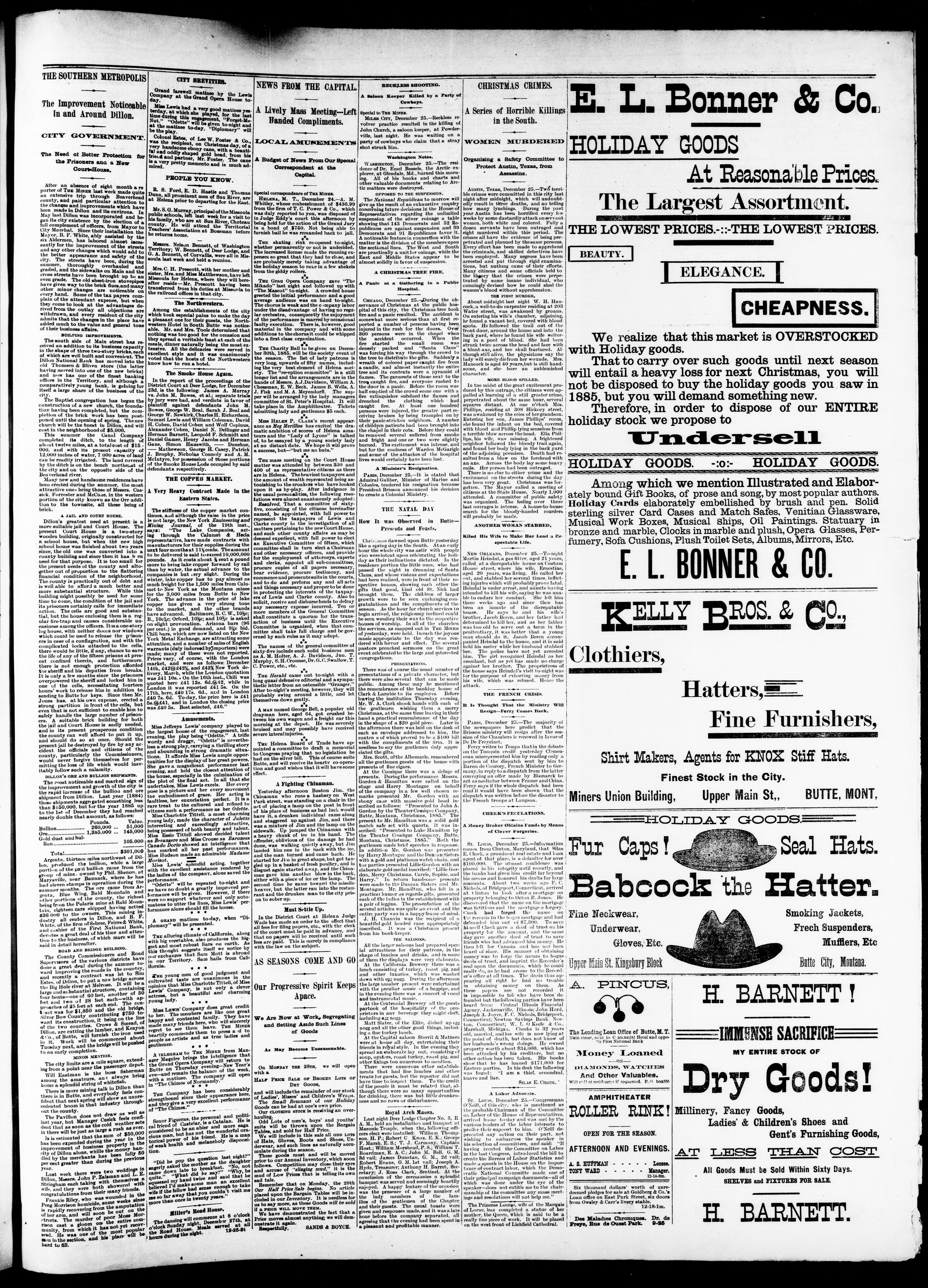
Butte's Semi-Weekly Miner for December 26, 1885, is far older than 95 years and in the public domain in its entirety. The scan below is the Library of Congress copy in Chronicling America, page two, column one. The crop runs the full length of the column, so the unrelated New Orleans report shows below the Austin story, and the citation and the Library's rights statement follow it.
The whole column is transcribed as it was set, the New Orleans item included, and none of it had to be marked illegible. Every slip stays in: "sti!l" with an exclamation point standing in for an i, "tne" for the, "Kiled," "hoase," "ssster," the New Orleans suspect spelled both Heindal and Heindel, and "bloody-handed murders" where murderers was meant. "Phillip" for Phillips is the paper's too.

Transcription
Transcribed word for word from the page scan. Original spelling, punctuation, capitalisation and typographical errors have been kept exactly as printed. Unreadable words are marked [illegible]. Nothing has been modernised or corrected.
CHRISTMAS CRIMES.
A Series of Horrible Killings in the South.
WOMEN MURDERED
Organizing a Safety Committee to Protect Austin, Texas, from Assassins.
AUSTIN, Texas, December 25.—Two terrible crimes were committed in this city last night after midnight, which will undoubtedly result in three deaths, and no telling how many lynchings. During the past year Austin has been horrified every few weeks by some dastardly attack on servant women, both white and colored. Fully a dozen servants have been outraged and eight murdered within this period. The crimes all have the evidence of being perpetrated and planned by the same persons. Every effort has been made to apprehend the criminals, and skilled detectives have been employed. Many negroes have been arrested and put through rigid examinations, but nothing came of their efforts. Many citizens and some officials held to the theory that the crimes were perpetrated by some insane individual, who cunningly devised how he could shed the women's blood without apprehension.
THE FIRST MURDER.
About midnight last night W. H. Hancock, a well-to-do carpenter residing at 203 Water street, was awakened by groans. On entering his wife's chamber, adjoining, he found a vacant bed, covered with blood spots. He followed the trail out of the front door, around the house and into the back yard, where he found his wife weltering in a pool of blood. She had been struck twice across the head and face with a blunt axe, and her skull fractured. Although sti!l alive, the physicians say the lady will surely die from her wounds. Mrs. Hancock is aged 40 years, but is still handsome, and she bore an unblemished character.
MORE BLOOD SPILLED.
In tne midst of the great excitement produced by this outrage, the citizens were appalled at learning of a still greater crime, perpetrated about the same hour, several squares distant. At one o'clock Mrs. Phillips, residing at 308 Hickory street, was awakened by the cries of her grandson. Entering her son, James Phillips' room, she found the infant on the bed, covered with blood and Phillip lying senseless from a terrible blow across the head. Ella Phillips, his wife, was missing. A frightened neighbor followed the bloody trail again, and found her body lying in the back yard of the adjoining premises. Death had resulted from a blow on the forehead with an axe. Across the body lay some heavy rails. Her person had been outraged.
There is no clue to either crime and the excitement on the streets during the day has been very great. Christmas was forgotten. The Mayor called a meeting of citizens at the State House. Nearly 1,000 attended. A committee of public safety was organized. The feeling over these last outrages is intense. A house-to-house search for the bloody-handed murders will probably be made.
ANOTHER WOMAN STABBED.
Kiled His Wife to Make Her Lead a Respectable Life.
NEW ORLEANS, December 25.—To-night Martin Heindal, a gas fitter, aged 21 years, called at a disreputable house on Custom House street, where his wife, Ernestine, aged 20 years, was living. He called her out, and stabbed her several times, inflicting injuries which will probably prove fatal. Heindal is under arrest, and admits having intended to kill his wife, saying he was unable to endure her conduct. She left him three weeks ago and since then has been an inmate of the disreputable hoase. He says he and his wife's brother, Jacob Beren, and her father had determined to kill her, and as her father was too old to serve out a term in the penitentiary, it was better that a young man should do it. Jacob Beren accompanied Heindel to the house, and it is said held his ssster while her husband stabbed her. The police have not yet arrested him. The girl recognized Heindal as her assailant, but as yet has made no charge against her brother. The proprietress of the house says Heindal's visit to-night was for the purpose of extorting money from his wife, which was refused. Hence the attack.