CARL PANZRAM DIES ON GALLOWS WITH SNEER ON HIS LIPS: THE WASHINGTON DAILY NEWS, SEPTEMBER 5, 1930
He had promised to curse the hangman, and he never got the chance. On the morning of September 5, 1930, Carl Panzram climbed the scaffold in a hidden corner of the federal penitentiary at Leavenworth, the black hood came down the moment he stepped onto it, and the trap fell at 6:01. The Washington Daily News had a particular interest in him: he had been sent to prison from the District of Columbia. It ran the United Press story that same day, starting on the front page and finishing on page six.
The wire reporter dwelt on the last night. Panzram turned away religious comfort and sent off two ministers. He sat in a cell stripped of its furniture, smoking without a break, reading continued serials in women's magazines, and said his one regret was that he would never learn how they ended. "I'll prance up those 13 steps like a blooded stallion," he said. "Are you sure the scaffold is strong enough?" His last request was for a full autopsy, which the paper took as fear of being buried alive. Outside, hidden machine guns covered the cellhouses.
The man he died for was the prison's laundry foreman, whom Panzram had come up behind with an iron bar and beaten until his skull broke. At his trial he had cursed the lawyer who tried to have him declared insane and asked for death. The story gives him the last word in his own voice, "I killed because I hate people," followed by the demand that society build him a monument for leaving no children, and then a closing line of its own: he claimed to have killed between 21 and 27 people, and none of it was verified.
This United Press story was filed within hours of the hanging and built partly from things Panzram had said earlier; the quotation about why he killed was not spoken on the scaffold. The paper names his victim Frank Warnke; the laundry foreman was Robert G. Warnke, killed on June 20, 1929. It has Panzram declared dead at 6:20; other accounts give 6:18, and some report a last remark to the hangman that this story says he never had time to make. Panzram was convicted of one murder, Warnke's. He confessed to twenty-one killings, of which only a handful have ever been corroborated, and the paper's twenty-seven, like the eight men drowned from a capsized boat, is his own unproved boast.
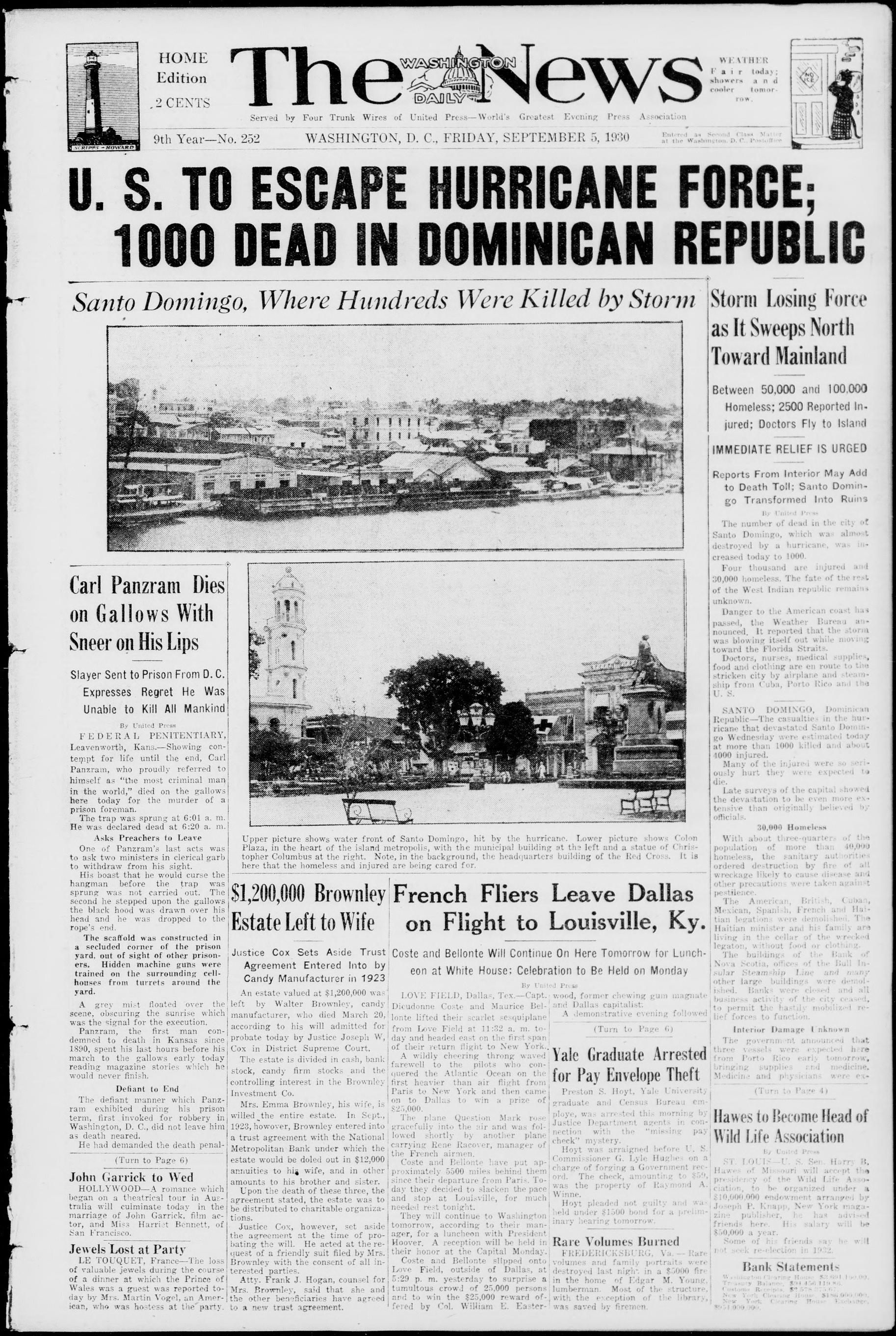
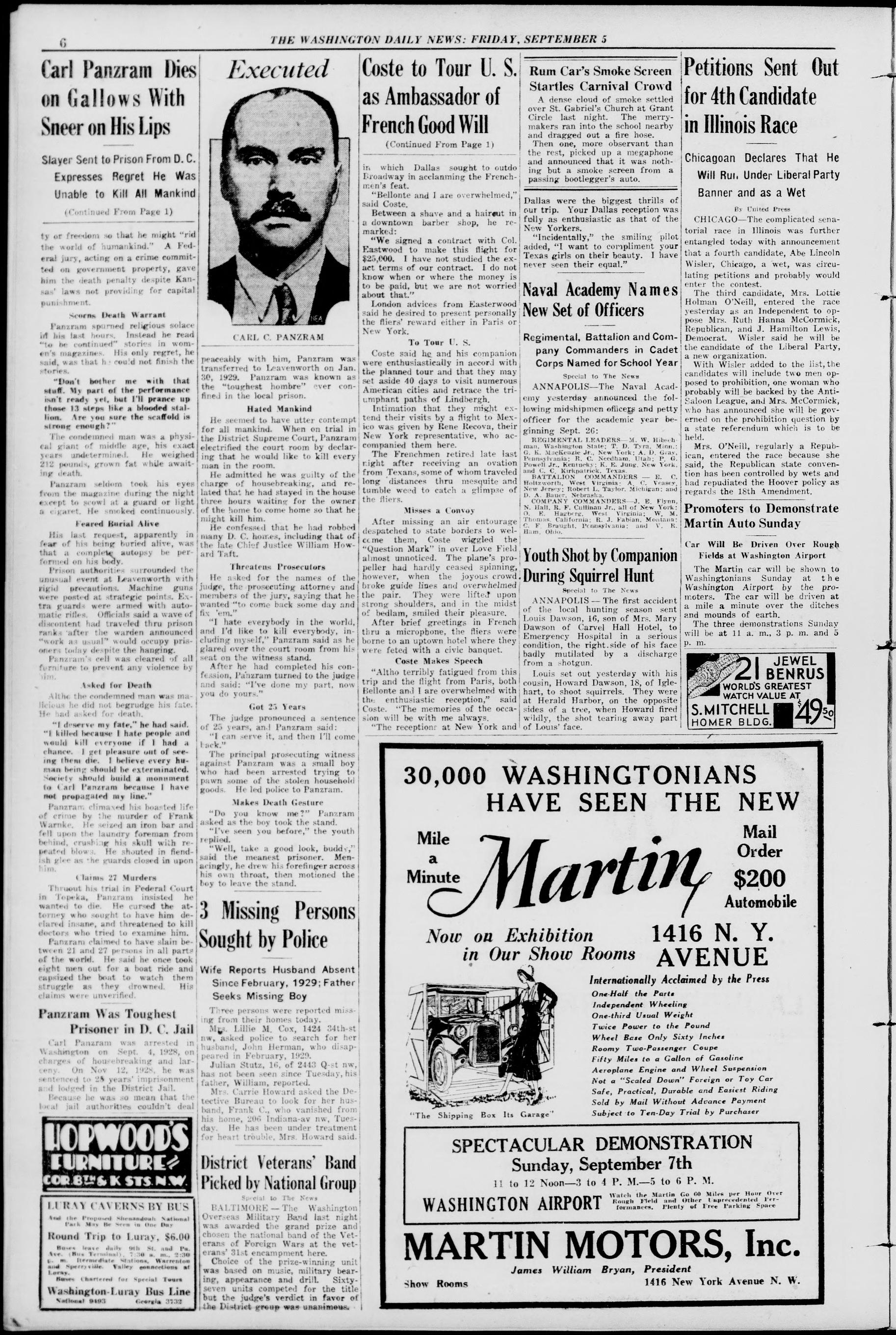
Both pages come from the September 5, 1930, issue of The Washington Daily News, published more than ninety-five years ago and in the public domain in full. The scans are the Library of Congress copies in Chronicling America, one for page one and one for page six, each with its citation and the Library's rights statement.
The story jumps, and both halves are here: the front-page column, which breaks off mid-word at "penal-," and the page-six continuation that picks it up under the repeated headline. Page one is crisp; page six is lightly and patchily inked but every word was read under magnification, so there are no illegible marks. The paper's forms stand as printed, among them "cigaret," "thru," "Thruout," "Altho" and "grey." A separate page-six sidebar on Panzram in the District jail, with a portrait, is a different article and was not transcribed.

Transcription
Transcribed word for word from the page scans. Original spelling, punctuation, capitalisation and typographical errors have been kept exactly as printed. Unreadable words are marked [illegible]. Nothing has been modernised or corrected.
PAGE ONE
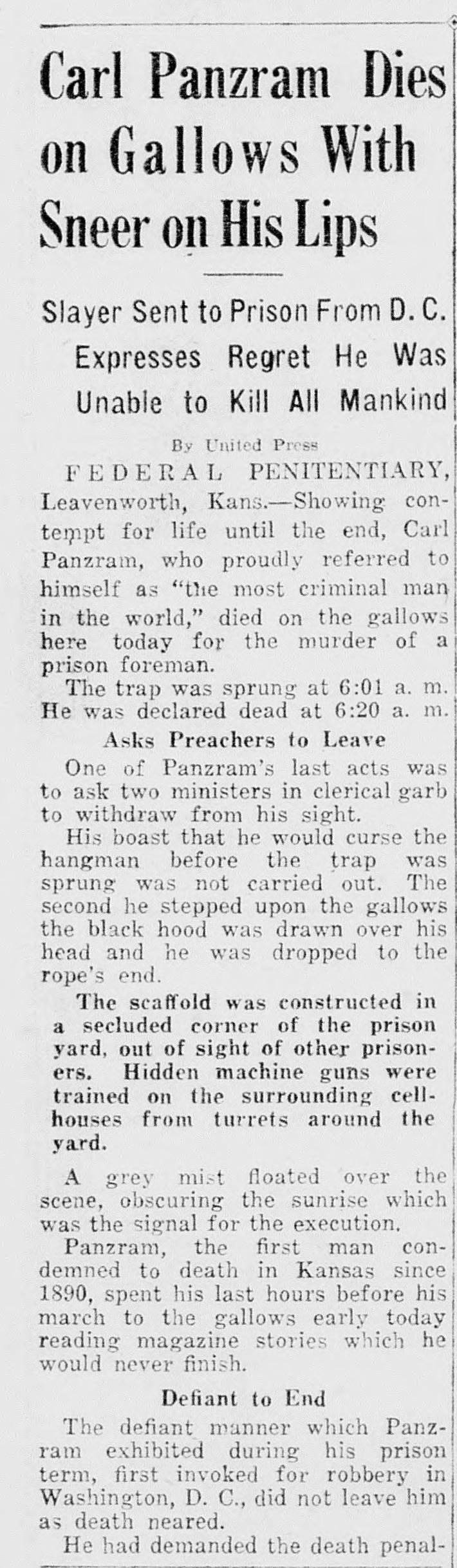
Carl Panzram Dies on Gallows With Sneer on His Lips
Slayer Sent to Prison From D. C. Expresses Regret He Was Unable to Kill All Mankind
By United Press
FEDERAL PENITENTIARY, Leavenworth, Kans.—Showing contempt for life until the end, Carl Panzram, who proudly referred to himself as "the most criminal man in the world," died on the gallows here today for the murder of a prison foreman.
The trap was sprung at 6:01 a. m. He was declared dead at 6:20 a. m.
Asks Preachers to Leave
One of Panzram's last acts was to ask two ministers in clerical garb to withdraw from his sight.
His boast that he would curse the hangman before the trap was sprung was not carried out. The second he stepped upon the gallows the black hood was drawn over his head and he was dropped to the rope's end.
The scaffold was constructed in a secluded corner of the prison yard, out of sight of other prisoners. Hidden machine guns were trained on the surrounding cellhouses from turrets around the yard.
A grey mist floated over the scene, obscuring the sunrise which was the signal for the execution.
Panzram, the first man condemned to death in Kansas since 1890, spent his last hours before his march to the gallows early today reading magazine stories which he would never finish.
Defiant to End
The defiant manner which Panzram exhibited during his prison term, first invoked for robbery in Washington, D. C., did not leave him as death neared.
He had demanded the death penal-
(Turn to Page 6)
PAGE SIX
Carl Panzram Dies on Gallows With Sneer on His Lips
Slayer Sent to Prison From D. C. Expresses Regret He Was Unable to Kill All Mankind
(Continued From Page 1)
ty or freedom so that he might "rid the world of humankind." A Federal jury, acting on a crime committed on government property, gave him the death penalty despite Kansas' laws not providing for capital punishment.
Scorns Death Warrant
Panzram spurned religious solace in his last hours. Instead he read "to be continued" stories in women's magazines. His only regret, he said, was that he could not finish the stories.
"Don't bother me with that stuff. My part of the performance isn't ready yet, but I'll prance up those 13 steps like a blooded stallion. Are you sure the scaffold is strong enough?"
The condemned man was a physical giant of middle age, his exact years undetermined. He weighed 212 pounds, grown fat while awaiting death.
Panzram seldom took his eyes from the magazine during the night except to scowl at a guard or light a cigaret. He smoked continuously.
Feared Burial Alive
His last request, apparently in fear of his being buried alive, was that a complete autopsy be performed on his body.
Prison authorities surrounded the unusual event at Leavenworth with rigid precautions. Machine guns were posted at strategic points. Extra guards were armed with automatic rifles. Officials said a wave of discontent had traveled thru prison ranks after the warden announced "work as usual" would occupy prisoners today despite the hanging.
Panzram's cell was cleared of all furniture to prevent any violence by him.
Asked for Death
Altho the condemned man was malicious he did not begrudge his fate. He had asked for death.
"I deserve my fate," he had said. "I killed because I hate people and would kill everyone if I had a chance. I get pleasure out of seeing them die. I believe every human being should be exterminated. Society should build a monument to Carl Panzram because I have not propagated my line."
Panzram climaxed his boasted life of crime by the murder of Frank Warnke. He seized an iron bar and fell upon the laundry foreman from behind, crushing his skull with repeated blows. He shouted in fiendish glee as the guards closed in upon him.
Claims 27 Murders
Thruout his trial in Federal Court in Topeka, Panzram insisted he wanted to die. He cursed the attorney who sought to have him declared insane, and threatened to kill doctors who tried to examine him.
Panzram claimed to have slain between 21 and 27 persons in all parts of the world. He said he once took eight men out for a boat ride and capsized the boat to watch them struggle as they drowned. His claims were unverified.
Transcriber's notes
- Readability: page one excellent; the page six continuation is fair to good — the inking there is light and patchy in places, but every word was legible at magnification. No [illegible] markers were needed.
- Kept as printed: "cigaret", "thru", "Thruout", "Altho", "grey", "13 steps", and the paper's spelling of the victim as Frank Warnke (other accounts give Warnke and Warnke/Wernke variously).
- The story jumps from page one to page six, where the headline and deck are repeated above "(Continued From Page 1)". Both parts are transcribed above, in order, and both pages are supplied as scans.
- Page six carries a separate, related sidebar headed "Panzram Was Toughest Prisoner in D. Jail", with a portrait captioned CARL C. PANZRAM, which continues into the next column. That sidebar is a second article and is not transcribed here; it is visible in the page six full-page scan.