BUNDY VERDICT 'GUILTY': THE HERALD JOURNAL, MARCH 2, 1976
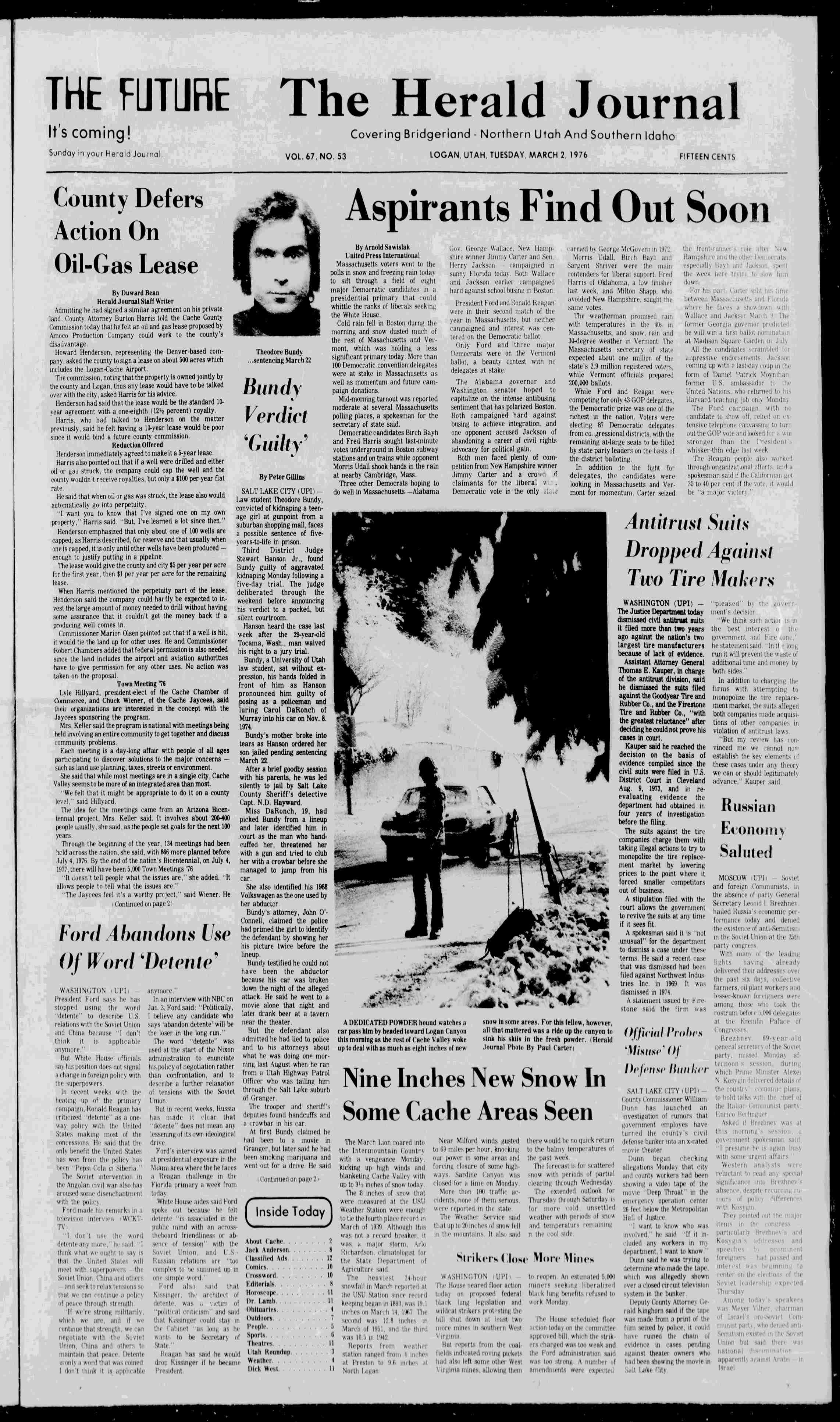
Ted Bundy's first conviction came from a judge, not a jury, and it came for a woman who got away. On Monday, March 1, 1976, after deliberating through the weekend, Third District Judge Stewart Hanson Jr. told a packed and silent courtroom in Salt Lake City that the University of Utah law student was guilty of aggravated kidnapping. The next day The Herald Journal in Logan ran Peter Gillins's United Press International story on its front page, under a photograph captioned with his sentencing date, March 22. Bundy, who had waived a jury, sat with his hands folded and no expression at all. His mother broke into tears.
The crime was the evening of November 8, 1974. A man posing as a policeman had lured Carol DaRonch of Murray from a suburban shopping mall into his Volkswagen, handcuffed her, threatened her with a gun and tried to club her with a crowbar before she jumped from the car. She picked Bundy out of a lineup, pointed to him in court and identified his 1968 Volkswagen. His lawyer, John O'Connell, said the police had primed her by showing her Bundy's picture twice before the lineup. Bundy testified that his car had been broken down that night, and that he had gone to a movie alone and then drunk beer near the theater.
His own words hurt him too. He admitted on the stand that he had lied to the police and to his lawyers about the morning the previous August when he ran from a Utah Highway Patrol trooper in the suburb of Granger, where handcuffs and a crowbar turned up in his car. First it was a movie; later, marijuana and a drive. The jump on page two reaches past the verdict. For a year the sheriff's office had tied the DaRonch case to three other local abductions, two young women found dead and one still missing, and detectives from Washington, Colorado and California had come to look at him. "The turning point was when you people started bringing in other cases," O'Connell told reporters.
The story was filed the day of the verdict and is a wire report, not a court record; the other abductions it mentions were suspicions at the time, not charges. It puts the possible sentence at five years to life, and Bundy was sentenced to one to fifteen. The trooper in Granger, unnamed here, was Sgt. Bob Hayward of the Utah Highway Patrol, not the sheriff's detective the paper calls Capt. N.D. Hayward. This kidnapping was the only crime any state but Florida ever convicted him of. Colorado charged him in October 1976 with the murder of Caryn Campbell, and he escaped twice from custody there. In Florida he was convicted of murdering Margaret Bowman, Lisa Levy and twelve-year-old Kimberly Leach, and he was electrocuted on January 24, 1989.
Peter Gillins wrote the story for United Press International, and The Herald Journal of Logan, Utah, printed it on March 2, 1976, with the credit "(UPI)" after his byline. The scans of both pages come from Utah Digital Newspapers, held by the J. Willard Marriott Library at the University of Utah, whose rights field for this issue is "No Copyright - United States (NoC-US)." The issue was published before 1978, when an American publication needed a copyright notice to stay in copyright; no notice appears on its masthead or on this story. Beneath the scans are the citation and the library's rights statement.
Page one and its continuation on page two were both transcribed, word for word, and no word was illegible. On page two the jump has its own headline, "Judge Says Bundy Guilty, Kidnaping," and two words there, "those" and "ever," have broken type and are set as the words intended. The paper's slips stand as printed: "Tocama, Wash." for Tacoma, a period in "Nov. 8. 1974," a stray comma in "Jr., found," "goodby," the single-p "kidnaping" of the period, and "his clients conviction" with no apostrophe.

Transcription
Transcribed word for word from the page scans. Original spelling, punctuation, capitalisation and typographical errors have been kept exactly as printed. Unreadable words are marked [illegible]. Nothing has been modernised or corrected.
Page 1
[Photo caption] Theodore Bundy ...sentencing March 22
Bundy Verdict 'Guilty'
By Peter Gillins
SALT LAKE CITY (UPI) — Law student Theodore Bundy, convicted of kidnaping a teenage girl at gunpoint from a suburban shopping mall, faces a possible sentence of five-years-to-life in prison.
Third District Judge Stewart Hanson Jr., found Bundy guilty of aggravated kidnaping Monday following a five-day trial. The judge deliberated through the weekend before announcing his verdict to a packed, but silent courtroom.
Hanson heard the case last week after the 29-year-old Tocama, Wash., man waived his right to a jury trial.
Bundy, a University of Utah law student, sat without expression, his hands folded in front of him as Hanson pronounced him guilty of posing as a policeman and luring Carol DaRonch of Murray into his car on Nov. 8. 1974.
Bundy's mother broke into tears as Hanson ordered her son jailed pending sentencing March 22.
After a brief goodby session with his parents, he was led silently to jail by Salt Lake County Sheriff's detective Capt. N.D. Hayward.
Miss DaRonch, 19, had picked Bundy from a lineup and later identified him in court as the man who handcuffed her, threatened her with a gun and tried to club her with a crowbar before she managed to jump from his car.
She also identified his 1968 Volkswagen as the one used by her abductor.
Bundy's attorney, John O'Connell, claimed the police had primed the girl to identify the defendant by showing her his picture twice before the lineup.
Bundy testified he could not have been the abductor because his car was broken down the night of the alleged attack. He said he went to a movie alone that night and later drank beer at a tavern near the theater.
But the defendant also admitted he had lied to police and to his attorneys about what he was doing one morning last August when he ran from a Utah Highway Patrol Officer who was tailing him through the Salt Lake suburb of Granger.
The trooper and sheriff's deputies found handcuffs and a crowbar in his car.
At first Bundy claimed he had been to a movie in Granger, but later said he had been smoking marijuana and went out for a drive. He said
(Continued on page 2)
Page 2
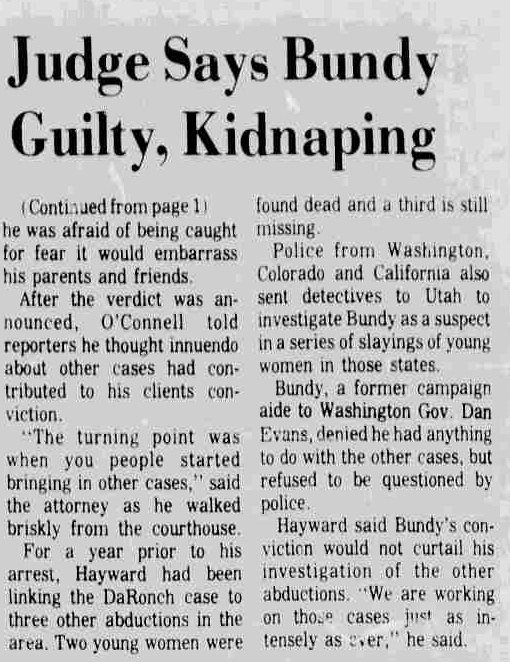
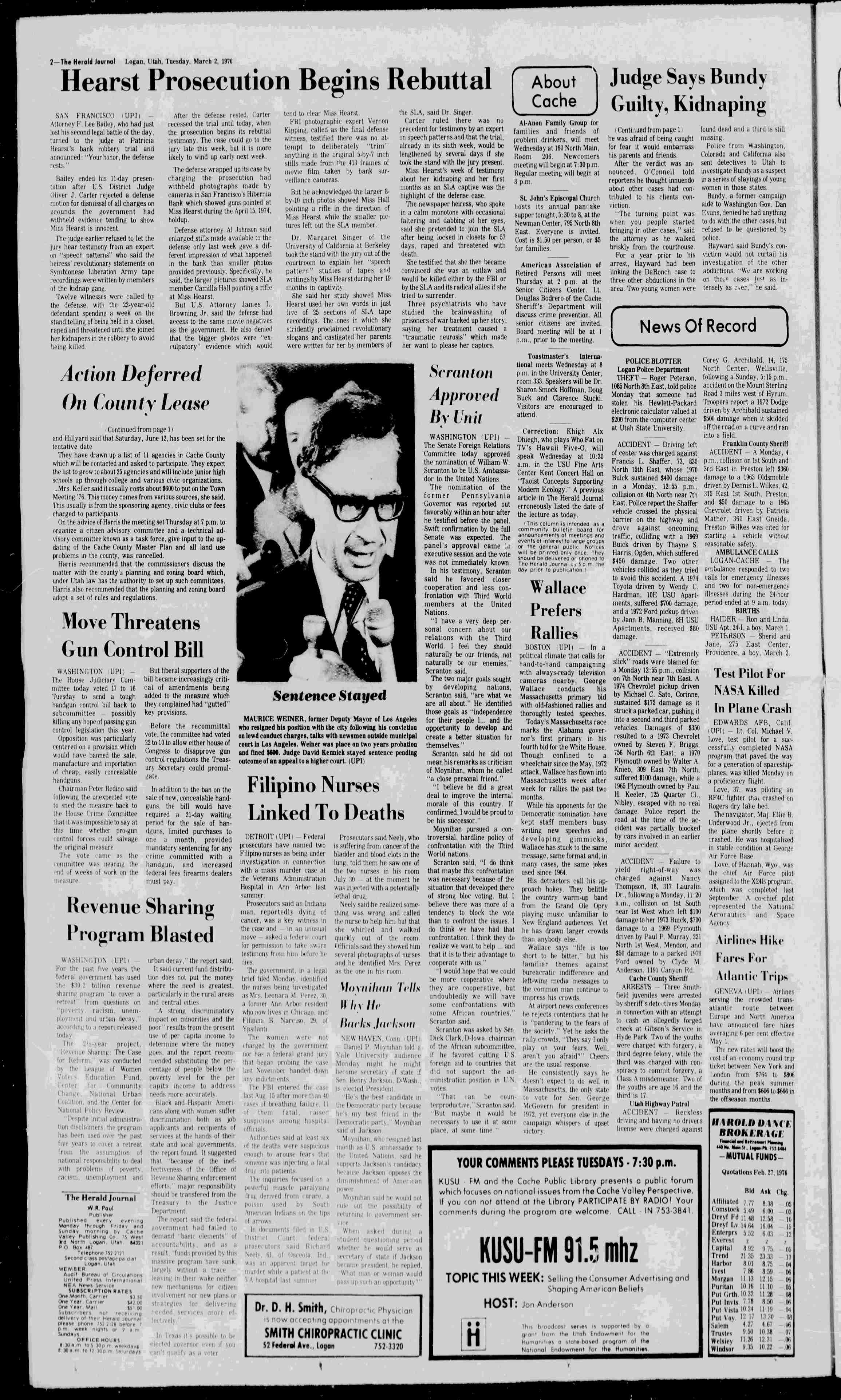
Judge Says Bundy Guilty, Kidnaping
(Continued from page 1)
he was afraid of being caught for fear it would embarrass his parents and friends.
After the verdict was announced, O'Connell told reporters he thought innuendo about other cases had contributed to his clients conviction.
"The turning point was when you people started bringing in other cases," said the attorney as he walked briskly from the courthouse.
For a year prior to his arrest, Hayward had been linking the DaRonch case to three other abductions in the area. Two young women were found dead and a third is still missing.
Police from Washington, Colorado and California also sent detectives to Utah to investigate Bundy as a suspect in a series of slayings of young women in those states.
Bundy, a former campaign aide to Washington Gov. Dan Evans, denied he had anything to do with the other cases, but refused to be questioned by police.
Hayward said Bundy's conviction would not curtail his investigation of the other abductions. "We are working on those cases just as intensely as ever," he said.
Notes, kept as printed: "Tocama" for Tacoma; "Nov. 8. 1974" with a full stop; "Jr., found" with a comma; "goodby"; "kidnaping"; "his clients conviction" without an apostrophe; "Officer" capitalised. The page-1 headline and photograph sit in column 2 above the story. On page 2 the jump carries its own headline, "Judge Says Bundy Guilty, Kidnaping". "those" and "ever" have broken letters in the page-2 scan and are set as the intended words. No words were illegible.