BOY TOOK TO SCIENCE OF POISON; NOW, LIFE IN JAIL: THE HERALD JOURNAL, JUNE 30, 1972
The United Press International story that reached Logan, Utah, from London on June 30, 1972, opened like a fable: "Graham Young's school friends spent their money on candy and comics. He spent his on poison." The Herald Journal ran it on page 12, a day after a jury had found Graham Frederick Young guilty of murdering two of his workmates. The wire writer went back to 1962 to explain him, to a bookish fourteen-year-old in the London suburb of Neasden who spent hours over toxicology books in the public library and tried out poisons he made at home from chemicals bought with his pocket money.
Then, the paper says, he turned to people. He laced the family's food with antimony, and his father, his sister and his stepmother fell sick. The doctor could not account for it until the boy's chemistry teacher said he was bringing poisons to school. His stepmother died soon afterward; doctors said poison was not the cause, but Young claimed the credit anyway. He was sent to Broadmoor, and in February 1971 he came out, pronounced "completely cured." He took a job at John Hadland, Ltd., a camera firm not far from home, and said nothing about where he had been.
His workmates knew him as a loner who talked about poisons and was "always eager to make tea for the staff." Robert Egle, the chief warehouseman, died within two months of his arrival. Frederick Biggs died soon after, and other men fell ill with the same vomiting until a pathologist found thallium. At Young's home police found a diary setting down how he had laced the tea. The verdict covered the two dead men and two attempted murders, and the sentence was life. He was twenty-four.
This UPI wire story, not a court record, differs from the case record in several places. It gives Bob Egle's age as 60 and Fred Biggs's as 56; the record gives 59 and 60. It says he served nine years of a 15-year Broadmoor term; he was released after eight. The 1962 case concerned his father, his sister and a school friend; nothing proved he caused his stepmother's death, and the paper itself says doctors ruled poison out. It was Young himself, asking the works doctor why thallium had not been considered, who sent the doctor to the police. At St Albans on June 29, 1972, he was convicted of two murders, two attempted murders and two counts of administering poison.
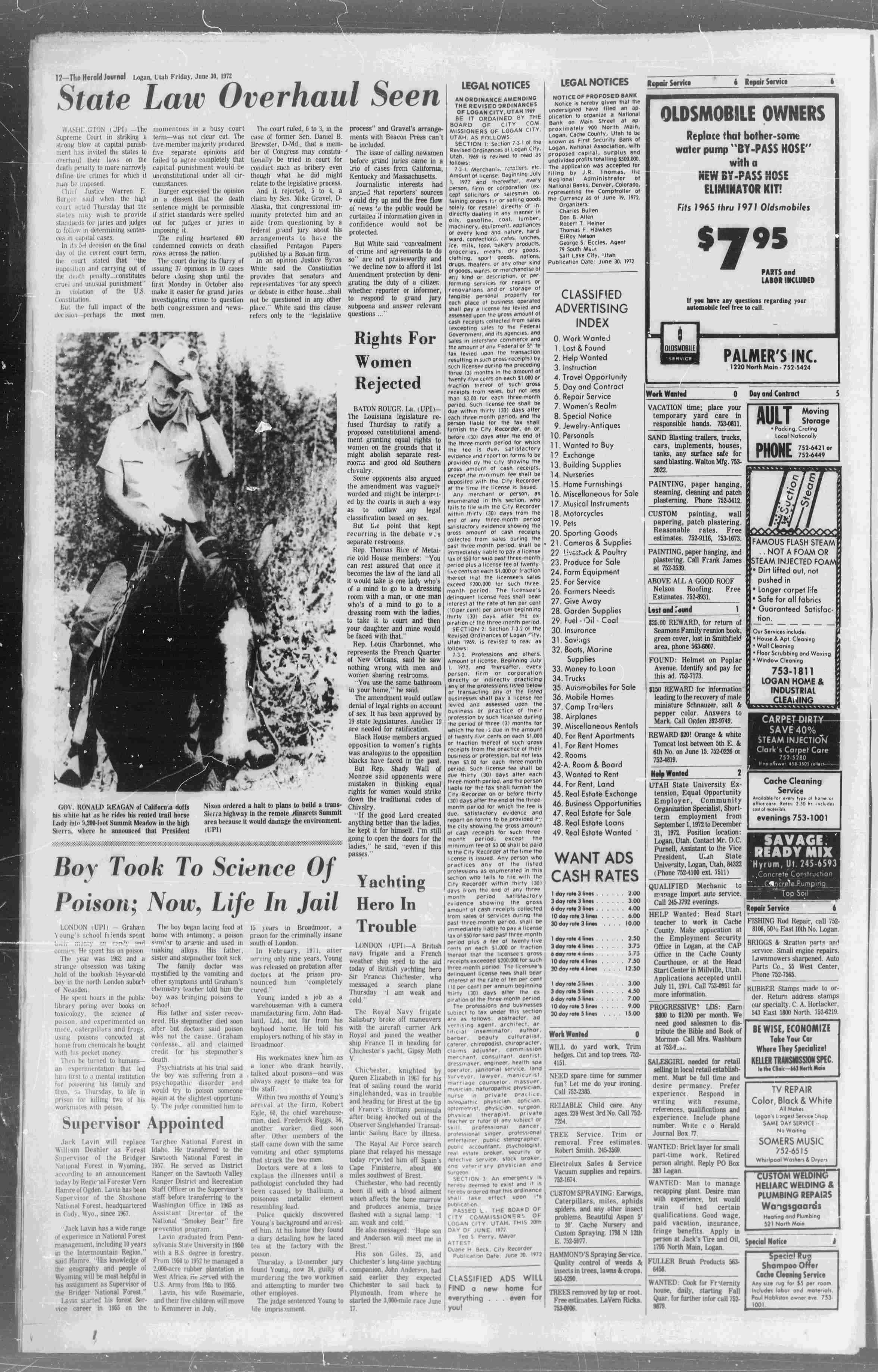
The Herald Journal, Logan, Utah, printed this unbylined UPI story on June 30, 1972. The scan is from Utah Digital Newspapers, the newspaper collection of the J. Willard Marriott Library at the University of Utah, which rates the issue "No Copyright - United States" in its item-level rights field. The issue was published when American works needed a copyright notice, and none appears anywhere in its fourteen pages, on this story or on anything else. The citation and the library's rights statement are given under the scan.
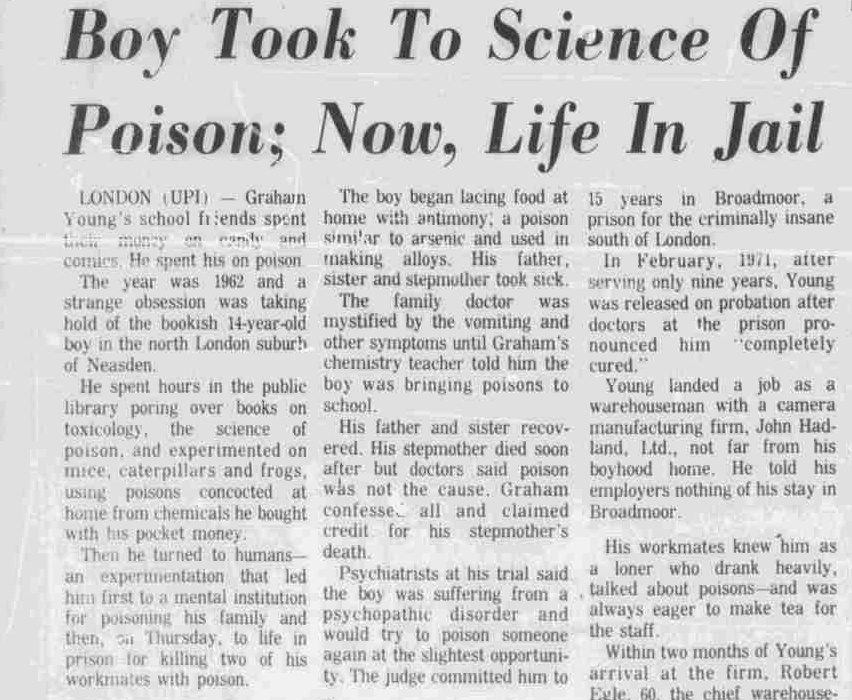
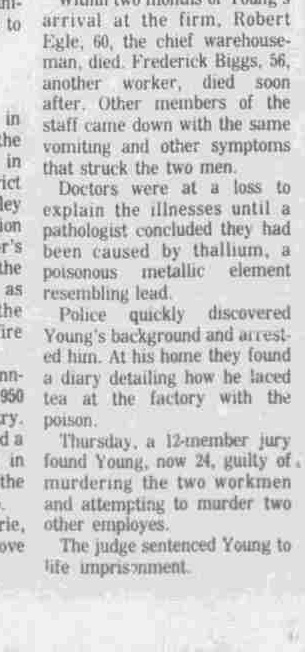
The story is L-shaped on the page: its first two columns stop above an unrelated item headed "Supervisor Appointed," while the third runs on down the page, so it is shown in two pieces, the headline with the tops of all three columns and then the rest of the third. The neighboring story in the fourth column is not part of it. The third line of the story is badly faded, but the surviving letter shapes support the reading given. "Employes" and "15 years in Broadmoor" stand as printed, and nothing was illegible.
Transcription
Transcribed word for word from the page scan. Original spelling, punctuation, capitalisation and typographical errors have been kept exactly as printed. Unreadable words are marked [illegible]. Nothing has been modernised or corrected.
Boy Took To Science Of Poison; Now, Life In Jail
LONDON (UPI) — Graham Young's school friends spent their money on candy and comics. He spent his on poison.
The year was 1962 and a strange obsession was taking hold of the bookish 14-year-old boy in the north London suburb of Neasden.
He spent hours in the public library poring over books on toxicology, the science of poison, and experimented on mice, caterpillars and frogs, using poisons concocted at home from chemicals he bought with his pocket money.
Then he turned to humans—an experimentation that led him first to a mental institution for poisoning his family and then, on Thursday, to life in prison for killing two of his workmates with poison.
The boy began lacing food at home with antimony, a poison similar to arsenic and used in making alloys. His father, sister and stepmother took sick.
The family doctor was mystified by the vomiting and other symptoms until Graham's chemistry teacher told him the boy was bringing poisons to school.
His father and sister recovered. His stepmother died soon after but doctors said poison was not the cause. Graham confessed all and claimed credit for his stepmother's death.
Psychiatrists at his trial said the boy was suffering from a psychopathic disorder and would try to poison someone again at the slightest opportunity. The judge committed him to 15 years in Broadmoor, a prison for the criminally insane south of London.
In February, 1971, after serving only nine years, Young was released on probation after doctors at the prison pronounced him "completely cured."
Young landed a job as a warehouseman with a camera manufacturing firm, John Hadland, Ltd., not far from his boyhood home. He told his employers nothing of his stay in Broadmoor.
His workmates knew him as a loner who drank heavily, talked about poisons—and was always eager to make tea for the staff.
Within two months of Young's arrival at the firm, Robert Egle, 60, the chief warehouseman, died. Frederick Biggs, 56, another worker, died soon after. Other members of the staff came down with the same vomiting and other symptoms that struck the two men.
Doctors were at a loss to explain the illnesses until a pathologist concluded they had been caused by thallium, a poisonous metallic element resembling lead.
Police quickly discovered Young's background and arrested him. At his home they found a diary detailing how he laced tea at the factory with the poison.
Thursday, a 12-member jury found Young, now 24, guilty of murdering the two workmen and attempting to murder two other employes.
The judge sentenced Young to life imprisonment.
Notes: "employes" as printed. The third line of the story ("their money on candy and") is badly faded in the scan; the reading is supported by the surviving letter shapes and the next line, and is not marked [illegible]. "15 years in Broadmoor" is as printed (he was in fact given a minimum of 15 years). The story is L-shaped: columns 1 and 2 stop above "Supervisor Appointed", while column 3 runs down the page. So it is supplied as ARTICLE-CROP.jpg (the headline and the tops of all three columns) and ARTICLE-CROP-PART-2.jpg (the rest of column 3). The neighbouring Chichester story in column 4 is not part of the article. No words were illegible.