BONES OF FIFTH VICTIM DUG UP AT LONDON'S 'HOUSE OF HORRORS': EVENING STAR, MARCH 29, 1953
Four days after the first bodies came out of the walls at 10 Rillington Place, the detectives were digging in the garden, and on the afternoon of March 28, 1953, they found more. A foot under a yellow forsythia bush, in an ashcan lid, lay charred human bones they believed were a woman's. The Associated Press filed the story from London that day, and Washington's Evening Star printed it on March 29. John Reginald Christie, the clerk who had lived in the ground-floor flat, was still missing, and Scotland Yard wanted him only "for questioning."
The dispatch catches the case before anyone knew its shape. Four women had been found inside the house, hidden behind a wall and under a floor, and one of them was Christie's wife. The new bones had been burned, which the police took as an attempt to get rid of the body, and nobody could say how long they had been in the ground. Detectives dug up pieces of cloth and two bottles, carried off the bush itself for clues, combed the Missing Persons Bureau file for a name, and ran down a report that a man of Christie's description had spent a night in a cheap lodging house, where a suitcase of his clothes had turned up.
Scotland Yard, the paper says, put every available detective on the case and feared the count would climb. It did. The garden held the remains of two women, not one: Ruth Fuerst, a twenty-one-year-old Austrian munitions worker killed in 1943, and Muriel Eady, a thirty-one-year-old who had worked alongside Christie at a radio factory in Acton, killed in 1944. His confession to both, in June, helped the police put names to the bones. Three days after this story ran, a constable stopped Christie on the embankment near Putney Bridge and asked him who he was.
This is wire copy written while Christie was a fugitive and before any charge, and it reports what the police feared that weekend, not what a court found. He was tried only for the murder of his wife, Ethel, and hanged at Pentonville on July 15, 1953. Eight people were killed at the house in all, among them Beryl Evans and her baby, Geraldine; Timothy Evans was hanged for Geraldine's murder in 1950 and pardoned in 1966. The paper makes Christie fifty-five; he was fifty-three. Its line that three of the women were "well known in the night spots of the district" is the paper's: Rita Nelson was visiting her sister from Belfast, and Hectorina MacLennan had no record of any kind.
Because this issue dates from 1953, it falls short of the ninety-five years that put American newspapers wholly in the public domain. The Library of Congress believes it is public domain too, but cautions that papers of this age may contain some copyrighted third-party material, and this story carries an Associated Press credit, which makes it syndicated wire copy; no copyright notice is printed on it. The scan below is the Library's Chronicling America copy, with the citation and rights statement attached.
The dispatch was copied word for word from the scan, and the type was clear enough that nothing is marked illegible. The paper's slips stay in: "expresed" for expressed in the second paragraph, a capital M on "Macabre," a lowercase p in "Rillington place," and "20's" in the last line. Where the column breaks partway through the sentence naming Christie, the text runs on without a gap, because no words are lost at the break.
Transcription
Transcribed word for word from the page scan. Original spelling, punctuation, capitalisation and typographical errors have been kept exactly as printed. Unreadable words are marked [illegible]. Nothing has been modernised or corrected.
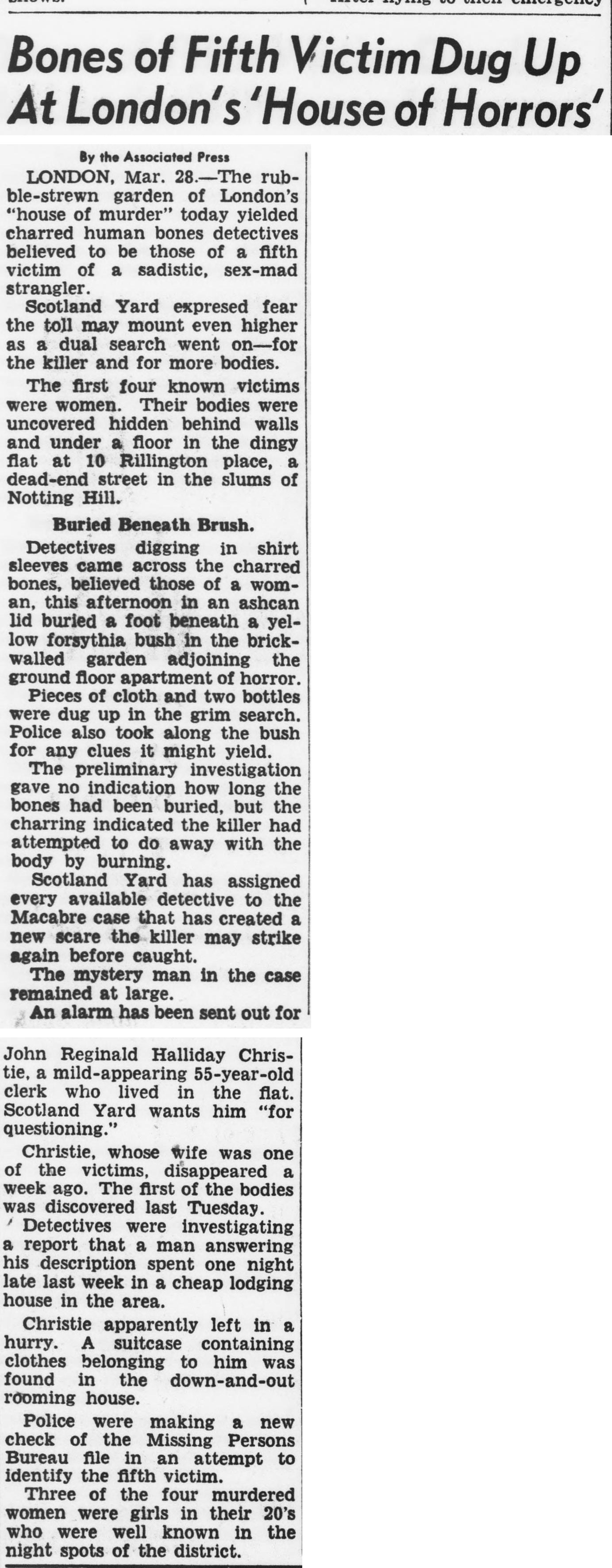
Bones of Fifth Victim Dug Up At London's 'House of Horrors'
By the Associated Press
LONDON, Mar. 28.—The rubble-strewn garden of London's "house of murder" today yielded charred human bones detectives believed to be those of a fifth victim of a sadistic, sex-mad strangler.
Scotland Yard expresed fear the toll may mount even higher as a dual search went on—for the killer and for more bodies.
The first four known victims were women. Their bodies were uncovered hidden behind walls and under a floor in the dingy flat at 10 Rillington place, a dead-end street in the slums of Notting Hill.
Buried Beneath Brush.
Detectives digging in shirt sleeves came across the charred bones, believed those of a woman, this afternoon in an ashcan lid buried a foot beneath a yellow forsythia bush in the brick-walled garden adjoining the ground floor apartment of horror.
Pieces of cloth and two bottles were dug up in the grim search. Police also took along the bush for any clues it might yield.
The preliminary investigation gave no indication how long the bones had been buried, but the charring indicated the killer had attempted to do away with the body by burning.
Scotland Yard has assigned every available detective to the Macabre case that has created a new scare the killer may strike again before caught.
The mystery man in the case remained at large.
An alarm has been sent out for John Reginald Halliday Christie, a mild-appearing 55-year-old clerk who lived in the flat. Scotland Yard wants him "for questioning."
Christie, whose wife was one of the victims, disappeared a week ago. The first of the bodies was discovered last Tuesday.
Detectives were investigating a report that a man answering his description spent one night late last week in a cheap lodging house in the area.
Christie apparently left in a hurry. A suitcase containing clothes belonging to him was found in the down-and-out rooming house.
Police were making a new check of the Missing Persons Bureau file in an attempt to identify the fifth victim.
Three of the four murdered women were girls in their 20's who were well known in the night spots of the district.