BLUEBEARD HOCH HANGED: HOLBROOK ARGUS, FEBRUARY 24, 1906
Johann Hoch made the State of Illinois wait for him to the last minute the law allowed. He had been respited three times. When his final appeal to the federal court was turned down, he gave up hope of escaping the rope, but his sentence allowed the hanging at any time between ten in the morning and two in the afternoon of February 23, 1906, and he asked to be allowed to live until 1:30. The request was granted. He ordered a hearty dinner and ate it. At 1:34 the trap fell in the Cook County jail.
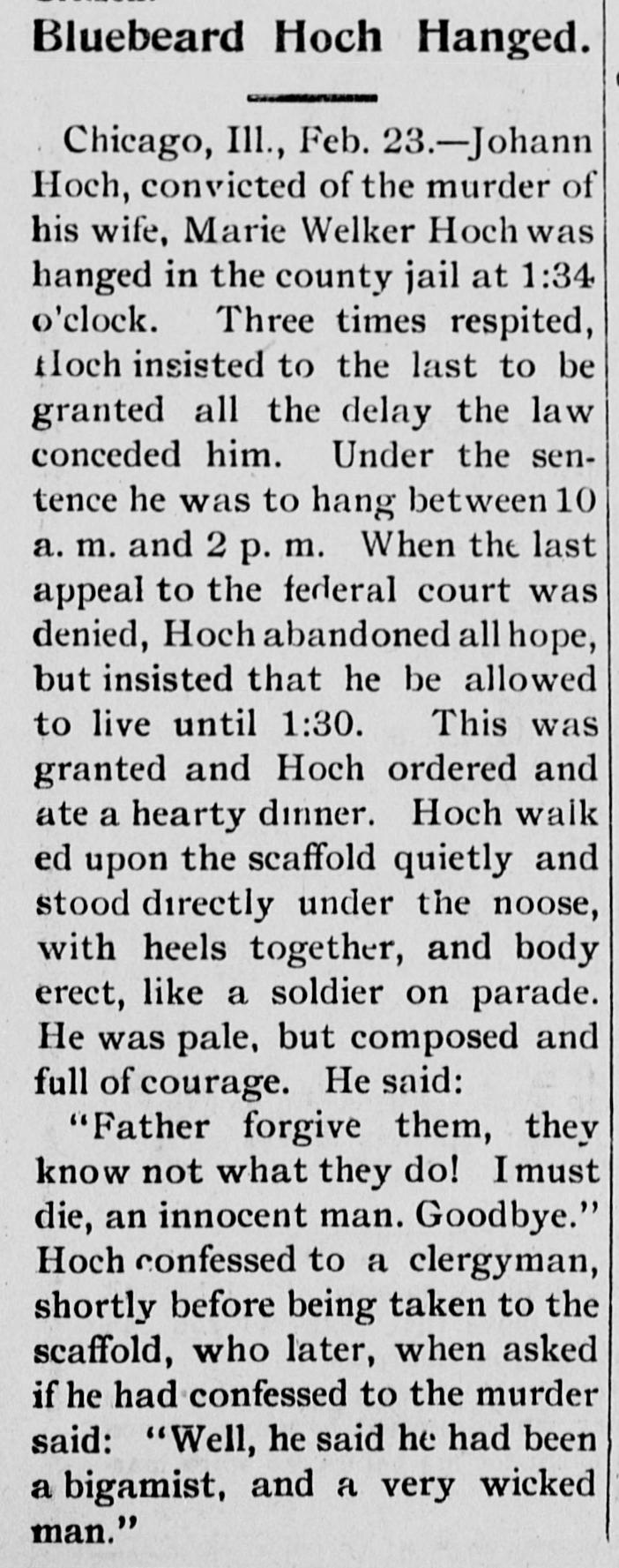
The Holbrook Argus, a weekly in the Arizona Territory, carried the wire report the next day under a headline that used the name the newspapers had given him: "Bluebeard Hoch Hanged." It describes him standing under the noose with his heels together, "like a soldier on parade," pale and composed, and it gives his last words in full: "Father forgive them, they know not what they do! I must die, an innocent man. Goodbye."
The final sentence carries more weight than everything before it. A clergyman had heard Hoch's confession shortly before he was taken to the scaffold, and when someone asked him afterward whether Hoch had confessed to the murder, he answered only this: "Well, he said he had been a bigamist, and a very wicked man." In a case made of serial marriages and arsenic, that is exactly the line Hoch drew at the end: the weddings he would own, the poisoning he would not.
This is a short wire item reprinted far from Chicago, and it reports what was said at the jail without testing any of it. It calls his wife Marie Welker Hoch; she appears elsewhere as Marie Walcker, and other papers that week gave her name in still other forms. Hoch was convicted of one murder, hers, in May 1905. The clergyman's answer, as the paper prints it, is the only account here of what he confessed, and it comes secondhand.
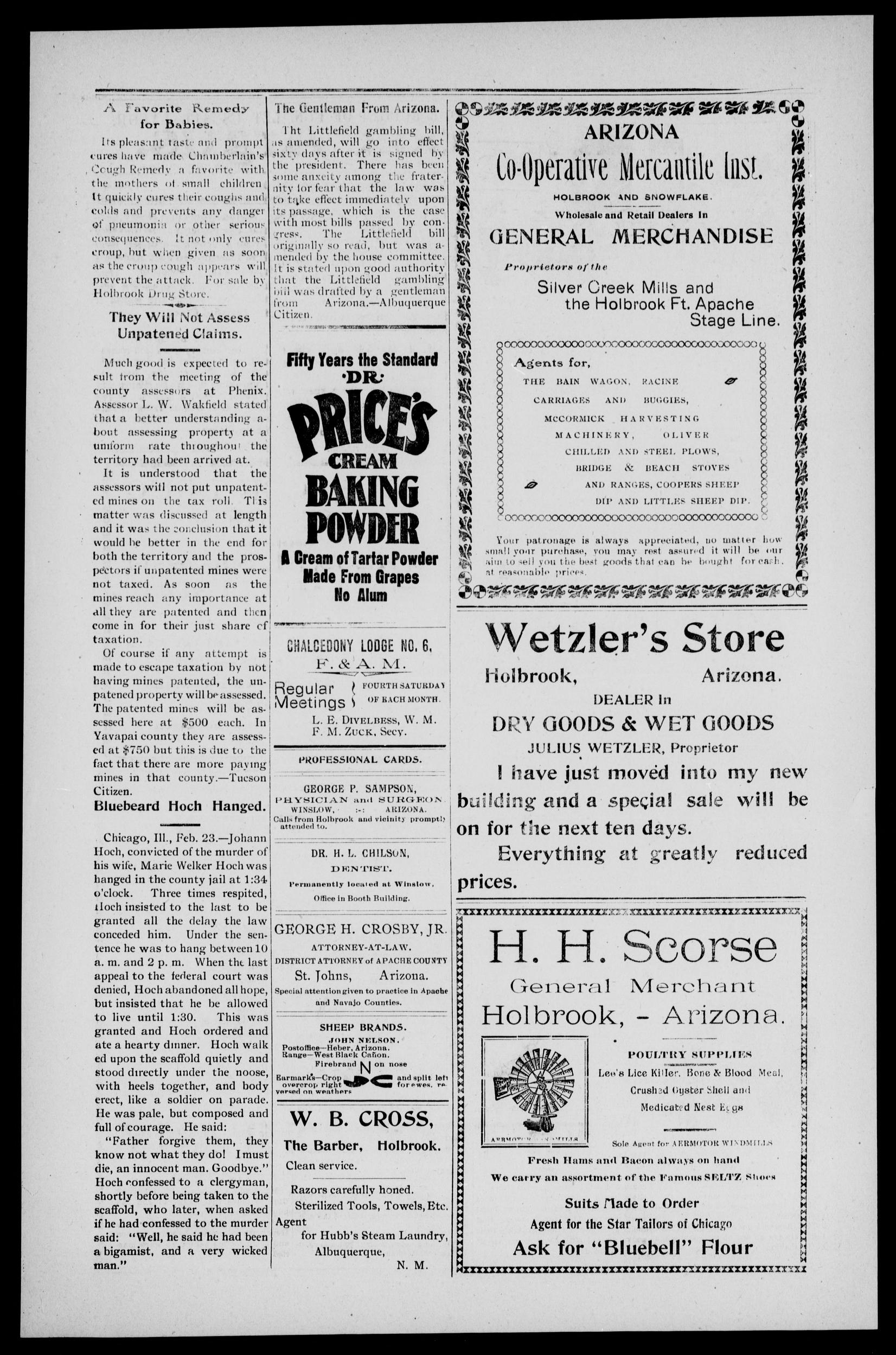
The Holbrook Argus for February 24, 1906, is in the public domain. The scan is the Library of Congress copy in Chronicling America, and its citation and rights statement are given in full under the scan.
The page is well preserved and the type is large, so the transcription below is complete and needed no illegible marks. It keeps the paper's text exactly: the missing comma after "Marie Welker Hoch," "Goodbye" as one word, and the clergyman's answer run on without a paragraph break, just as it was set.
Transcription
Transcribed word for word from the page scan. Original spelling, punctuation, capitalisation and typographical errors have been kept exactly as printed. Unreadable words are marked [illegible]. Nothing has been modernised or corrected.
Bluebeard Hoch Hanged.
Chicago, Ill., Feb. 23.—Johann Hoch, convicted of the murder of his wife, Marie Welker Hoch was hanged in the county jail at 1:34 o'clock. Three times respited, Hoch insisted to the last to be granted all the delay the law conceded him. Under the sentence he was to hang between 10 a. m. and 2 p. m. When the last appeal to the federal court was denied, Hoch abandoned all hope, but insisted that he be allowed to live until 1:30. This was granted and Hoch ordered and ate a hearty dinner. Hoch walked upon the scaffold quietly and stood directly under the noose, with heels together, and body erect, like a soldier on parade. He was pale, but composed and full of courage. He said:
"Father forgive them, they know not what they do! I must die, an innocent man. Goodbye." Hoch confessed to a clergyman, shortly before being taken to the scaffold, who later, when asked if he had confessed to the murder said: "Well, he said he had been a bigamist, and a very wicked man."
Transcriber's notes
- Readability: excellent. Large, clean type on a well-preserved page. No words required an [illegible] marker.
- Kept as printed: the missing comma after "Marie Welker Hoch"; "Goodbye" as one word; the reported clergyman's answer run on without a paragraph break.
- The wife's name appears here as "Marie Welker Hoch"; other papers of the same week give it as Marie Walcker or Mrs. Emily Welker Hoch. The form printed here is left untouched.