BLUEBEARD DIES BY GUILLOTINE: THE BEATRICE DAILY EXPRESS, FEBRUARY 25, 1922
The guillotine went up in the middle of the street outside the prison at Versailles, and before daylight on February 25, 1922, a crowd had come to see it used, held back by 400 cavalrymen. Henri Désiré Landru had expected a reprieve until the last moment. He met death stoically, the wire report said, and faltered only once, when he was led out into the cold dawn and the frame of the machine loomed up in the half light. The Beatrice Daily Express in Nebraska printed the story the same day and called him "the most remarkable criminal of modern times."
He had refused religious consolation in his cell that morning and declined both liquor and a cigarette. His last words, as the paper gives them, were a denial and a request: "I am innocent. I have nothing to add. I hope some one will care for my children." He had four, Marie-Angèle, Maurice, Suzanne and Charles. Then the account turns brisk and mechanical: a short walk from the gates, a man pushed against an upright board and hastily tied, the board tipping forward, the weighted knife coming down with a thud.
The closing paragraph holds the strangest fact of the case. None of the women he was convicted of killing had ever been found. The jury had paper instead: a notebook with eleven names on one page, single train tickets to Gambais beside his returns, emptied apartments and sold furniture, and a kitchen stove. The paper calls that evidence "almost overwhelming." The names belonged to real lives, among them Jeanne Cuchet and her teenage son, André, the widowed housekeeper Célestine Buisson, and Andrée Babelay, a nineteen-year-old servant who was crying on a Métro platform when Landru met her.
The count in this same-day wire report matches the verdict. Landru was convicted at Versailles on November 30, 1921, by a majority of the jury, of eleven premeditated murders: ten women and André Cuchet. The other crimes the paper lists, "white slavery" and abduction, appear nowhere in that verdict, and the "burning of their bodies" was the prosecution's case rather than a proved fact, since the bone fragments found at the Gambais villa were never matched to any named woman. He never confessed. A story that he spoke of a secret at the foot of the scaffold rests on his lawyer's word alone.
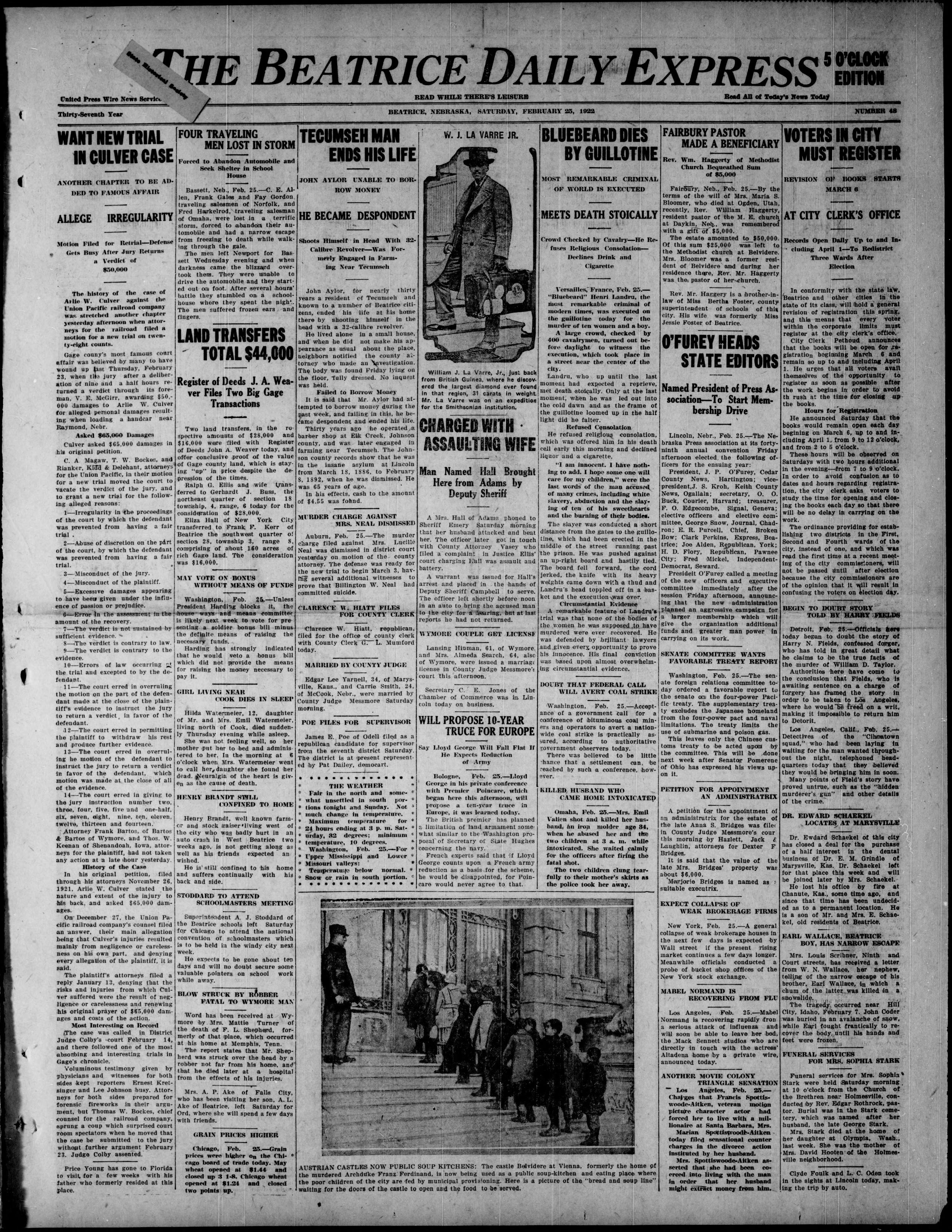
The Beatrice Daily Express of February 25, 1922, appeared more than a century ago, and it is long out of copyright and in the public domain without qualification. The Library of Congress holds the original issue in Chronicling America and supplies the scan reproduced here; the Library's full citation and its rights statement appear underneath.
A crease runs down the column, but every word survived it, and the transcription is complete with no illegible marks. It keeps the paper's "up-right" with its hyphen, "some one" as two words in his last words, "center," and the decks of the headline with their own capitals and dashes. The story is whole in a single column between rules and continues nowhere else.
Transcription
Transcribed word for word from the page scan. Original spelling, punctuation, capitalisation and typographical errors have been kept exactly as printed. Unreadable words are marked [illegible]. Nothing has been modernised or corrected.
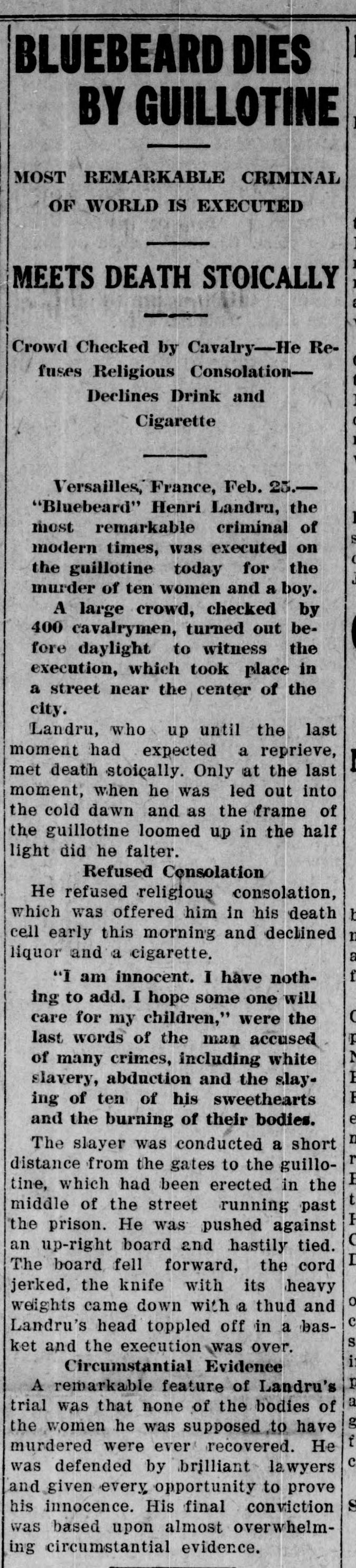
BLUEBEARD DIES BY GUILLOTINE
MOST REMARKABLE CRIMINAL OF WORLD IS EXECUTED
MEETS DEATH STOICALLY
Crowd Checked by Cavalry—He Refuses Religious Consolation—Declines Drink and Cigarette
Versailles, France, Feb. 25.—"Bluebeard" Henri Landru, the most remarkable criminal of modern times, was executed on the guillotine today for the murder of ten women and a boy.
A large crowd, checked by 400 cavalrymen, turned out before daylight to witness the execution, which took place in a street near the center of the city.
Landru, who up until the last moment had expected a reprieve, met death stoically. Only at the last moment, when he was led out into the cold dawn and as the frame of the guillotine loomed up in the half light did he falter.
Refused Consolation
He refused religious consolation, which was offered him in his death cell early this morning and declined liquor and a cigarette.
"I am innocent. I have nothing to add. I hope some one will care for my children," were the last words of the man accused of many crimes, including white slavery, abduction and the slaying of ten of his sweethearts and the burning of their bodies.
The slayer was conducted a short distance from the gates to the guillotine, which had been erected in the middle of the street running past the prison. He was pushed against an up-right board and hastily tied. The board fell forward, the cord jerked, the knife with its heavy weights came down with a thud and Landru's head toppled off in a basket and the execution was over.
Circumstantial Evidence
A remarkable feature of Landru's trial was that none of the bodies of the women he was supposed to have murdered were ever recovered. He was defended by brilliant lawyers and given every opportunity to prove his innocence. His final conviction was based upon almost overwhelming circumstantial evidence.
Transcriber's notes
- Readability: very good. The paper is lightly creased down the column, but every word was legible. No [illegible] markers were needed.
- Kept as printed: "up-right" hyphenated, "center", "some one" as two words, and the headline's own capitalisation and dashes.
- The execution took place on the morning of 25 February 1922 and the dateline is the same day. The paper gives the count as "ten women and a boy"; Landru was convicted of eleven murders — ten women and the son of one of them.
- The article is self-contained in one column, set between rules.