BELGIAN BORGIA FACES TRIAL FOR MURDERING 11 PARK BENCH FRIENDS: IMPERIAL VALLEY PRESS, JUNE 7, 1938
She found them on park benches, the wire report said, and she was kind to them. On June 7, 1938, Marie Alexandrine Becker, a 58-year-old widow from Liège whom the papers had named "the Belgian Borgia," went on trial for her life on charges of poisoning eleven people, and the same day the Imperial Valley Press in El Centro, California, carried the United Press account on page 3. It prints her as Marie Petitjean Becker, giving her maiden name, and it describes the method in one sentence: she had won her victims over with kindness and "nursed them tenderly when they fell ill under her doses of digitalis."
Ten of the eleven were women, "mostly widows whose money Mme. Becker was accused of seeking." The deaths ran from March 1933 to October 1936. The first known victim, Marie Doupagne-Castaldot, died on March 21, 1933, after drinking tea Becker had made for her; the last was Marie Luxem-Weiss, sixty-two, who died in October 1936. When the police took Becker in, they found a phial of digitalis and four rings on her. Her explanation was her own heart; the doctors who examined her found nothing wrong with it, and six doctors declared that the dead had been poisoned with the drug.
The dispatch closes on a sketch of the woman before the deaths began: living quietly with her husband, a cabinet-maker who owned a sawmill, and then, after he died of cancer, out at "night spots," first with women friends and later with men younger than herself. The trial it announced ran until July 8. She was convicted of eleven murders and five attempted murders, along with theft and forgery, and sentenced to death, and the sentence was commuted to life imprisonment, just as the paper predicted Belgium would do with a woman. She never confessed. She died in Forest prison in Brussels on June 11, 1942.
This is agency copy written for the trial's first morning, before a single witness had spoken, and every charge in it was still an accusation when it was printed; it is not a court record. It says she was arrested after she "allegedly picked her sweetheart as her 11th victim," but other accounts of the case have police waiting for her on October 16, 1936, the day she had announced a visit to another widow, Madame Lamy, and gives the eleventh death as Marie Luxem-Weiss. The paper dates her husband's death to 1932; other accounts give October 1932 or 1933. Its "Six hundred witnesses" sits beside a figure of some sixty character witnesses recorded elsewhere. The verdict of July 1938 covered all eleven deaths.
Because this issue appeared in 1938, less than ninety-five years ago, the Library of Congress's statement is more guarded: it believes the paper is in the public domain but warns that newspapers of that age may contain some copyrighted third-party material. This story is United Press wire copy, credited "(UP)" in the dateline rather than written by the Imperial Valley Press, and no separate copyright notice appears on or beside it. The scan is the Library of Congress copy in Chronicling America, with its citation and rights statement below.
The type is sharp throughout and the whole report is transcribed, headline to last line, without a single illegible mark. It keeps the paper's styling: "LIEGE" without its accent, the abbreviation "Mme.," "phial" for a small bottle, "cabinet-maker" with its hyphen, the comma in "March, 1933," and the quotation marks the wire put around "night spots." The opening paragraph is set across two columns and the rest runs down one; nothing continues onto another page.
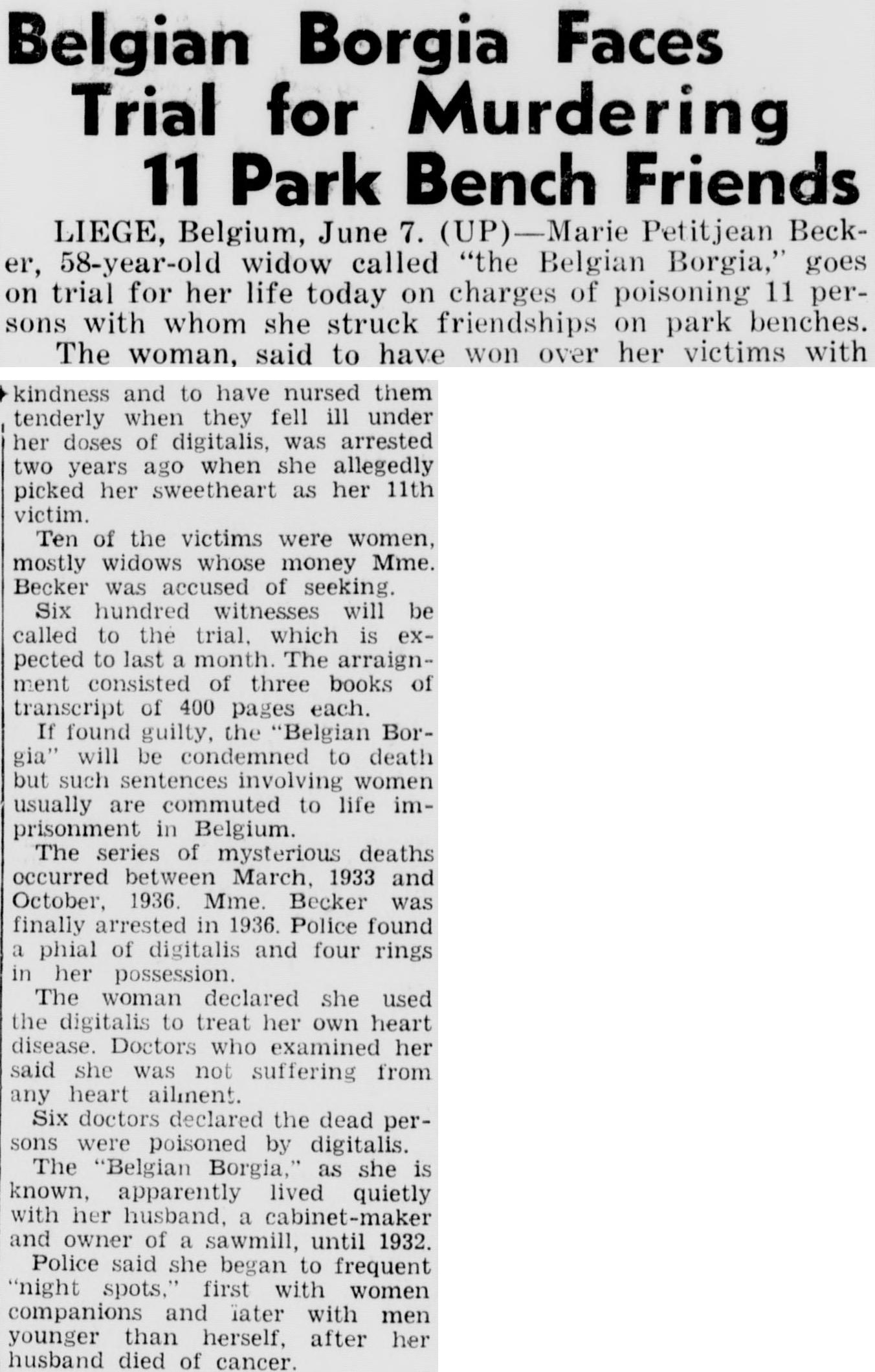

Transcription
Transcribed word for word from the page scan. Original spelling, punctuation, capitalisation and typographical errors have been kept exactly as printed. Unreadable words are marked [illegible]. Nothing has been modernised or corrected.
Belgian Borgia Faces Trial for Murdering 11 Park Bench Friends
LIEGE, Belgium, June 7. (UP)—Marie Petitjean Becker, 58-year-old widow called "the Belgian Borgia," goes on trial for her life today on charges of poisoning 11 persons with whom she struck friendships on park benches.
The woman, said to have won over her victims with kindness and to have nursed them tenderly when they fell ill under her doses of digitalis, was arrested two years ago when she allegedly picked her sweetheart as her 11th victim.
Ten of the victims were women, mostly widows whose money Mme. Becker was accused of seeking.
Six hundred witnesses will be called to the trial, which is expected to last a month. The arraignment consisted of three books of transcript of 400 pages each.
If found guilty, the "Belgian Borgia" will be condemned to death but such sentences involving women usually are commuted to life imprisonment in Belgium.
The series of mysterious deaths occurred between March, 1933 and October, 1936. Mme. Becker was finally arrested in 1936. Police found a phial of digitalis and four rings in her possession.
The woman declared she used the digitalis to treat her own heart disease. Doctors who examined her said she was not suffering from any heart ailment.
Six doctors declared the dead persons were poisoned by digitalis.
The "Belgian Borgia," as she is known, apparently lived quietly with her husband, a cabinet-maker and owner of a sawmill, until 1932.
Police said she began to frequent "night spots," first with women companions and later with men younger than herself, after her husband died of cancer.