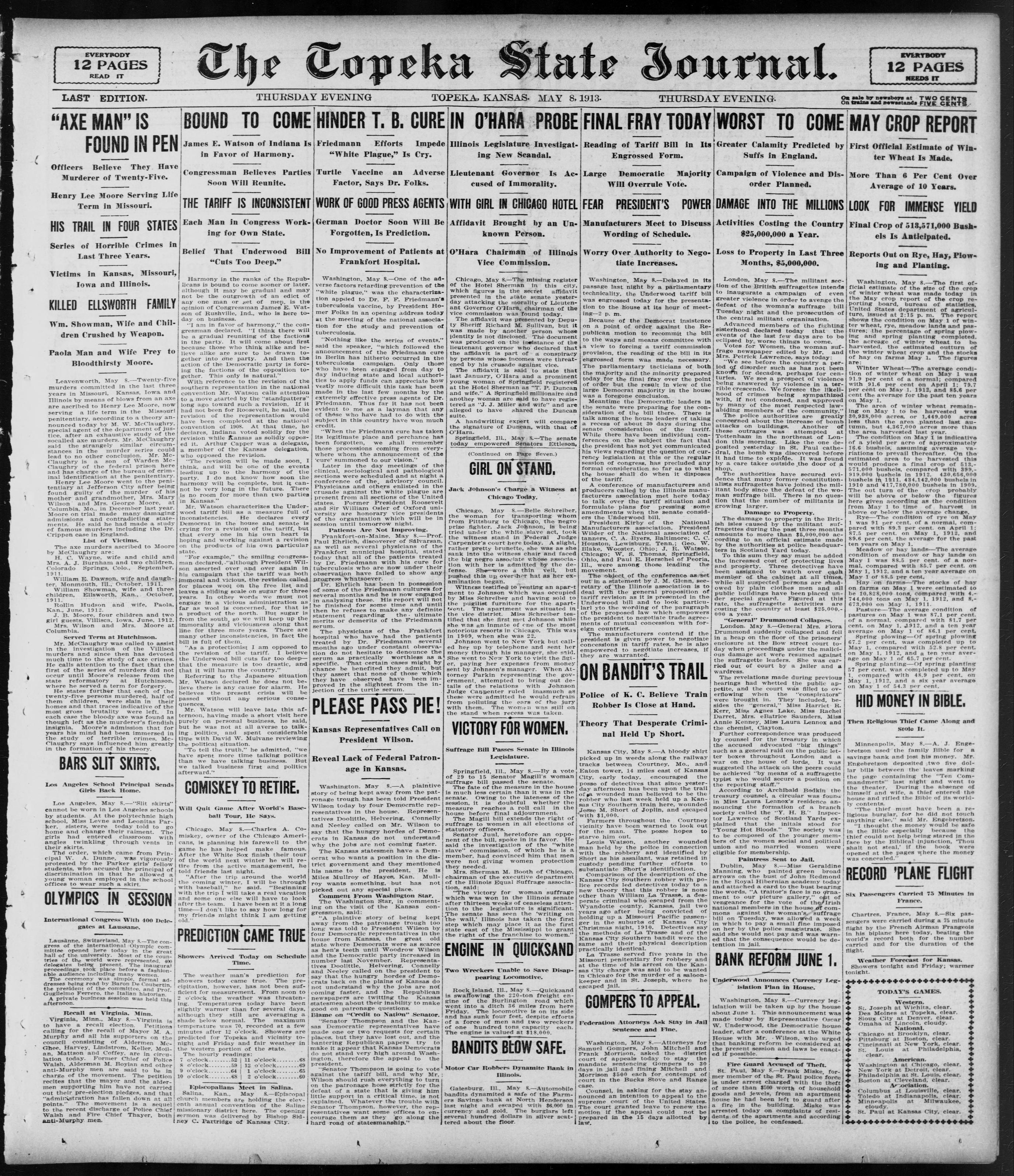
"AXE MAN" IS FOUND IN PEN: THE TOPEKA STATE JOURNAL, MAY 8, 1913
Henry Lee Moore had been in the Missouri penitentiary less than two months, serving life for the axe murders of his mother and grandmother in Columbia, when a federal agent in Leavenworth announced a theory that made him responsible for twenty-five murders in four states. The Topeka State Journal put the story at the top of its front page on May 8, 1913, under a stack of nine decks that began "AXE MAN" IS FOUND IN PEN and ended with a Paola couple, "Prey to Bloodthirsty Moore." The headlines spoke with a certainty the theory beneath them never earned.
The agent was M. W. McClaughry of the Justice Department, son of the warden of the federal prison and head of its bureau of criminal identification, who had been called in on the Villisca murders. His list began in Colorado Springs in September 1911, where Henry and Blanche Wayne and their baby, Lula, were killed alongside May Alice Burnham and her children, Nellie and John. It ran through the Dawsons at Monmouth, Illinois, and the Showmans at Ellsworth, Kansas, that October, to Paola and Villisca in June 1912, where the dead included two visiting girls, Ina Mae and Lena Stillinger. Its center was timing: the killings began only after Moore left the Hutchinson reformatory, where he had served a term for forgery.
The rest was resemblance. Each family was killed at home, half the dead were children, and in every house, McClaughry said, the bloody axe was found "as though left as the murderer's fiendish insignia." He was swayed, too, by Moore's admission that for years his mind had been immersed in the study of terrible crimes; at his trial Moore had said he had studied famous murders, the Crippen case among them. McClaughry said the similarities could lead to no other conclusion. They could. The inquiry the theory set off in Colorado Springs later collapsed when the reformatory superintendent reported that Moore had been writing to him at the time, from home in Columbia.
This is a newspaper account of one official's theory, put into headlines as though it were a finding, and it is not a court record. Henry Lee Moore was convicted on March 14, 1913, of two murders only, his mother's and his grandmother's, and no charge was ever brought against him over any other death; the Villisca case remains formally unsolved. Several names differ from other records: the agent appears elsewhere as W. M. McClaughry, Moore's mother as Georgia Moore rather than Mrs. George Moore, the Paola victim as Roland Hudson, and the Villisca householder as Josiah Moore, who was no relation to Henry. The Villisca line also leaves out Mrs. Moore; eight people died in that house.
More than ninety-five years have passed since The Topeka State Journal printed this page on May 8, 1913, and it is in the public domain in its entirety. The Library of Congress holds the scan in Chronicling America, among its holdings of Kansas papers, and the citation and rights statement are reproduced below it, exactly as the Library gives them.
All nine decks are transcribed, along with the list of victims as the paper set it, one place to a line, and nothing on the column was illegible. The paper's forms are kept as printed, including "socalled" run together as one word, "Wm." in the deck about the Showman family, the plural "were slain" after "each of the twenty-five persons," and "the Dr. Crippen case" without his name.
Transcription
Transcribed word for word from the page scan. Original spelling, punctuation, capitalisation and typographical errors have been kept exactly as printed. Unreadable words are marked [illegible]. Nothing has been modernised or corrected.
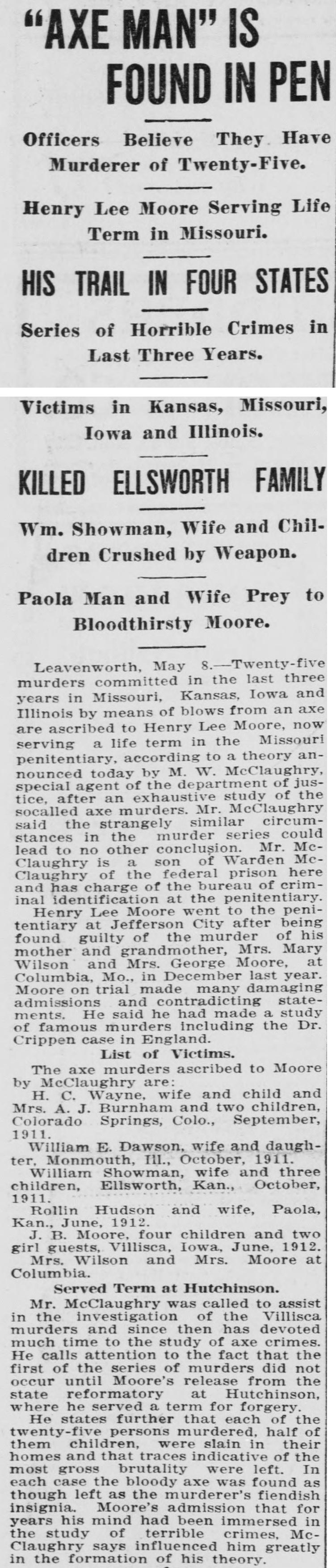
"AXE MAN" IS FOUND IN PEN
Officers Believe They Have Murderer of Twenty-Five.
Henry Lee Moore Serving Life Term in Missouri.
HIS TRAIL IN FOUR STATES
Series of Horrible Crimes in Last Three Years.
Victims in Kansas, Missouri, Iowa and Illinois.
KILLED ELLSWORTH FAMILY
Wm. Showman, Wife and Children Crushed by Weapon.
Paola Man and Wife Prey to Bloodthirsty Moore.
Leavenworth, May 8.—Twenty-five murders committed in the last three years in Missouri, Kansas, Iowa and Illinois by means of blows from an axe are ascribed to Henry Lee Moore, now serving a life term in the Missouri penitentiary, according to a theory announced today by M. W. McClaughry, special agent of the department of justice, after an exhaustive study of the socalled axe murders. Mr. McClaughry said the strangely similar circumstances in the murder series could lead to no other conclusion. Mr. McClaughry is a son of Warden McClaughry of the federal prison here and has charge of the bureau of criminal identification at the penitentiary.
Henry Lee Moore went to the penitentiary at Jefferson City after being found guilty of the murder of his mother and grandmother, Mrs. Mary Wilson and Mrs. George Moore, at Columbia, Mo., in December last year. Moore on trial made many damaging admissions and contradicting statements. He said he had made a study of famous murders including the Dr. Crippen case in England.
List of Victims.
The axe murders ascribed to Moore by McClaughry are:
H. C. Wayne, wife and child and Mrs. A. J. Burnham and two children, Colorado Springs, Colo., September, 1911.
William E. Dawson, wife and daughter, Monmouth, Ill., October, 1911.
William Showman, wife and three children, Ellsworth, Kan., October, 1911.
Rollin Hudson and wife, Paola, Kan., June, 1912.
J. B. Moore, four children and two girl guests, Villisca, Iowa, June, 1912.
Mrs. Wilson and Mrs. Moore at Columbia.
Served Term at Hutchinson.
Mr. McClaughry was called to assist in the investigation of the Villisca murders and since then has devoted much time to the study of axe crimes. He calls attention to the fact that the first of the series of murders did not occur until Moore's release from the state reformatory at Hutchinson, where he served a term for forgery.
He states further that each of the twenty-five persons murdered, half of them children, were slain in their homes and that traces indicative of the most gross brutality were left. In each case the bloody axe was found as though left as the murderer's fiendish insignia. Moore's admission that for years his mind had been immersed in the study of terrible crimes, McClaughry says influenced him greatly in the formation of his theory.