THE PENALTY PAID: FOSTER'S DAILY DEMOCRAT, JUNE 11, 1896
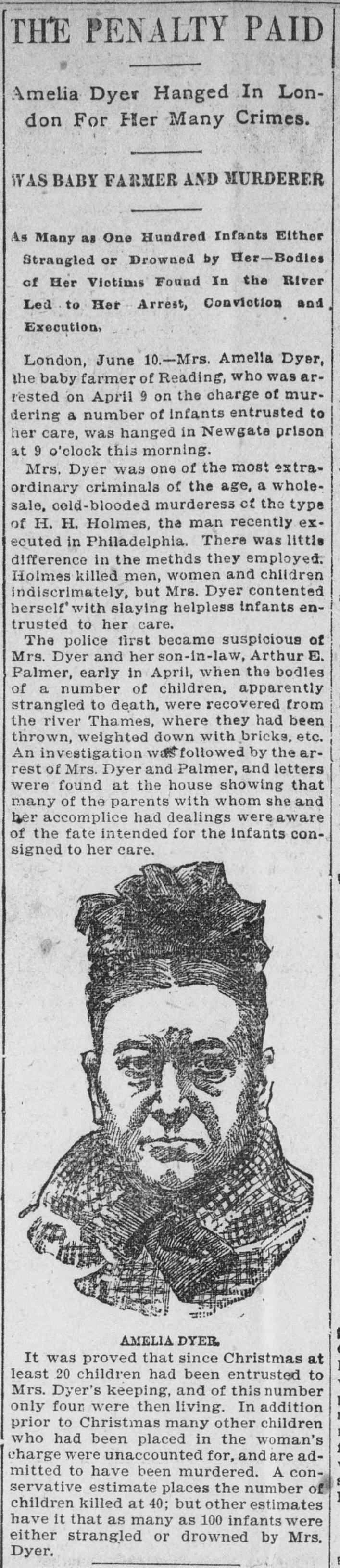
Amelia Elizabeth Dyer was hanged inside Newgate prison at nine o'clock on the morning of June 10, 1896, and the next day a paper in Dover, New Hampshire, three thousand miles from the river where her victims were found, told its readers what she had done. Foster's Daily Democrat called her "the baby farmer of Reading" and gave her an engraved portrait set right into the column, a matronly face in the middle of the account of dead infants.
To explain her, the paper reached for the only comparison its American readers would know. Five weeks earlier H. H. Holmes had gone to the gallows in Philadelphia, and the Democrat ranks her beside him as "a wholesale, cold-blooded murderess," with one difference: Holmes had killed men, women and children, and Mrs. Dyer had confined herself to "helpless infants entrusted to her care." The story of her discovery follows. Early in April the bodies of children, apparently strangled, came out of the Thames weighted with bricks, and the police turned to her and to her son-in-law, Arthur Palmer.
The column ends on numbers, and it handles them more carefully than its headline does. At least twenty children, it says, had been handed to her since Christmas, and only four were then alive. Others placed with her before that were never accounted for. A conservative estimate put the number of children she had killed at forty; other estimates reached a hundred, the figure the deck above the story had already printed in capitals.
This London wire report, printed a day later for American readers who knew nothing of Reading, is not a court record, and it mixes what was proved with what was suspected. It gives the date of her arrest as April 9; she was arrested on April 4. It says letters showed that many parents knew what was intended for their babies and calls Palmer her accomplice, but the inquest found no evidence that the Palmers had taken part, and Arthur Palmer was discharged. Dyer was tried at the Old Bailey on a single count and convicted on May 22, 1896, of murdering Doris Marmon. The column's forty and hundred are estimates; the true number has never been known, and later estimates run far higher.
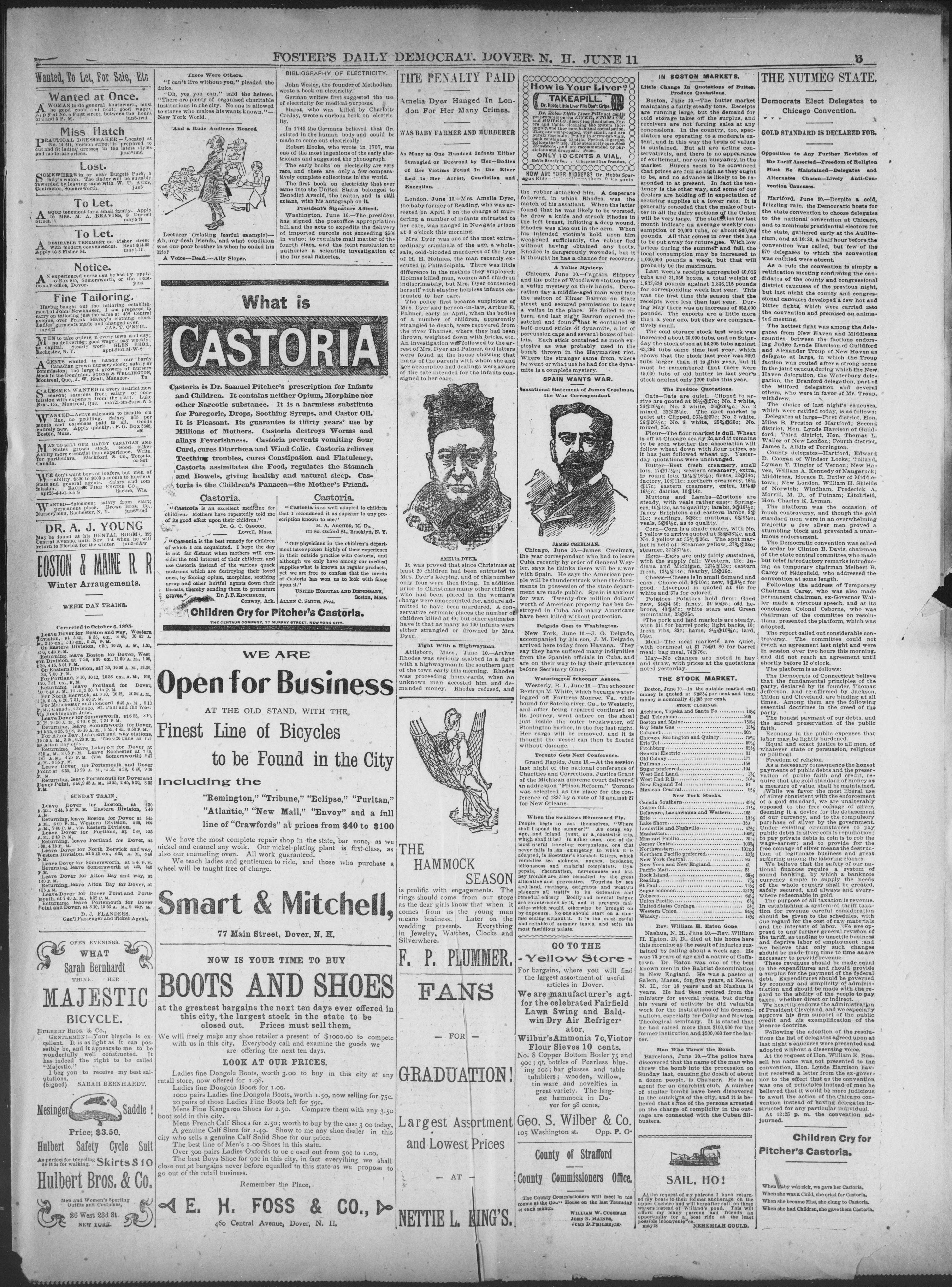
Foster's Daily Democrat printed this on June 11, 1896, and it has long been in the public domain, with no restriction on any part of it. The scan is the Library of Congress copy in Chronicling America, page 3, column 4, and the full citation and the Library's rights statement appear under it.
A clean, lightly foxed column gave a full reading, so nothing below is marked illegible. The compositor's slips are left where he set them: "methds" for methods, "indiscrimately," and the comma that closes the third deck after "Execution." Where the engraving breaks into the text, the transcription marks its place and caption, and no words are lost. A separate item about a highwayman begins under the rule at the foot of the crop and is not part of this report.
Transcription
Transcribed word for word from the page scan. Original spelling, punctuation, capitalisation and typographical errors have been kept exactly as printed. Unreadable words are marked [illegible]. Nothing has been modernised or corrected.
THE PENALTY PAID
Amelia Dyer Hanged In London For Her Many Crimes.
WAS BABY FARMER AND MURDERER
As Many as One Hundred Infants Either Strangled or Drowned by Her—Bodies of Her Victims Found In the River Led to Her Arrest, Conviction and Execution,
London, June 10.—Mrs. Amelia Dyer, the baby farmer of Reading, who was arrested on April 9 on the charge of murdering a number of infants entrusted to her care, was hanged in Newgate prison at 9 o'clock this morning.
Mrs. Dyer was one of the most extraordinary criminals of the age, a wholesale, cold-blooded murderess of the type of H. H. Holmes, the man recently executed in Philadelphia. There was little difference in the methds they employed. Holmes killed men, women and children indiscrimately, but Mrs. Dyer contented herself with slaying helpless infants entrusted to her care.
The police first became suspicious of Mrs. Dyer and her son-in-law, Arthur E. Palmer, early in April, when the bodies of a number of children, apparently strangled to death, were recovered from the river Thames, where they had been thrown, weighted down with bricks, etc. An investigation was followed by the arrest of Mrs. Dyer and Palmer, and letters were found at the house showing that many of the parents with whom she and her accomplice had dealings were aware of the fate intended for the infants consigned to her care.
[engraved portrait, captioned: AMELIA DYER.]
It was proved that since Christmas at least 20 children had been entrusted to Mrs. Dyer's keeping, and of this number only four were then living. In addition prior to Christmas many other children who had been placed in the woman's charge were unaccounted for, and are admitted to have been murdered. A conservative estimate places the number of children killed at 40; but other estimates have it that as many as 100 infants were either strangled or drowned by Mrs. Dyer.
Transcriber's notes
- Readability: very good. Clean type, lightly foxed. No [illegible] markers were needed.
- Printer's errors kept as printed: "methds" for methods; "indiscrimately" for indiscriminately; the comma ending the deck after "Execution,"; and "In the River" and "In Addition" with the paper's own capitalisation in the deck.
- The comparison drawn in the second paragraph is to H. H. Holmes, executed in Philadelphia five weeks earlier — the subject of the first article in this series of transcriptions (The Kimball graphic, 16 May 1896).
- An engraved portrait of Dyer is set into the middle of the article, interrupting the text; its position and caption are marked above. No words are missing.
- The article ends at a rule, below which a separate item headed "Fight With a Highwayman." begins. That item is not part of this article.