A DEMON STRANGLED: THE SEATTLE POST-INTELLIGENCER, NOVEMBER 15, 1892
The hangman did not get his usual look at the man he was to kill. James Billington had to size up Dr. Thomas Neill Cream through the inspection wicket of a Newgate cell, noting his height and build as he paced, and at nine o'clock on the morning of November 15, 1892, he hanged him in a courtyard that no outside window could see into. A black flag went up the prison flagstaff the instant the drop fell. The Seattle Post-Intelligencer had the London dispatch in print that same day, under a headline that settled the matter: "A DEMON STRANGLED."
The dispatch spends its time on the last hours. Cream, ill, silent and moody, kept writing, stopping often to rest. His solicitor, Waters, drew up his will and came back that night with a document to sign. Cream made no confession, and Waters urged him, if he wished to unburden his mind, to do it to the chaplain. Only then, the paper says, did he seem to understand where he was. He broke down and thanked the lawyer for sparing no effort to save him. His body was to go into a coffin filled with quicklime under the flagstones of the corridor he walked to the scaffold.
Below the dispatch the paper set its own summary in square brackets, and it reads like the prosecution's case. It follows Cream from Glasgow and Montreal to London and Chicago, then to Lambeth, where a chemist named Priest sold him nux vomica by the ounce, along with small empty gelatine capsules. It names the women: Matilda Clover, who died in agony early on October 21, 1891; Ellen Donworth, who fell in the street and in her last moments accused the man who had given her something from a bottle; and Alice Marsh and Emma Shrivell, who died the following April. Each had received a letter by post, and letters, in the end, were what undid him.
A wire dispatch with the paper's own background note attached, this is not a court record, and the note is wrong in places. It gives his birth year as 1855; he was born in Glasgow on May 27, 1850. It dates Clover's murder to October 31, though its own account has her dying on October 21. It says he was arrested on June 3, 1892, on a charge of blackmail; that day he was arrested for her murder. Its closing claim that he also poisoned a young girl in London, Ontario, is unsupported, and no court tried him for any death there. It says nothing of his 1881 conviction in Illinois for poisoning Daniel Stott. The Old Bailey jury convicted him on October 21, 1892, after twelve minutes.
Published in Seattle on November 15, 1892, the same day as the hanging it reports, the paper is well over a century old and in the public domain, wire dispatch and bracketed note alike. Its scan is the Library of Congress copy in Chronicling America, with the citation and the Library's rights statement beneath it.
Heavy, slightly over-inked type fades toward the foot of the column, but every word could be read under magnification and none is marked [illegible]. One figure gave trouble: the house number on Lambeth Palace road has a broken last digit that could be a 3 or an 8, and it is given as 103, the number in the trial record. The paper's slips are left alone, including "burried," "Engladd," "incased" and "Winters" where the solicitor's name is Waters. The square brackets around the closing paragraph are the paper's own.

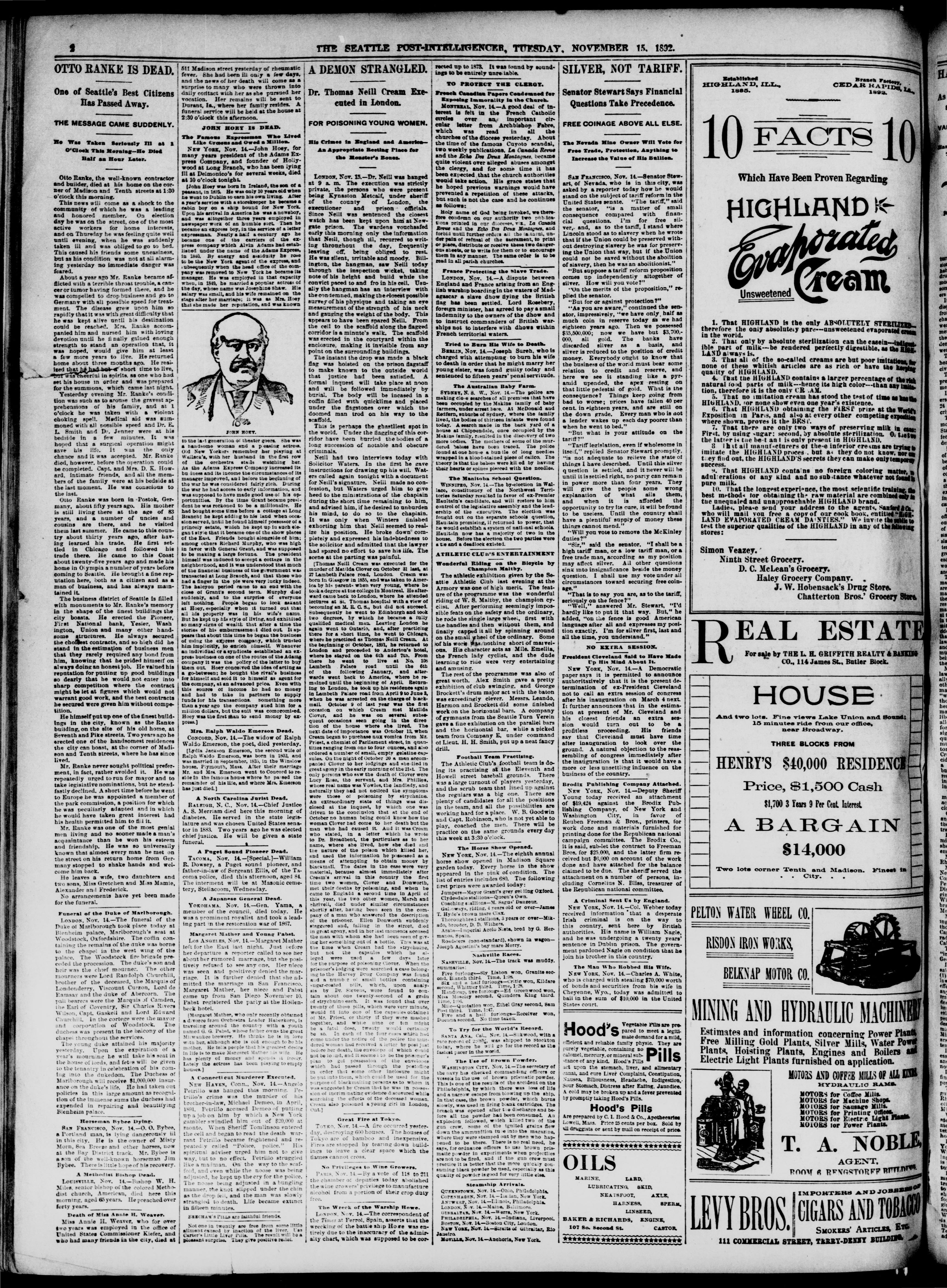
Transcription
Transcribed word for word from the page scan. Original spelling, punctuation, capitalisation and typographical errors have been kept exactly as printed. Unreadable words are marked [illegible]. Nothing has been modernised or corrected.
A DEMON STRANGLED.
Dr. Thomas Neill Cream Executed in London.
FOR POISONING YOUNG WOMEN.
His Crimes in England and America—An Appropriate Resting Place for the Monster's Bones.
LONDON, Nov. 15.—Dr. Neill was hanged at 9 a. m. The execution was strictly private, the persons who were present being Kynaston Metcalf, under sheriff of the county of London, the executioner and prison officials. Since Neill was sentenced the closest watch has been kept upon him at Newgate prison. The wardens vouchsafed early this morning only the information that Neill, though ill, recurred to writing throughout the day, frequently leaving off, being obliged to rest. He was silent, irritable and moody. Billington, the hangman, saw Neill today through the inspection wicket, taking note of his height and build while the convict paced to and fro in his cell. Usually the hangman has an interview with the condemned, making the closest possible survey of his physique and taking an eye measurement of the strength of his neck and gauging the weight of the body. This appears to have been spared Neill. From the cell to the scaffold along the flagged corridor is a minute's walk. The scaffold was erected in the courtyard within the enclosure, making it invisible from any point on the surrounding buildings.
The instant the drop was made a black flag was hoisted on the prison flagstaff to make known to the outside world that justice had been satisfied. A formal inquest will take place at noon and will be followed immediately by burial. The body will be incased in a coffin filled with quicklime and placed under the flagstones over which the doomed man trod on his way to the scaffold.
This is perhaps the ghastliest spot in the world. Under the flagging of this corridor have been burried the bodies of a long succession of notable and obscure criminals.
Neill had two interviews today with Solicitor Waters. In the first he gave instructions for drawing up his will. Waters called again tonight with a document for Neill's signature. Neill made no confession, but Waters urged him to give heed to the ministrations of the chaplain during the short time remaining to him, and advised him, if he desired to unburden his mind, to do so to the chaplain. It was only when Winters finished exhorting him that Neill seemed to realize his position. He broke down completely and expressed his indebtedness to the solicitor and admitted that the lawyer had spared no effort to save his life. The scene at the parting was painful.
[Thomas Neill Cream was executed for the murder of Matilda Clover on October 31 last, at 27 Lambeth Palace road, London. Cream was born in Glasgow in 1855, and was taken to America by his parents when very young, where he took a degree at the college in Montreal. He afterward came back to London, where he attended lectures at St. Thomas hospital with a view of becoming an M. R. C. S., but did not succeed. Subsequently he went to Edinburgh and took two degrees, by which he became a fully qualified medical man. Leaving London he again went to Ontario, and, after practicing there for a short time, he went to Chicago, where he practiced as Thomas Neill Cream. At the beginning of October, 1891, he returned to London and proceeded to Anderton's hotel, where he stayed on the 6th and 7th. From there he went to live at No. 103 Lambeth Palace road until the 6th of the following January, and afterwards went back to America, where he remained until the beginning of April. Returning to London, he took up his residence again in Lambeth Palace road from April 9 to June 3, when he was arrested on the charge of blackmail. October 9 of last year was the first occasion on which Cream met Matilda Clover, and he was on several subsequent occasions seen going in the direction of the house where she lived. The next date of importance was October 13, when Cream began to purchase nux vomica from Mr. Priest, a chemist of Parliament street, in quantities ranging from one to four ounces, and also ordered a number of small, empty gelatine capsules. On the night of October 20 a man accompanied Clover to her lodgings and she died in great agony in the early morning of the 21st. The only persons who saw the death of Clover were Lucy Rose, the servant, and Mrs. Phillips, whose real name was Vowles, the landlady, and naturally they had not noticed the symptoms were those of poisoning by strychnine. An extraordinary state of things was disclosed at the inquest, by which one was driven to the conclusion that at the end of October no human being could know how the woman Clover had come to her death but the man who had caused it. And it was Cream who stated, in a letter which he wrote to Dr. Broadbent, the particulars as to her name, where she lived, how she died and the nature of the poison which killed her, and used the information he possessed as a means of attempting to obtain money by blackmail. The dates in the case were very material, because almost immediately after Cream's arrival in this country the first time two women, Clover and Donworth, met their deaths by poisoning, and when he came to Engladd a second time in April of this year, the two other women, Marsh and Shrivell, died under similar circumstances shortly after, having been seen in the company of a man who answered the description of the prisoner. Ellen Donworth suddenly staggered and, falling in the street, died in great agony, and in her last moments accused the man with whom she had been seen of giving her something out of a bottle. This was at the time when Cream had the strychnine, but not the capsules which he alleged were used a few days later for the purpose of poisoning Clover. When the prisoner's lodging were searched a case belonging to the Harvey Drug Company was found and a number of small bottles containing sugar-coated pills, which, upon analysis by Dr. Stevens, were found to contain about one twenty-second of a grain of strychnine each. It was found that over twenty of these pills, which were very minute, would fit into one of the capsules obtained of Mr. Priest, or thirty if they were mashed together, and while nine or ten might be a fatal dose, twenty would certainly be so. In each of the four cases which had come under the notice of the police the murdered woman had received a letter by post just before her death, the envelope of which could not be found, and it seemed to be the prisoner's plan to get possession of the envelopes which had passed through the postoffice in order that some other inclosure might be put into them, which could be used for the purpose of blackmailing persons as to whom it was suggested by Cream that he was in possession of incriminating evidence discovered while searching the effects of the deceased woman. Cream also poisoned a young girl in London, Ont.]
Transcriber's notes
- Readability: good. The type is heavy and slightly over-inked, and the lower third of the column is lighter, but every word was legible at magnification. No [illegible] markers were needed.
- Printer's errors kept as printed: "burried" for buried; "Engladd" for England; "Winters" where the sense requires Waters (the solicitor named two sentences earlier); "incased"; "postoffice" as one word; "prisoner's lodging were searched"; and "practicing".
- One digit is indistinct: the house number in "went to live at No. 103 Lambeth Palace road" is printed with a broken final figure that could be read as 3 or 8. It is given here as 103, the number in the trial record. The reading is flagged rather than silently chosen.
- The closing paragraph is the newspaper's own bracketed note of explanation, printed in square brackets after the wire dispatch. The brackets are the paper's, and are reproduced.
- The article runs down the full column and ends with "London, Ont.]"; the items printed below it ("Great Fire at Tokyo" and others) are unrelated.