A BORN POISONER: THE DAWSON NEWS, MARCH 3, 1914
In March 1914 a weekly in Dawson, Georgia, filled part of a column on its fourth page with a Frenchwoman who had been dead for nearly two hundred and forty years. The Dawson News called Marquise Brinvilliers (properly the Marquise de Brinvilliers, born Marie-Madeleine Dreux d'Aubray) "one of the greatest female criminals in the history of the world," and built the whole piece on a single idea: that some people are born for crime, and that she had been "abnormal from childhood." It is a story told at a distance of centuries, for readers who knew nothing about her, by a writer who signed no name.
In the feature's telling she left her husband for two hardened criminals, St. Croix and Exili, and the three of them made poison and used it "for no apparent reason other than to see how it would work." Her father, her sister and both her brothers died of it in 1670. The secret came out by accident. St. Croix wore a glass mask while he distilled his poisons, the mask fell, and one breath of the fumes killed him. Among his effects the authorities found packets of poison, each labeled with the effect it would produce before death. She ran to England, then to Liège, and was found there and brought back to Paris.
The piece closes by quoting her sentence, and the sentence quietly contradicts it. The court found her guilty of poisoning her father and two brothers and attempting the life of her sister, and made her confess she had done it "for wicked revenge and in order to be possessed of their estates." She was to be carried in a cart, barefoot, a rope around her neck and a burning torch in her hands, to kneel before the great door of Notre-Dame, then beheaded, her body burned and the ashes scattered to the wind, after torture to make her name accomplices. The motive the writer could not find is written into the judgment the piece prints.
This is a later feature, written in 1914 long after the events, unsigned and credited to no one, and it blends the court's findings with legend. Her father died in 1666 and her brothers in 1670; her sister Thérèse was the target of an attempt, not a victim, as the quoted sentence itself says. Sainte-Croix was an army officer who died suddenly in Paris in 1672, and the falling glass mask is a traditional story, not an established fact. Her husband was Antoine Gobelin, marquis de Brinvilliers, a colonel in the Auvergne regiment. The Parlement of Paris condemned her on July 16, 1676, for poisoning her father and having her brothers poisoned, and she was beheaded on the Place de Grève the next day.
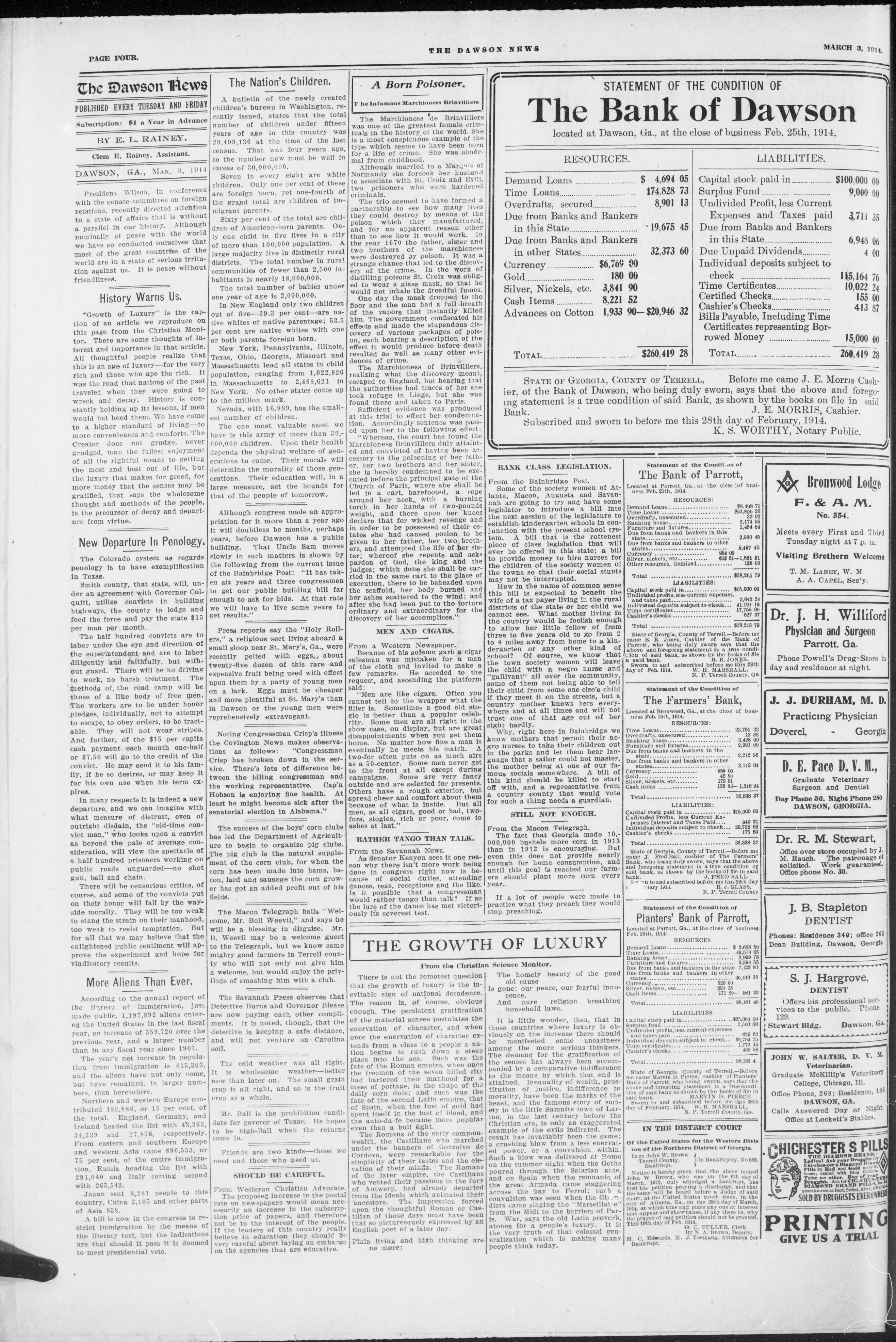
The Dawson News for March 3, 1914, was published more than ninety-five years ago and is in the public domain in the United States. No byline or syndicate credit appears with the piece. The scan is the Library of Congress copy in Chronicling America, and its citation and rights statement are printed under it.
Read from a clear scan, the transcription is complete and needed no illegible marks. The printer's oddities stay: the deck's letter-spaced "T he," "posion" for poison, "two-pounds weight," and "at this trial" when no trial has been mentioned. "Marquis" and "Exili" are partly broken in the type but readable, and a scratch running across the top of the column hides no letters. The next item, "MEN AND CIGARS," is left out.
Transcription
Transcribed word for word from the page scan. Original spelling, punctuation, capitalisation and typographical errors have been kept exactly as printed. Unreadable words are marked [illegible]. Nothing has been modernised or corrected.
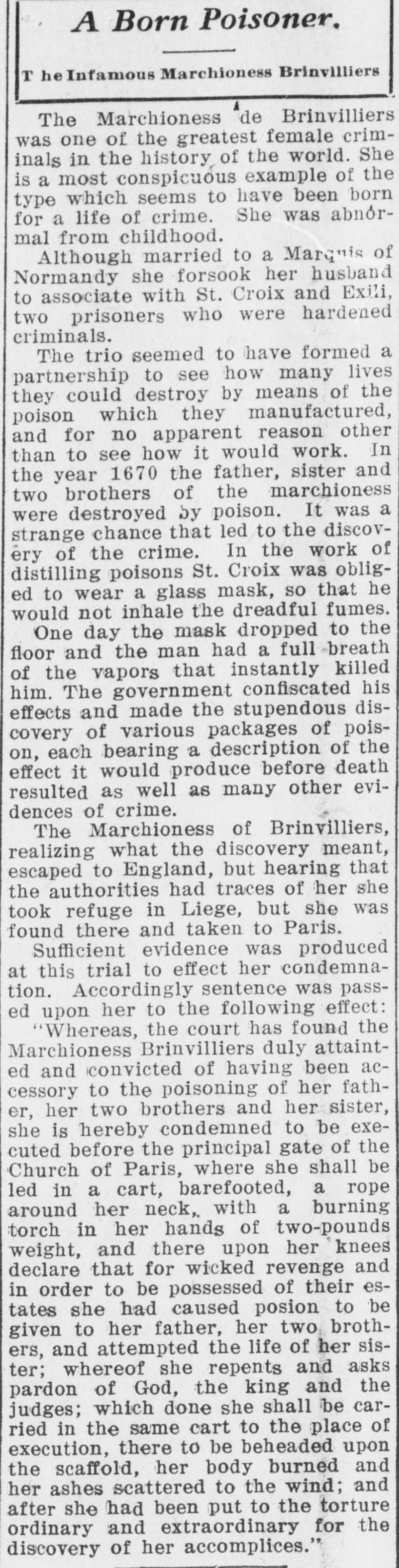
A Born Poisoner.
T he Infamous Marchioness Brinvilliers
The Marchioness de Brinvilliers was one of the greatest female criminals in the history of the world. She is a most conspicuous example of the type which seems to have been born for a life of crime. She was abnormal from childhood.
Although married to a Marquis of Normandy she forsook her husband to associate with St. Croix and Exili, two prisoners who were hardened criminals.
The trio seemed to have formed a partnership to see how many lives they could destroy by means of the poison which they manufactured, and for no apparent reason other than to see how it would work. In the year 1670 the father, sister and two brothers of the marchioness were destroyed by poison. It was a strange chance that led to the discovery of the crime. In the work of distilling poisons St. Croix was obliged to wear a glass mask, so that he would not inhale the dreadful fumes.
One day the mask dropped to the floor and the man had a full breath of the vapors that instantly killed him. The government confiscated his effects and made the stupendous discovery of various packages of poison, each bearing a description of the effect it would produce before death resulted as well as many other evidences of crime.
The Marchioness of Brinvilliers, realizing what the discovery meant, escaped to England, but hearing that the authorities had traces of her she took refuge in Liege, but she was found there and taken to Paris.
Sufficient evidence was produced at this trial to effect her condemnation. Accordingly sentence was passed upon her to the following effect:
"Whereas, the court has found the Marchioness Brinvilliers duly attainted and convicted of having been accessory to the poisoning of her father, her two brothers and her sister, she is hereby condemned to be executed before the principal gate of the Church of Paris, where she shall be led in a cart, barefooted, a rope around her neck, with a burning torch in her hands of two-pounds weight, and there upon her knees declare that for wicked revenge and in order to be possessed of their estates she had caused posion to be given to her father, her two brothers, and attempted the life of her sister; whereof she repents and asks pardon of God, the king and the judges; which done she shall be carried in the same cart to the place of execution, there to be beheaded upon the scaffold, her body burned and her ashes scattered to the wind; and after she had been put to the torture ordinary and extraordinary for the discovery of her accomplices."
Notes: Unsigned feature; no source or syndicate credit is printed. The crop takes in the boxed headline ("A Born Poisoner." with the deck "T he Infamous Marchioness Brinvilliers", where the deck's first word is letter-spaced in print as "T he") and the whole text, ending above a short rule; the next item in the column ("MEN AND CIGARS.") is excluded. Printed forms kept: "Marchioness de Brinvilliers" / "Marchioness of Brinvilliers" / "Marchioness Brinvilliers", "St. Croix", "Exili", "posion" (for poison), "two-pounds weight", "at this trial" (no trial has been mentioned before). The text says the sister was poisoned, while the sentence it quotes says only that her life was attempted; both are kept as printed. "Marquis" and "Exili" are partly damaged in print ("Marq..is", "Exi!i") but readable from the surviving letters and context; "by" in "destroyed by poison" has a broken "b". A speck after "neck," is not punctuation and has been ignored. Line-end hyphenation from column setting has been joined (e.g. "crim-/inals", "abnor-/mal", "discov-/ery", "oblig-/ed", "attaint-/ed", "exe-/cuted"). A fold or scratch line runs diagonally across the upper part of the column without hiding any letters. Readability: good; no [illegible] marks needed.