8 BODIES FOUND; TEEN SAYS HE KILLED SLAYER: OGDEN STANDARD-EXAMINER, AUGUST 9, 1973
On Wednesday afternoon, August 8, 1973, a seventeen-year-old named Elmer Wayne Henley called police headquarters and told officers he had shot and killed a man earlier that day. The man was Dean Corll, thirty-three, an employee of the Houston Lighting & Power Co., and officers found him dead in his Pasadena home, shot with a .22-caliber pistol. By the next morning Henley had taken police to a rented boat stall in southwest Houston, and the Ogden Standard-Examiner was printing what they had found there across three columns of its front page. Eight bodies had come out of shallow graves, and the digging had not stopped.
Everything the story knew about the shooting came from Henley, by way of the police. There had been an all-night party at Corll's house, he said, and he and two other youths had passed out from sniffing spray paint. He woke to find Corll handcuffing him. The other two were already bound, and Corll said he would have to kill them all. Henley convinced him he was an ally, and Corll put the pistol down. When Corll came at him, Henley killed him. Corll, the youth told police, had talked about killing people and burying them in the boat stall.
Henley also gave them names. "We checked with missing persons and those names checked out so we came out here and started digging," said Breck Porter, a police officer. They expected three bodies, the three boys Henley had mentioned. They kept finding more, some wrapped in plastic bags and tied with nylon rope. At Corll's house officers found what looked like instruments of torture, and Pasadena police were preparing to dig up his yard. The story stops there, at eight, with nobody yet knowing that the count would reach at least twenty-eight and that the boat stall was only the first of three burial grounds.
This is an Associated Press report written within a day of the shooting, built almost entirely on what police said Henley had told them, and his account was not tested then; he had every reason to put the killing on Corll. The paper gives the dead man's name as Dean Allen Corll; he was Dean Arnold Corll. The "two other youths" were a boy and a girl, both of whom survived. Later accounts say Corll released Henley after offering him a share in killing the other two. Corll, dead before the first grave was opened, was never charged, and at least 28 deaths are now attributed to him. Henley was never charged over the shooting and was later convicted of six of the murders. "Homosexual perversion" is the paper's 1973 phrase.
The Ogden Standard-Examiner ran this AP wire story, without a staff byline, on page 1 on August 9, 1973. The scan comes from Utah Digital Newspapers at the University of Utah's J. Willard Marriott Library, whose item-level rights field rates the issue "No Copyright - United States," its finding that the issue is free of copyright under US law. In 1973 a published work needed a notice to keep its copyright, and none appears on the masthead or on this story. The large photograph of Henley that sat above the story carries its own caption and is not part of the scan shown here.
Every word of the story was legible and is transcribed exactly as printed, including "employe" for employee. The story is L-shaped on the page, its first column running well below the other two, so it is shown in two pieces: the kicker, headline and all three columns, then the foot of the first column. The paper's subheads stay where the compositor put them, among them "DECOMPOSED," which sits over paragraphs about Henley's account rather than anything about the bodies.
Transcription
Transcribed word for word from the page scan. Original spelling, punctuation, capitalisation and typographical errors have been kept exactly as printed. Unreadable words are marked [illegible]. Nothing has been modernised or corrected.
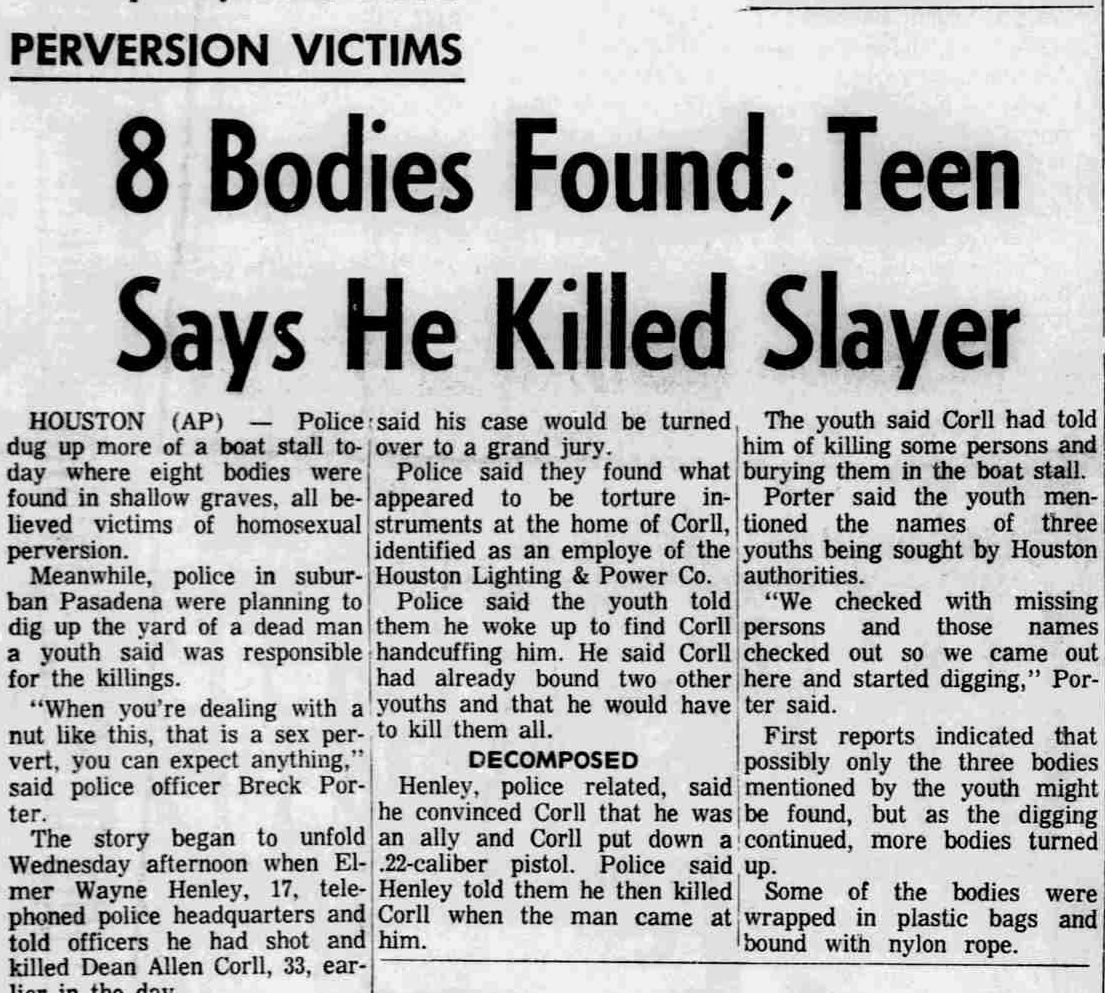
PERVERSION VICTIMS
8 Bodies Found; Teen Says He Killed Slayer
HOUSTON (AP) — Police dug up more of a boat stall today where eight bodies were found in shallow graves, all believed victims of homosexual perversion.
Meanwhile, police in suburban Pasadena were planning to dig up the yard of a dead man a youth said was responsible for the killings.
"When you're dealing with a nut like this, that is a sex pervert, you can expect anything," said police officer Breck Porter.
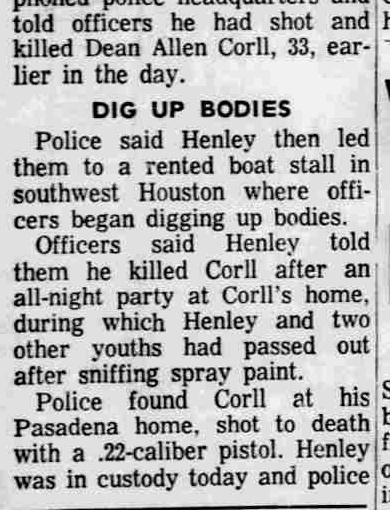
The story began to unfold Wednesday afternoon when Elmer Wayne Henley, 17, telephoned police headquarters and told officers he had shot and killed Dean Allen Corll, 33, earlier in the day.
DIG UP BODIES
Police said Henley then led them to a rented boat stall in southwest Houston where officers began digging up bodies.
Officers said Henley told them he killed Corll after an all-night party at Corll's home, during which Henley and two other youths had passed out after sniffing spray paint.
Police found Corll at his Pasadena home, shot to death with a .22-caliber pistol. Henley was in custody today and police said his case would be turned over to a grand jury.
Police said they found what appeared to be torture instruments at the home of Corll, identified as an employe of the Houston Lighting & Power Co.
Police said the youth told them he woke up to find Corll handcuffing him. He said Corll had already bound two other youths and that he would have to kill them all.
DECOMPOSED
Henley, police related, said he convinced Corll that he was an ally and Corll put down a .22-caliber pistol. Police said Henley told them he then killed Corll when the man came at him.
The youth said Corll had told him of killing some persons and burying them in the boat stall.
Porter said the youth mentioned the names of three youths being sought by Houston authorities.
"We checked with missing persons and those names checked out so we came out here and started digging," Porter said.
First reports indicated that possibly only the three bodies mentioned by the youth might be found, but as the digging continued, more bodies turned up.
Some of the bodies were wrapped in plastic bags and bound with nylon rope.
Notes: "employe" as printed. The story is L-shaped: column 1 runs further down the page than columns 2 and 3. So it is supplied as ARTICLE-CROP.jpg (the kicker, the headline and all three columns) and ARTICLE-CROP-PART-2.jpg (the foot of column 1). The large front-page photograph of Henley above the story has its own caption and is not part of this crop. No words were illegible.